Indian Institute of Technology Madras
BS Degree Programme · Examination & Study Paper
Deep Learning
Quiz 2 · 3 Aug 2025 (Afternoon)
Examination Instructions & Guidelines
- Solve on notebook/paper first before checking solutions.
- MCQ: Exactly 1 option is correct. Negative marking applies.
- MSQ: One or more options correct. Select all to score.
- NAT: Numerical response. No negative marking.
- Scientific calculator allowed for all calculations.
- Official answer key is sealed at the end of this sheet.
- Q1MCQ3 Marks·Choose one option
Consider four training experiments, each involving a neural network trained on the same dataset for 50 epochs using gradient descent. The loss curves for these models are shown below. The model obtained at the end of 50 epochs is retained in each of the four cases. The solid curve is the training loss and the dashed curve is the validation loss.
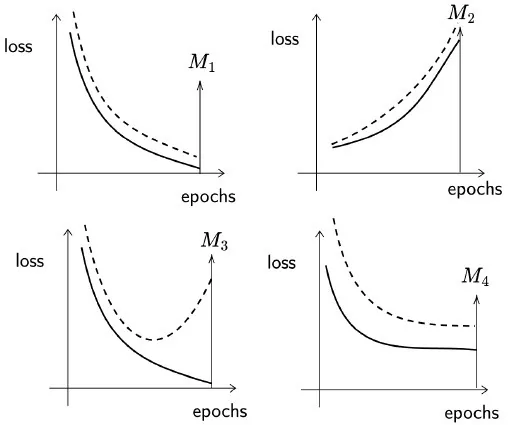 Now consider these four statements.
(A) Learning rate used is too high
(B) Low bias and high variance
(C) Low bias and low variance
(D) High bias and low variance
Choose the most appropriate pairing of models with the statements.
Now consider these four statements.
(A) Learning rate used is too high
(B) Low bias and high variance
(C) Low bias and low variance
(D) High bias and low variance
Choose the most appropriate pairing of models with the statements.- A

- B

- C

- D

- A
- Q2MSQ3 Marks·Choose all correct options
Which of the following optimizers use an adaptive learning rate?
- AADAM
- BRMSprop
- CMomentum based GD
- DNesterov accelerated gradient descent
- Q3NAT2 Marks·Write the number
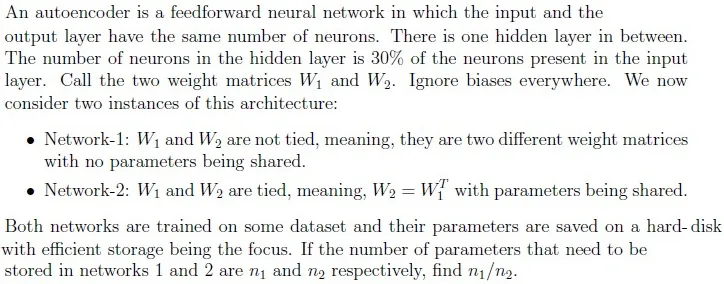 Your answer:
 - Q4NAT4 Marks·Write the number
 Your answer:
 Read the passage below, then answer Q5–Q7
The input volume to a convolutional layer of a CNN has shape 64 × 64 × 8, where 8 is the depth or the number of channels. The conv-layer has 16 kernels each of spatial extent 5 × 5. The stride is 1 and padding is 2. Ignore biases.
Based on the above data, answer the given subquestions.
Q5MCQ3 Marks·Choose one optionWhich of these is the shape of the output volume after the convolution operation?
- A64 × 64 × 16
- B62 × 62 × 16
- C64 × 64 × 8
- D32 × 32 × 8
- E32 × 32 × 16
- Q6NAT3 Marks·Write the number
Find the total number of parameters associated with the convolutional layer.
Your answer: - Q7MCQ3 Marks·Choose one option
If the input volume to the convolutional layer is 128 × 128 × 8, would the number of parameters associated with the conv layer change?
- AYes, it will double.
- BYes, it will halve.
- CYes, it will quadrapule.
- DNo, it will remain the same.
Read the passage below, then answer Q8–Q10
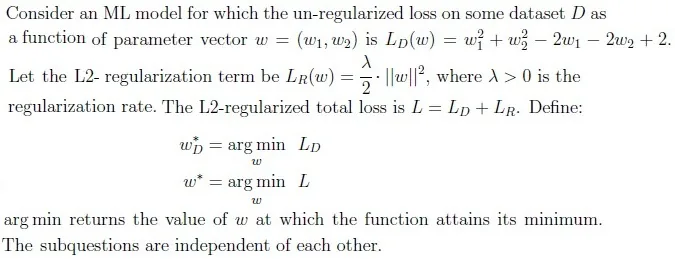
Based on the above data, answer the given subquestions.
Q8MCQ3 Marks·Choose one option
- A(1, 1)
- B(0, 0)
- C(−1,−1)
- D(1,−1)
- E(−1, 1)
- Q9NAT3 Marks·Write the number
 Your answer:
 - Q10MCQ3 Marks·Choose one option
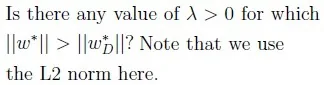
- AYes, there is at least one such value for which this happens.
- BYes, there are infinitely many values for which this happens.
- CYes, there are finitely many values from which this happens.
- DNo, there is no such λ> 0 for which this happens.
Read the passage below, then answer Q11–Q13
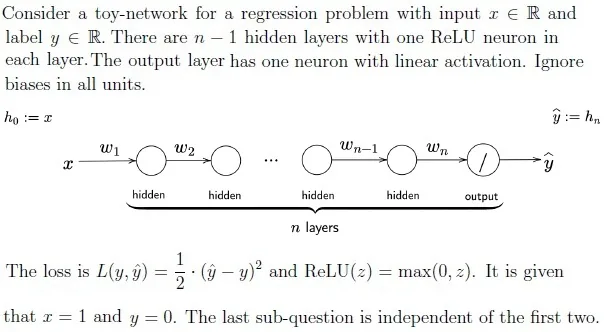
Based on the above data, answer the given subquestions.
Q11MCQ3 Marks·Choose one option
- A

- B

- C

- A
- Q12MCQ3 Marks·Choose one option
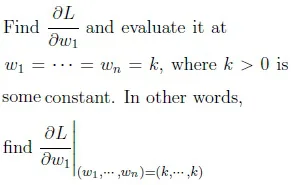
- A

- B

- C

- D

- E

- A
- Q13MCQ4 Marks·Choose one option
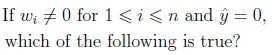
- A

- B

- C

- A
Read the passage below, then answer Q14–Q16
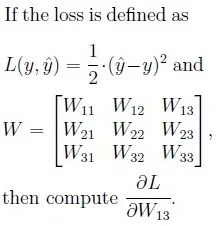
For a regression problem, consider an image X of size 4×4 and true label y that is passed through a toy convolutional network that has one convolutional layer with a single kernel followed by a max- pooling layer. Ignore the bias.
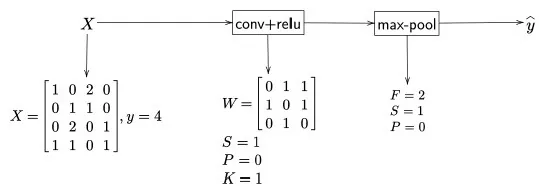
W denotes the kernel. S is the stride. P is the padding and K is the number of kernels. F is the spatial extent of the kernel for the max-pooling operation.
Based on the above data, answer the given subquestions.
Q14MCQ3 Marks·Choose one optionWhich of the following is the output produced by the conv+relu layer?
- A

- B

- C

- D

- A
- Q15NAT3 Marks·Write the number
 Your answer:
 - Q16NAT4 Marks·Write the number
 Your answer: