Indian Institute of Technology Madras
BS Degree Programme · Examination & Study Paper
Design Thinking for Data-Driven App Development
Karmic Design Thinking & Empathize
Examination Instructions & Guidelines
- Solve on notebook/paper first before checking solutions.
- MCQ: Exactly 1 option is correct. Negative marking applies.
- Scientific calculator allowed for all calculations.
- Official answer key is sealed at the end of this sheet.
Useful Reference Data for this Paper
 Q1MCQ1 Mark·Choose one option
The Test phase in Karmic Design Thinking (KDT) corresponds to:
- ANirodha
- BSamudaya
- CDukkha
- DMarga
- Q2MCQ1 Mark·Choose one option
Which of the following is NOT a way to analyze user needs during the design thinking process?
- AAsking open-ended questions to users
- BObserving user behavior
- CCreating user personas
- DMaking assumptions about user needs
- Q3MCQ1 Mark·Choose one option
During the Empathize phase of KDT, how can you minimize assumptions and accurately uncover latent user needs?
- ABy noting problems that users explicitly mention as frequent in their daily routines
- BBy using HMW problem statements to discover friction points that may not be verbally expressed
- CBy mapping end-to-end experiences across multiple users to reveal patterns
- DBy testing a range of proposed solutions to validate which one aligns with the user’s expectations
- Q4MCQ1 Mark·Choose one option
Which of the following best reflects the relationship between design research and marketing research in understanding user needs? 1. Marketing research generate value for the organization, design research generate value for the end user 2. Marketing research offers qualitative depth, while design research scales insights across demographics 3. Design research uncovers deep user needs from small samples; marketing research reveals broad purchasing patterns 4. Designers and marketers should work independently to avoid conflicts in user insights and product positioning Select the correct option using the codes given below:
- A1, 2 and 3 only
- B1, 2 and 4 only
- C1 and 3 only
- D1, 3 and 4 only
- Q5MCQ1 Mark·Choose one option
State whether the following statement is TRUE or FALSE: ‘People who cannot temporarily let go of their role or status or set aside their own expertise or opinion will fail to empathize with others who have conflicting thoughts, experiences, or mental models.’
- ATRUE
- BFALSE
- Q6MCQ1 Mark·Choose one option
Which of the following activities represent appropriate Empathize phase practices in the KDT process? 1. Harish spends a week working at the BS programs office to observe how the exam question paper team handles last-minute requests from the course team. 2. Syed, an employee with the exam logistics team, travels to remote exam centers in rural Telangana to shadow supervisors and document infrastructure pain points. 3. Akshaya, reviews survey responses from 500 students about their satisfaction with campus events after Shaastra, a tech festival at IIT Madras. 4. Avni, a student volunteer, participates in a collegiate festival called Paradox, observing crowd movement and accessibility across venues. 5. Hamsini, a data scientist, builds a machine learning model to predict student dropout risk using course clickstream and assignment data. 6. Shriprasad, spends time interacting with student founders at the Research Park and Centre for Innovation (CFI) to learn how the campus supported their startup journeys. Select the correct option using the codes given below:
- A1, 3, 4, 5 and 6 only
- B1,2,4 and 6 only
- C1, 2, 4, 5 and 6 only
- D1, 3, 4, and 6 only
Read the passage below, then answer Q7–Q11
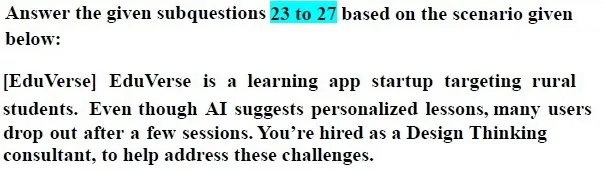 Q7MCQ2 Marks·Choose one option
[EduVerse] Which of the following activities best represent initial steps in the Empathize phase of Karmic Design Thinking when addressing rural student challenges? 1.Talk to local teachers of rural schools 2.Analyze drop-out reports of rural students 3.Conduct field interviews with rural students Select the correct option using the codes given below:
- A1, 2 and 3 only
- B1 and 3 only
- C2 and 3 only
- D3 only
- Q8MCQ2 Marks·Choose one option
[EduVerse] After empathizing, how do you identify patterns in student pain points?
- AMulti-Why analysis
- BConflict of interest
- CJourney mapping
- DA/B testing
- Q9MCQ2 Marks·Choose one option
[EduVerse] You discover dropouts happen due to poor UX & no human contact. Which phase of Karmic Design Thinking are you in?
- AEmpathize
- BAnalyze
- CTest
- DSolve
- Q10MCQ2 Marks·Choose one option
[EduVerse] The team has brainstormed “gamified quizzes” and “teacher nudges via WhatsApp” as final ideas. What’s your next step?
- ARoll both ideas to market
- BVote and launch best
- CPrototype and test with students
- DAdd 10 more ideas
- Q11MCQ2 Marks·Choose one option
[EduVerse] The EduVerse team finalizes their learning app prototype based on your recommendation and begins developing key features like personalized dashboards, gamified quizzes, and AI-based feedback systems. They allocate tasks across teams, manage dependencies, and begin implementing the core functionality while tracking deliverables. Which phase of the project management cycle does this represent?
- APlanning
- BExecution
- CMonitoring & Control
- DClosure