Indian Institute of Technology Madras
BS Degree Programme · Examination & Study Paper
Deep Learning Practice
Segmentation & depth estimation
Examination Instructions & Guidelines
- Solve on notebook/paper first before checking solutions.
- MCQ: Exactly 1 option is correct. Negative marking applies.
- MSQ: One or more options correct. Select all to score.
- Scientific calculator allowed for all calculations.
- Official answer key is sealed at the end of this sheet.
End Term · 31 Aug 2025 (FN)End Term
- Q1MCQ5 Marks·Choose one option
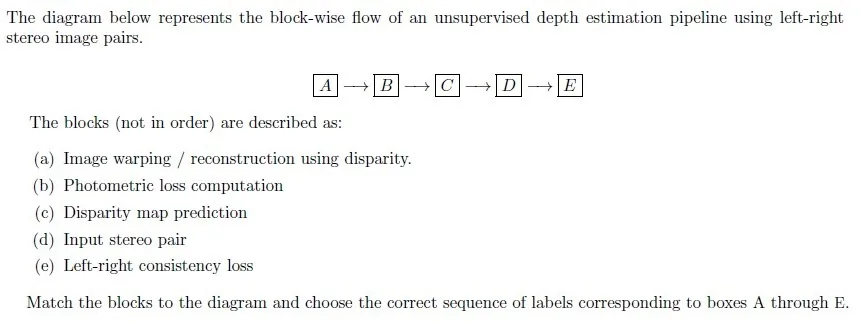
- AA–(e), B–(c), C–(a), D–(d), E–(b)
- BA–(e), B–(b), C–(c), D–(a), E–(d)
- CA–(e), B–(a), C–(c), D–(d), E–(b)
- DA–(c), B–(e), C–(a), D–(b), E–(d)
- Q2MCQ5 Marks·Choose one option
Consider the original U-Net architecture. Which of the following statements about the convolutional and pooling operations is correct?
- AU-Net uses 5 × 5 convolutional filters and 2 × 2 max pooling filters with stride 2 in the encoder path.
- BU-Net uses 3 × 3 convolutional filters and 2 × 2 average pooling filters with stride 1 in both encoder and decoder.
- CU-Net uses 3 × 3 convolutional filters (with padding) and 2 × 2 max pooling filters with stride 2 to halve the spatial resolution in the encoder.
- DU-Net uses 3 × 3 filters and 1 × 1 pooling to preserve spatial dimensions between contracting and expanding paths.
End Term · 31 Aug 2025 (AN)End Term
- Q3MCQ5 Marks·Choose one option
In the original U-Net architecture, which of the following statements about the decoder (expanding) path is correct?
- AThe decoder upsamples the feature maps using 2 x 2 transposed convolutions and concatenates them with corresponding encoder features.
- BThe decoder uses 3 x 3 max pooling to increase the spatial resolution before feature fusion.
- CThe decoder applies 1 x 1 convolutions to increase spatial dimensions and reduce channel depth.
- DThe decoder merges encoder and decoder features using element-wise addition instead of concatenation.
End Term · 13 Apr 2025 (AN)End Term
- Q4MCQ5 Marks·Choose one option
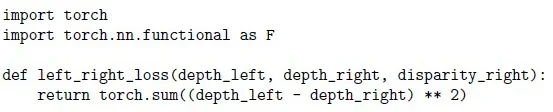
In self-supervised depth estimation, left-right consistency loss is often used to ensure that the depth maps from stereo images agree with each other. Which of the following code snippets correctly implements a left-right consistency loss by reconstructing the left depth map from the right depth map using disparity?
- A
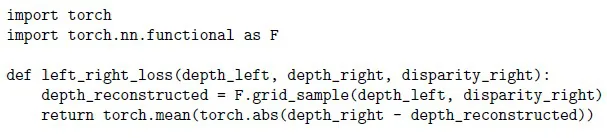
- B
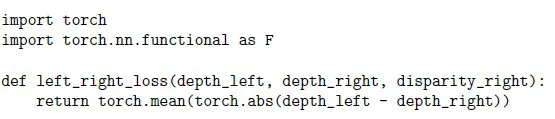
- C
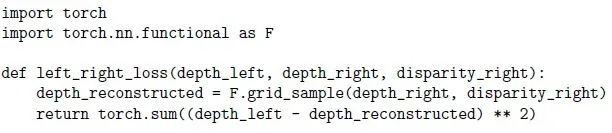
- D
- A
- Q5MCQ5 Marks·Choose one option
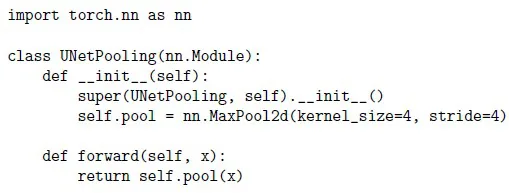
In the U-Net architecture, downsampling is performed using pooling layers to reduce spatial dimensions while preserving important features. Which of the following code snippets correctly implement the pooling layer in U-Net?
- A
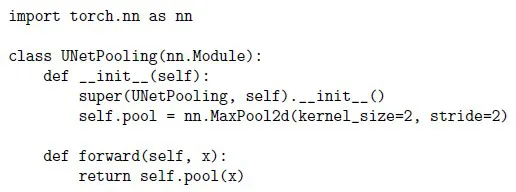
- B
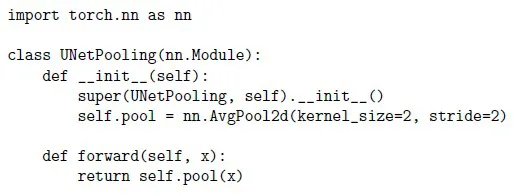
- C
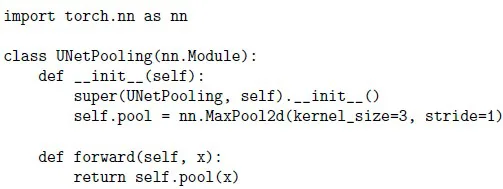
- D
- A
- Q6MSQ5 Marks·Choose all correct options
Estimating depth from a single image using a multiscale deep neural network presents several challenges. Which of the following correctly describe these challenges?
- AUnderstanding global context and handling variations in scene geometry and textureless regions.
- BDealing with scale ambiguity and the lack of absolute depth reference in monocular images.
- CReducing computational complexity while matching points across two images.
- DHandling occlusions and depth discontinuities, especially at object boundaries.
- EAccurately aligning stereo image pairs and computing disparity for depth estimation.
- Q7MSQ5 Marks·Choose all correct options
Monocular depth estimation using a multiscale deep neural network presents several challenges due to the lack of direct depth cues. Which of the following is a primary challenge specific to monocular depth estimation?
- AHandling scale ambiguity and the absence of absolute depth reference in single images.
- BAccurately computing depth by triangulating matching keypoints between two images.
- CEstimating depth consistently in textureless regions and under varying lighting conditions.
- DUsing LiDAR or structured light to obtain precise depth values instead of predicting them.