Indian Institute of Technology Madras
BS Degree Programme · Examination & Study Paper
Deep Learning Practice
GANs, super-resolution & restoration
Examination Instructions & Guidelines
- Solve on notebook/paper first before checking solutions.
- MCQ: Exactly 1 option is correct. Negative marking applies.
- MSQ: One or more options correct. Select all to score.
- NAT: Numerical response. No negative marking.
- Scientific calculator allowed for all calculations.
- Official answer key is sealed at the end of this sheet.
End Term · 31 Aug 2025 (FN)End Term
- Q1MSQ5 Marks·Choose all correct options
Which of the following statements are correct regarding Generative Adversarial Networks (GANs)?
- AThe generator tries to minimize the probability that the discriminator correctly classifies fake samples.
- BThe discriminator is trained to maximize the probability of correctly classifying real and generated (fake) data.
- CThe generator directly receives labeled training data to learn the target distribution.
- DDuring training, the generator is updated based on the discriminator’s feedback to improve sample quality.
- EGAN training can suffer from instability due to the adversarial objective, leading to issues like mode collapse.
- FA perfectly trained discriminator ensures faster convergence of the generator.
- Q2MSQ5 Marks·Choose all correct options
SRGAN and ESRGAN are both deep learning architectures designed for single image super- resolution. Which of the following statements correctly describe the key differences between ESRGAN and SRGAN?
- AESRGAN replaces the standard residual blocks in SRGAN with Residual-in- Residual Dense Blocks (RRDB) for better performance.
- BSRGAN employs Perceptual Loss, while ESRGAN removes it to focus only on pixel-wise MSE loss for training stability.
- CESRGAN produces sharper and more realistic textures than SRGAN due to architectural and loss function improvements.
- DBoth SRGAN and ESRGAN use a VGG-based perceptual loss computed on feature maps extracted from deeper and shallower layers, respectively, of a pretrained classifier.
- ESRGAN is trained using only adversarial and perceptual losses, whereas ESRGAN includes a content loss computed using pixel-wise L1 loss.
- Q3MSQ5 Marks·Choose all correct options
The Multi-stage Progressive Image Restoration Network (MPRNet) is a state-of-the-art architecture for tasks like image deblurring and deraining. It follows a multi-stage design where features are progressively refined across stages. how many of the above components are explicitly part of the original MPRNet architecture?
- Aa single layer neural network.
- BUNet
- CSupervised Attention Module
- DChannel Attention Block
- EFast RCNN block
Read the passage below, then answer Q4–Q6
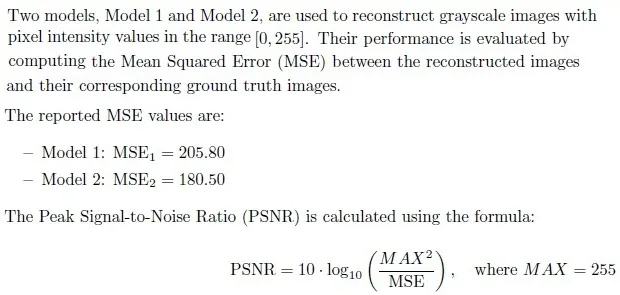
Based on the above data, answer the given subquestions.
Q4NAT1.5 Marks·Write the numberCompute the PSNR for Model 1 (in dB) (rounded to 2 decimal places) :
Your answer:- Q5NAT1.5 Marks·Write the number
Compute the PSNR for Model 2 (in dB) (rounded to 2 decimal places):
Your answer: - Q6NAT2 Marks·Write the number
Which model produces an image more similar to the ground truth?
Your answer:
End Term · 31 Aug 2025 (AN)End Term
- Q7MSQ5 Marks·Choose all correct options
Which of the following statements are correct regarding the training dynamics and properties of Generative Adversarial Networks (GANs)?
- AThe generator’s objective is to produce data that the discriminator cannot distinguish from real data.
- BThe discriminator is trained to minimize the distance between the generated data and the real data distributions.
- CGAN training is a min-max game where the generator and discriminator have opposing goals.
- DMode collapse refers to the generator producing diverse outputs that cover multiple modes of the data distribution.
- EA balance between generator and discriminator learning rates is important to ensure stable training.
- FConditional GANs extend standard GANs by incorporating label information into both the generator and discriminator.
- Q8MSQ5 Marks·Choose all correct options
SRGAN and ESRGAN are both deep learning architectures designed for single image super- resolution. Which of the following statements about the differences between ESRGAN and SRGAN are NOT correct?
- AESRGAN replaces the standard residual blocks in SRGAN with Residual-in- Residual Dense Blocks (RRDB) for better performance.
- BSRGAN employs Perceptual Loss, while ESRGAN removes it to focus only on pixel-wise MSE loss for training stability.
- CESRGAN produces sharper and more realistic textures than SRGAN due to architectural and loss function improvements.
- DBoth SRGAN and ESRGAN use a VGG-based perceptual loss computed on feature maps extracted from deeper layers of a pretrained classifier.
- ESRGAN is trained using only adversarial and perceptual losses, whereas ESRGAN includes a content loss computed using pixel-wise L1 loss.
- Q9MSQ5 Marks·Choose all correct options
The Multi-stage Progressive Image Restoration Network (MPRNet) is designed to progressively restore degraded images across multiple stages. It integrates several architectural innovations to enhance image restoration performance. How many of the above components are explicitly part of the original MPRNet architecture?
- AUNet-style encoder-decoder at each stage
- BResidual Channel Attention Network (RCAN)
- CSupervised Attention Module (SAM)
- DSkip connections across stages
- ENon-local Attention Module
Read the passage below, then answer Q10–Q12
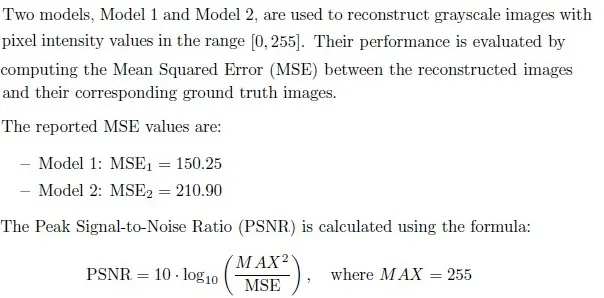
Based on the above data, answer the given subquestions.
Q10NAT1.5 Marks·Write the numberCompute the PSNR for Model 1 (in dB) (rounded to 2 decimal places):
Your answer:- Q11NAT1.5 Marks·Write the number
Compute the PSNR for Model 2 (in dB) (rounded to 2 decimal places):
Your answer: - Q12NAT2 Marks·Write the number
Which model produces an image more similar to the ground truth?
Your answer:
End Term · 13 Apr 2025 (AN)End Term
- Q13MCQ5 Marks·Choose one option
LAKDNet is designed to enhance feature extraction and knowledge distillation in deep neural networks. Which of the following best describes its core architectural improvement?
- AIt employs a Dual Attention Mechanism (Spatial and Channel Attention) to improve feature aggregation.
- BIt uses Graph Convolutional Networks (GCNs) to capture hierarchical dependencies in spatial features.
- CIt integrates Recurrent Neural Networks (RNNs) to enhance temporal feature extraction.
- DIt relies on Transformer-based self-attention to capture global contextual dependencies.
- Q14MCQ5 Marks·Choose one option
SRGAN is a deep learning-based approach for image super-resolution that improves the perceptual quality of upscaled images. Which of the following best describes the role of the adversarial loss in SRGAN?
- AIt minimizes the pixel-wise difference between the super-resolved and high- resolution images to ensure pixel accuracy.
- BIt encourages the generator to produce high-resolution images that are perceptually similar to real images by fooling the discriminator.
- CIt directly optimizes the Structural Similarity Index (SSIM) to improve texture and detail preservation.
- DIt ensures that the generated high-resolution images have better Peak Signal- to-Noise Ratio (PSNR) compared to traditional interpolation methods.