Indian Institute of Technology Madras
BS Degree Programme · Examination & Study Paper
Deep Learning Practice
Most repeated questions
Examination Instructions & Guidelines
- Solve on notebook/paper first before checking solutions.
- MCQ: Exactly 1 option is correct. Negative marking applies.
- MSQ: One or more options correct. Select all to score.
- NAT: Numerical response. No negative marking.
- Scientific calculator allowed for all calculations.
- Official answer key is sealed at the end of this sheet.
Type 1 · asked 4 times · GANs, super-resolution & restoration
Compute PSNR in dB from a given MSE
Read the passage below, then answer Q1–Q2
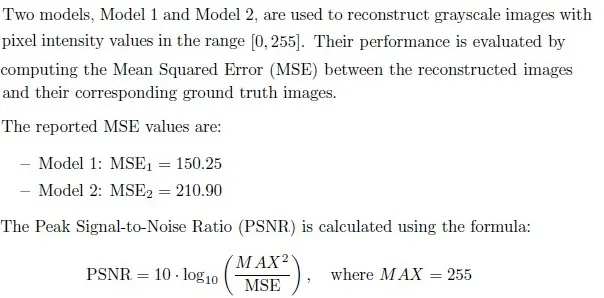
Based on the above data, answer the given subquestions.
Q1NAT1.5 Marks·Write the numberEnd Term · 31 Aug 2025 (AN)Key ↓Compute the PSNR for Model 1 (in dB) (rounded to 2 decimal places):
Your answer:- Q2NAT1.5 Marks·Write the numberEnd Term · 31 Aug 2025 (AN)Key ↓
Compute the PSNR for Model 2 (in dB) (rounded to 2 decimal places):
Your answer: Read the passage below, then answer Q3–Q4
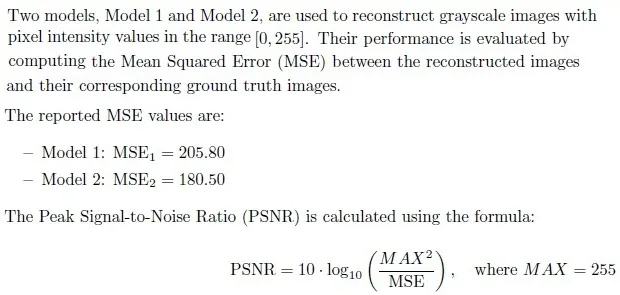
Based on the above data, answer the given subquestions.
Q3NAT1.5 Marks·Write the numberEnd Term · 31 Aug 2025 (FN)Key ↓Compute the PSNR for Model 1 (in dB) (rounded to 2 decimal places) :
Your answer:- Q4NAT1.5 Marks·Write the numberEnd Term · 31 Aug 2025 (FN)Key ↓
Compute the PSNR for Model 2 (in dB) (rounded to 2 decimal places):
Your answer:
Type 2 · asked 3 times · Convolution & pooling arithmetic
Find the output shape of a conv layer given kernel, stride and padding
- Q5MCQ5 Marks·Choose one optionEnd Term · 13 Apr 2025 (AN)Key ↓
An RGB image of size 227 × 227 × 3 is first converted to grayscale and then passed through a 2D Convolutional Neural Network (CNN) layer with the following parameters: – Kernel size: 3 × 3 – Stride: 1 – Padding: 1 – Number of filters: 16 What will be the shape of the output feature map?
- A(227, 227, 3)
- B(227, 227, 16)
- C(225, 225, 16)
- D(114, 114, 16)
- Q6NAT5 Marks·Write the numberEnd Term · 31 Aug 2025 (AN)Key ↓
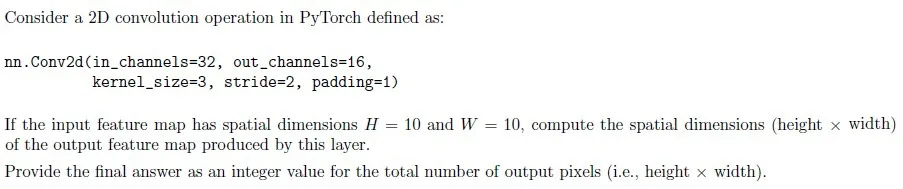 Your answer:
 - Q7NAT5 Marks·Write the numberEnd Term · 31 Aug 2025 (FN)Key ↓
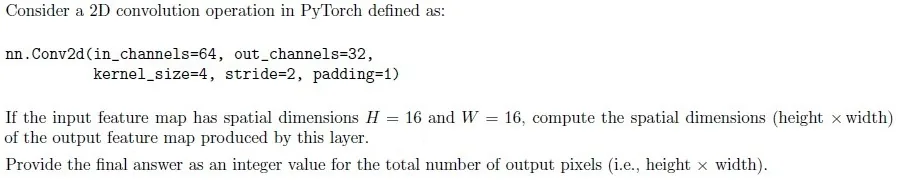 Your answer:
Type 3 · asked 3 times · CNN architectures & transfer learning
Replace the final layer of a pretrained CNN for a new number of classes
- Q8MCQ5 Marks·Choose one optionEnd Term · 13 Apr 2025 (AN)Key ↓
Consider the following code snippet for modifying an AlexNet architecture to adapt it for a custom classification task with 10 output classes. Fill in the blank portion with the most appropriate code snippet.
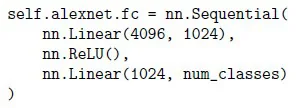
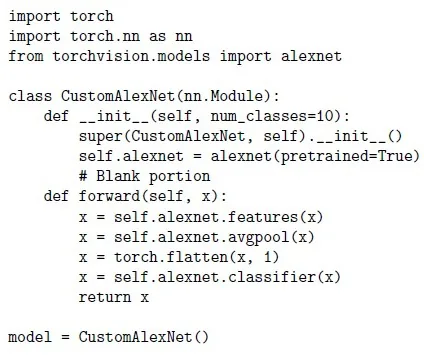 Which of the following code snippets correctly fills the blank portion to modify the AlexNet classifier while preserving the pretrained feature extraction layers?
- A

- B

- C
- D

- A
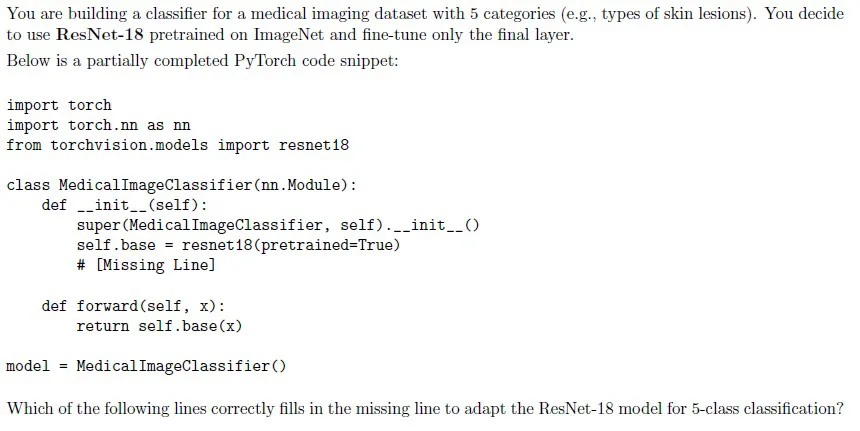
- Q9MCQ5 Marks·Choose one optionEnd Term · 31 Aug 2025 (AN)Key ↓
- A

- B

- C

- D

- A
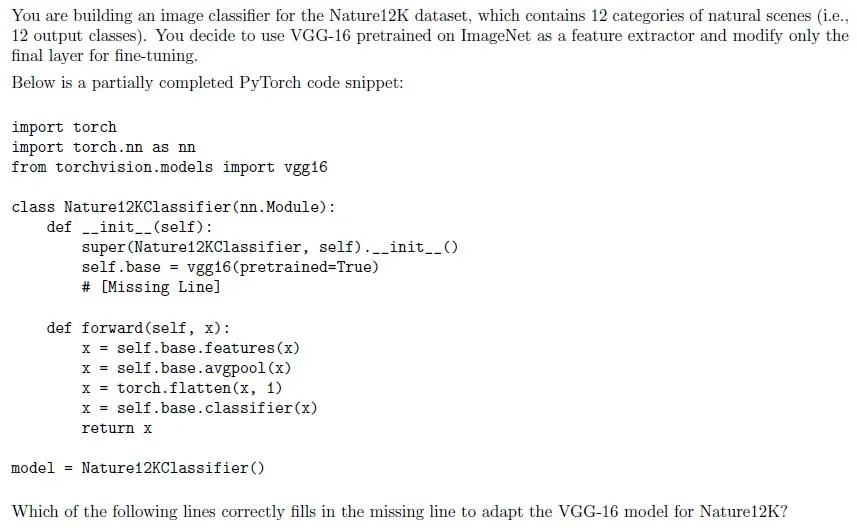
- Q10MCQ5 Marks·Choose one optionEnd Term · 31 Aug 2025 (FN)Key ↓
- A

- B

- C

- D

- A
Type 4 · asked 3 times · Object detection & its metrics
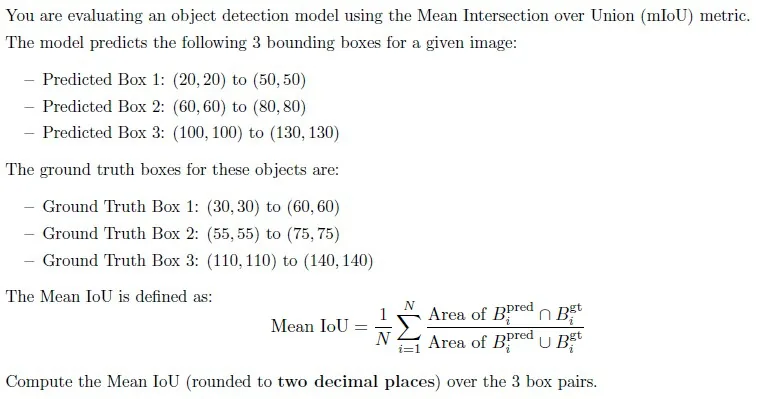
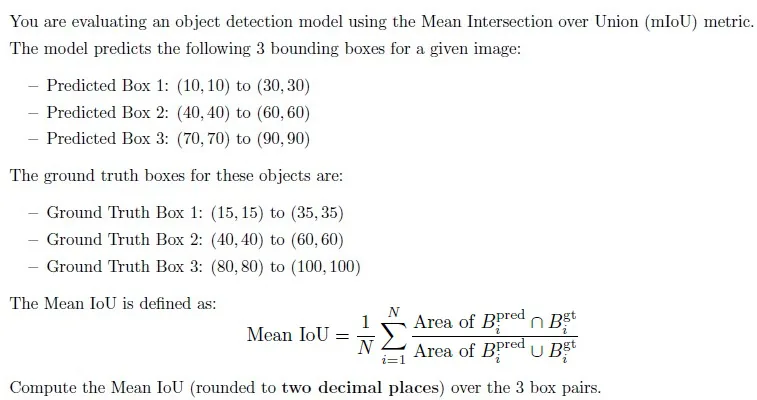
Compute IoU / mean IoU of predicted vs ground-truth bounding boxes

Type 5 · asked 3 times · Object detection & its metrics
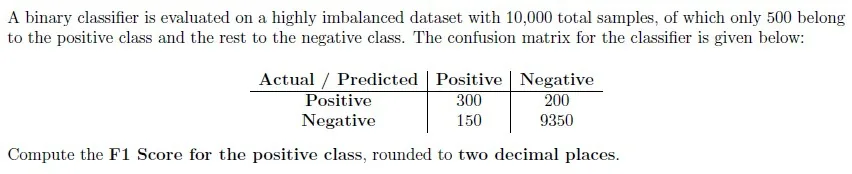
Compute the F1 score from predictions or a confusion matrix
- Q14MCQ5 Marks·Choose one optionEnd Term · 13 Apr 2025 (AN)Key ↓
Consider the following code snippet, which calculates the F1-score for an object detection task:
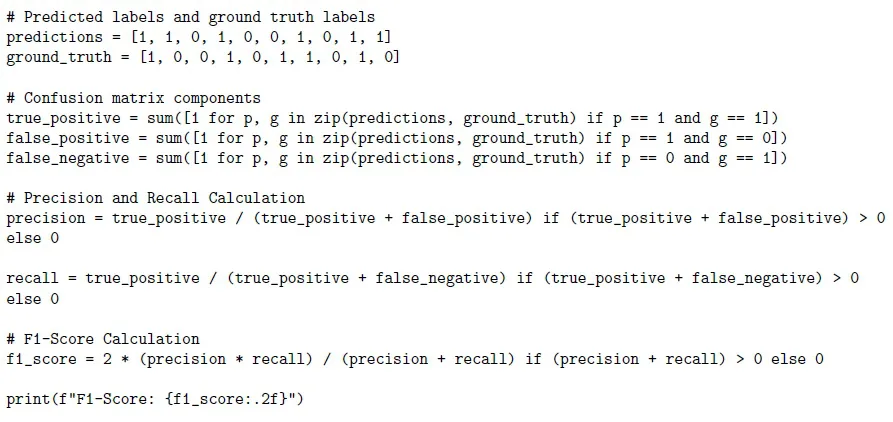 Given the predictions and ground truth, what is the calculated F1-score?
- A0.67
- B0.71
- C0.73
- D0.75
- Q15NAT5 Marks·Write the numberEnd Term · 31 Aug 2025 (AN)Key ↓
 Your answer:
 - Q16NAT5 Marks·Write the numberEnd Term · 31 Aug 2025 (FN)Key ↓
 Your answer:
Type 6 · asked 2 times · Convolution & pooling arithmetic
Pick the Conv2d code that keeps a grayscale image's spatial size
- Q17MCQ5 Marks·Choose one optionEnd Term · 31 Aug 2025 (AN)Key ↓
Consider the task of applying a convolutional layer with a stride of 1 to an image of size 111 × 111 (Grayscale), while ensuring that the output feature map retains the same spatial dimensions. Which of the following code snippets correctly implements this using PyTorch?
- A

- B

- C

- D

- A
- Q18MCQ5 Marks·Choose one optionEnd Term · 31 Aug 2025 (FN)Key ↓
Consider the task of applying a convolutional layer with a stride of 1 to an image of size 227 × 227 (Grayscale), while ensuring that the output feature map retains the same spatial dimensions. Which of the following code snippets correctly implements this using PyTorch?
- A

- B

- C

- D

- A
Type 7 · asked 2 times · Convolution & pooling arithmetic
Find MaxPool2d output size and effective receptive field with dilation
- Q19MCQ5 Marks·Choose one optionEnd Term · 31 Aug 2025 (AN)Key ↓

- AOutput size: 15 × 15; Effective receptive field: 5 × 5
- BOutput size: 17 × 17; Effective receptive field: 5 × 5
- COutput size: 13 × 13; Effective receptive field: 5 × 5
- DOutput size: 15 × 15; Effective receptive field: 3 × 3
- Q20MCQ5 Marks·Choose one optionEnd Term · 31 Aug 2025 (FN)Key ↓

- AOutput size: 8 × 8; Effective receptive field: 5 × 5
- BOutput size: 10 × 10; Effective receptive field: 5 × 5
- COutput size: 10 × 10; Effective receptive field: 3 × 3
- DOutput size: 12 × 12; Effective receptive field: 7 × 7
Type 8 · asked 2 times · CNN architectures & transfer learning
Order AlexNet, VGG-19, Inception-v3 and ResNet-50 by depth
- Q21MCQ5 Marks·Choose one optionEnd Term · 31 Aug 2025 (AN)Key ↓
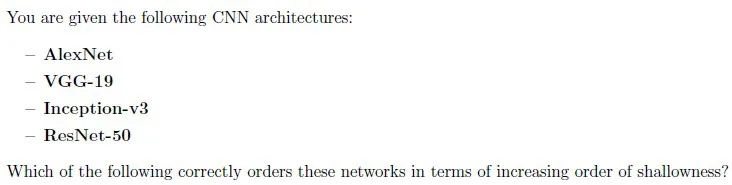
- AResNet-50 > Inception-v3 > VGG-19 > AlexNet
- BResNet-50 > VGG-19 > Inception-v3 > AlexNet
- CInception-v3 > ResNet-50 > VGG-19 > AlexNet
- DVGG-19 > ResNet-50 > Inception-v3 > AlexNet
- Q22MCQ5 Marks·Choose one optionEnd Term · 31 Aug 2025 (FN)Key ↓
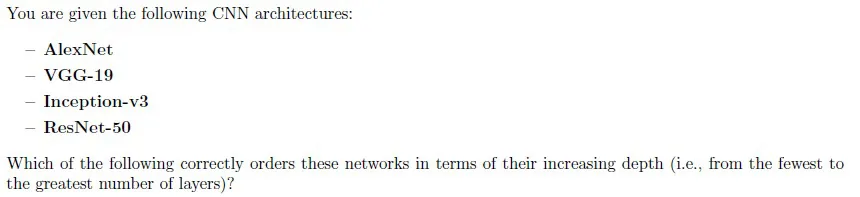
- AAlexNet < InceptionNet-v3 < VGG-19 < ResNet-50
- BAlexNet < VGG-19 < Inception-v3 < ResNet-50
- CInception-v3 < AlexNet < VGG-19 < ResNet-50
- DAlexNet < Inception-v3 < ResNet-50 < VGG-19
Type 9 · asked 2 times · CNN architectures & transfer learning
Explain why a deeper network does not help on a small image dataset
- Q23MCQ5 Marks·Choose one optionEnd Term · 31 Aug 2025 (AN)Key ↓
Consider the following PyTorch CNN model used for a classification task on a small dataset of 32 x 32 RGB images:
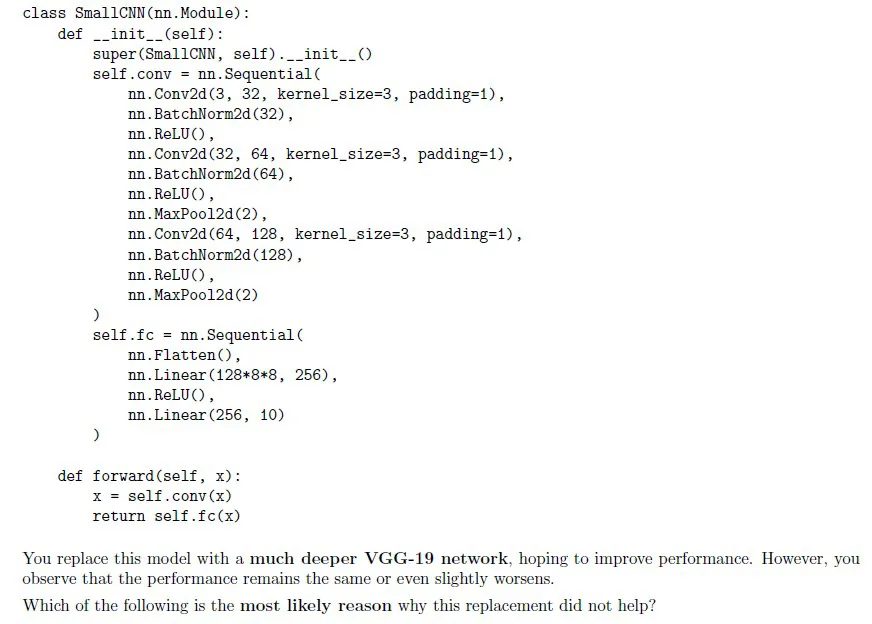
- AVGG-19 uses too many skip connections, which interfere with shallow patterns.
- BThe original model had batch normalization, and VGG-19 lacks it by default.
- CThe dataset is too small and simple for a deep architecture like VGG-19 to show its advantages, and may even overfit.
- DVGG-19 performs better only on grayscale images, not RGB images.
- Q24MCQ5 Marks·Choose one optionEnd Term · 31 Aug 2025 (FN)Key ↓
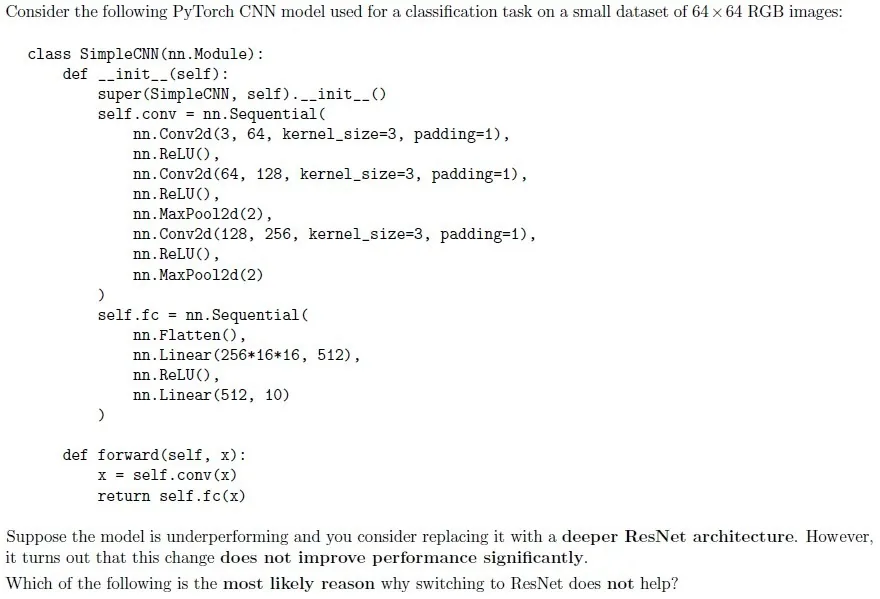
- AResNet has too many parameters for this simple task.
- BResidual connections are only useful when training very deep networks, and this task does not require such depth.
- CResNet architectures perform poorly on low-resolution inputs due to their reliance on fixed feature scales.
- DInceptionNet would have been better because it uses multiple receptive fields in parallel.
Type 10 · asked 2 times · Convolution & pooling arithmetic
Select valid advantages of CNNs over MLPs for images
- Q25MSQ5 Marks·Choose all correct optionsEnd Term · 31 Aug 2025 (AN)Key ↓
Which of the following are valid reasons why Convolutional Neural Networks (CNNs) are preferred over fully connected Multilayer Perceptrons (MLPs) for image processing tasks?
- ACNNs reduce the number of parameters by using local connections and weight sharing.
- BCNNs can process images of arbitrary size without any architectural changes.
- CCNNs exploit the spatial structure of images, making them more efficient at recognizing patterns.
- DCNNs perform better than MLPs because they always use deeper networks.
- ECNNs maintain spatial hierarchies by stacking convolution and pooling layers.
- FCNNs can generalize better to unseen data due to their built-in translational invariance.
- Q26MSQ5 Marks·Choose all correct optionsEnd Term · 31 Aug 2025 (FN)Key ↓
Which of the following are valid advantages of using Convolutional Neural Networks (CNNs) instead of fully connected Multilayer Perceptrons (MLPs) for image-based tasks?
- ACNNs require significantly fewer parameters than MLPs for high-dimensional image inputs.
- BCNNs are better at capturing spatial hierarchies due to weight sharing and local connectivity.
- CCNNs can approximate any function with fewer layers than MLPs due to the universal approximation theorem.
- DCNNs are translation invariant by design, making them robust to object position shifts in images.
- ECNNs do not require any activation functions since convolutions are linear operators.
- FCNNs are computationally faster than MLPs on image data due to sparse connections and weight sharing.
Type 11 · asked 2 times · Object detection & its metrics
Select valid advantages of YOLO over Fast/Faster R-CNN
- Q27MSQ5 Marks·Choose all correct optionsEnd Term · 31 Aug 2025 (AN)Key ↓
Which of the following are valid advantages of YOLO compared to Fast R-CNN or Faster R-CNN?
- AYOLO is faster at inference time because it predicts bounding boxes and class probabilities in a single pass.
- BYOLO is fully end-to-end trainable and does not rely on external region proposal mechanisms.
- CYOLO achieves higher recall than Faster R-CNN on all types of objects, especially small and overlapping ones.
- DYOLO formulates detection as a combination of regression (for bounding box coordinates and objectness score) and classification (for discrete object categories).
- EYOLO uses multi-scale feature fusion to improve detection of small objects.
- FYOLO’s architecture allows it to be deployed more easily on real-time and edge devices due to its compactness.
- Q28MSQ5 Marks·Choose all correct optionsEnd Term · 31 Aug 2025 (FN)Key ↓
Which of the following are valid advantages of YOLO compared to Fast R-CNN or Faster R-CNN?
- AYOLO performs object classification and localization in a single forward pass, making it faster than two-stage detectors like Fast R-CNN and Faster R-CNN.
- BYOLO does not require region proposal generation, making the entire pipeline fully end-to-end trainable.
- CYOLO achieves higher localization accuracy than Faster R-CNN on small objects due to its coarse grid-based prediction.
- DYOLO treats bounding box coordinates and objectness score as regression outputs, while computing class probabilities through classification.
- EYOLO achieves higher precision by using a large number of anchor boxes per region.
- FYOLO treats object detection as a regression problem, which simplifies the detection pipeline and reduces computational overhead.
Type 12 · asked 2 times · CNN architectures & transfer learning
Pick the advantages of one CNN architecture over another
- Q29MSQ5 Marks·Choose all correct optionsEnd Term · 31 Aug 2025 (AN)Key ↓
Which of the following are NOT advantages of AlexNet over InceptionNet?
- AAlexNet is simpler and easier to implement compared to the complex multi- branch design of InceptionNet.
- BAlexNet requires fewer parameters than InceptionNet due to its shallow architecture.
- CAlexNet has better accuracy on ImageNet than InceptionNet due to its early adoption of ReLU and dropout.
- DAlexNet is faster to train on small datasets because of its shallow depth and simpler structure.
- EInceptionNet extracts multi-scale features using filters of different sizes in parallel, which improves accuracy.
- FAlexNet lacks 1 x 1 convolutions, which are used in InceptionNet for dimensionality reduction and increased efficiency.
- Q30MSQ5 Marks·Choose all correct optionsEnd Term · 31 Aug 2025 (FN)Key ↓
Which of the following are advantages of ResNet over VGG-19?
- AResNet requires fewer parameters than VGG-19 while achieving higher accuracy.
- BResNet’s residual connections help mitigate vanishing gradients in very deep networks.
- COn the CIFAR-10 dataset, ResNet achieves higher training and validation accuracy using significantly fewer convolutional layers than VGG-19.
- DResNet models can be trained with depths exceeding 100 layers without suffering from degradation problems.
- EResNet blocks require more memory and training time due to the skip connections compared to VGG-19.
- FVGG-19 is easier to deploy on edge devices because of its lightweight residual architecture.
Type 13 · asked 2 times · CNN architectures & transfer learning
Identify PyTorch code snippets valid for data augmentation
- Q31MSQ5 Marks·Choose all correct optionsEnd Term · 31 Aug 2025 (AN)Key ↓
Which of the following code snippets can be used for data augmentation during training in PyTorch?
- A
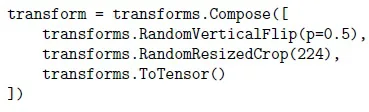
- B
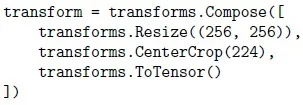
- C

- D
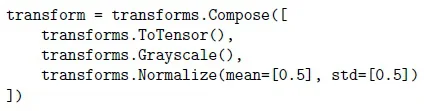
- E

- A
- Q32MSQ5 Marks·Choose all correct optionsEnd Term · 31 Aug 2025 (FN)Key ↓
Which of the following code snippets can be used for data augmentation during training in PyTorch?
- A
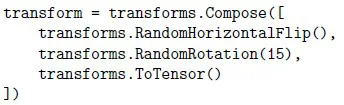
- B
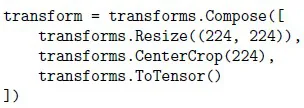
- C
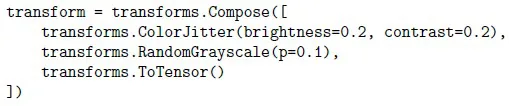
- D

- E
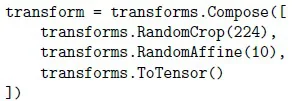
- A
Type 14 · asked 2 times · GANs, super-resolution & restoration
Select correct statements about GAN training
- Q33MSQ5 Marks·Choose all correct optionsEnd Term · 31 Aug 2025 (AN)Key ↓
Which of the following statements are correct regarding the training dynamics and properties of Generative Adversarial Networks (GANs)?
- AThe generator’s objective is to produce data that the discriminator cannot distinguish from real data.
- BThe discriminator is trained to minimize the distance between the generated data and the real data distributions.
- CGAN training is a min-max game where the generator and discriminator have opposing goals.
- DMode collapse refers to the generator producing diverse outputs that cover multiple modes of the data distribution.
- EA balance between generator and discriminator learning rates is important to ensure stable training.
- FConditional GANs extend standard GANs by incorporating label information into both the generator and discriminator.
- Q34MSQ5 Marks·Choose all correct optionsEnd Term · 31 Aug 2025 (FN)Key ↓
Which of the following statements are correct regarding Generative Adversarial Networks (GANs)?
- AThe generator tries to minimize the probability that the discriminator correctly classifies fake samples.
- BThe discriminator is trained to maximize the probability of correctly classifying real and generated (fake) data.
- CThe generator directly receives labeled training data to learn the target distribution.
- DDuring training, the generator is updated based on the discriminator’s feedback to improve sample quality.
- EGAN training can suffer from instability due to the adversarial objective, leading to issues like mode collapse.
- FA perfectly trained discriminator ensures faster convergence of the generator.
Type 15 · asked 2 times · GANs, super-resolution & restoration
Identify correct/incorrect differences between SRGAN and ESRGAN
- Q35MSQ5 Marks·Choose all correct optionsEnd Term · 31 Aug 2025 (AN)Key ↓
SRGAN and ESRGAN are both deep learning architectures designed for single image super- resolution. Which of the following statements about the differences between ESRGAN and SRGAN are NOT correct?
- AESRGAN replaces the standard residual blocks in SRGAN with Residual-in- Residual Dense Blocks (RRDB) for better performance.
- BSRGAN employs Perceptual Loss, while ESRGAN removes it to focus only on pixel-wise MSE loss for training stability.
- CESRGAN produces sharper and more realistic textures than SRGAN due to architectural and loss function improvements.
- DBoth SRGAN and ESRGAN use a VGG-based perceptual loss computed on feature maps extracted from deeper layers of a pretrained classifier.
- ESRGAN is trained using only adversarial and perceptual losses, whereas ESRGAN includes a content loss computed using pixel-wise L1 loss.
- Q36MSQ5 Marks·Choose all correct optionsEnd Term · 31 Aug 2025 (FN)Key ↓
SRGAN and ESRGAN are both deep learning architectures designed for single image super- resolution. Which of the following statements correctly describe the key differences between ESRGAN and SRGAN?
- AESRGAN replaces the standard residual blocks in SRGAN with Residual-in- Residual Dense Blocks (RRDB) for better performance.
- BSRGAN employs Perceptual Loss, while ESRGAN removes it to focus only on pixel-wise MSE loss for training stability.
- CESRGAN produces sharper and more realistic textures than SRGAN due to architectural and loss function improvements.
- DBoth SRGAN and ESRGAN use a VGG-based perceptual loss computed on feature maps extracted from deeper and shallower layers, respectively, of a pretrained classifier.
- ESRGAN is trained using only adversarial and perceptual losses, whereas ESRGAN includes a content loss computed using pixel-wise L1 loss.
Type 16 · asked 2 times · GANs, super-resolution & restoration
Count which listed components belong to the original MPRNet
- Q37MSQ5 Marks·Choose all correct optionsEnd Term · 31 Aug 2025 (AN)Key ↓
The Multi-stage Progressive Image Restoration Network (MPRNet) is designed to progressively restore degraded images across multiple stages. It integrates several architectural innovations to enhance image restoration performance. How many of the above components are explicitly part of the original MPRNet architecture?
- AUNet-style encoder-decoder at each stage
- BResidual Channel Attention Network (RCAN)
- CSupervised Attention Module (SAM)
- DSkip connections across stages
- ENon-local Attention Module
- Q38MSQ5 Marks·Choose all correct optionsEnd Term · 31 Aug 2025 (FN)Key ↓
The Multi-stage Progressive Image Restoration Network (MPRNet) is a state-of-the-art architecture for tasks like image deblurring and deraining. It follows a multi-stage design where features are progressively refined across stages. how many of the above components are explicitly part of the original MPRNet architecture?
- Aa single layer neural network.
- BUNet
- CSupervised Attention Module
- DChannel Attention Block
- EFast RCNN block
Type 17 · asked 2 times · Convolution & pooling arithmetic
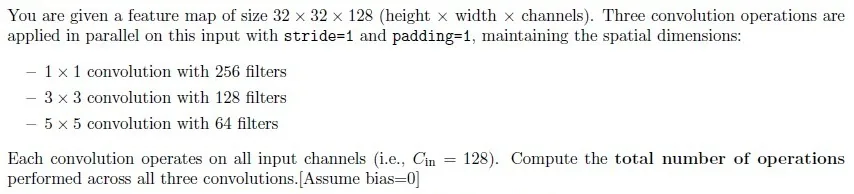
Count total operations of parallel 1x1, 3x3 and 5x5 convolutions
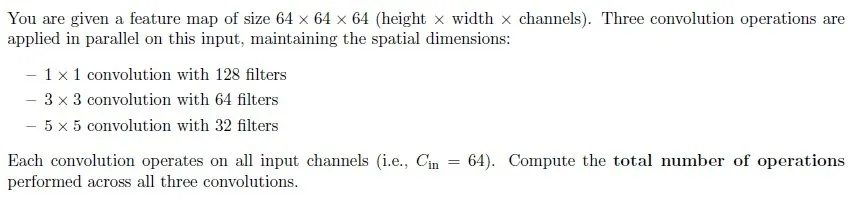
Type 18 · asked 2 times · GANs, super-resolution & restoration
Decide which model is closer to ground truth using PSNR
Read the passage below, then answer Q41
Based on the above data, answer the given subquestions.
Q41NAT2 Marks·Write the numberEnd Term · 31 Aug 2025 (AN)Key ↓Which model produces an image more similar to the ground truth?
Your answer:Read the passage below, then answer Q42
Based on the above data, answer the given subquestions.
Q42NAT2 Marks·Write the numberEnd Term · 31 Aug 2025 (FN)Key ↓Which model produces an image more similar to the ground truth?
Your answer:
Type 19 · asked 2 times · Segmentation & depth estimation
Identify the correct statement about the original U-Net layers
- Q43MCQ5 Marks·Choose one optionEnd Term · 31 Aug 2025 (AN)Key ↓
In the original U-Net architecture, which of the following statements about the decoder (expanding) path is correct?
- AThe decoder upsamples the feature maps using 2 x 2 transposed convolutions and concatenates them with corresponding encoder features.
- BThe decoder uses 3 x 3 max pooling to increase the spatial resolution before feature fusion.
- CThe decoder applies 1 x 1 convolutions to increase spatial dimensions and reduce channel depth.
- DThe decoder merges encoder and decoder features using element-wise addition instead of concatenation.
- Q44MCQ5 Marks·Choose one optionEnd Term · 31 Aug 2025 (FN)Key ↓
Consider the original U-Net architecture. Which of the following statements about the convolutional and pooling operations is correct?
- AU-Net uses 5 × 5 convolutional filters and 2 × 2 max pooling filters with stride 2 in the encoder path.
- BU-Net uses 3 × 3 convolutional filters and 2 × 2 average pooling filters with stride 1 in both encoder and decoder.
- CU-Net uses 3 × 3 convolutional filters (with padding) and 2 × 2 max pooling filters with stride 2 to halve the spatial resolution in the encoder.
- DU-Net uses 3 × 3 filters and 1 × 1 pooling to preserve spatial dimensions between contracting and expanding paths.
Official KeyMaster Answer Key & Explanations
Official answer keys from IIT Madras BS past papers. Click any question to review.
Reveal KeyCollapse Key
Master Answer Key & Explanations
Official answer keys from IIT Madras BS past papers. Click any question to review.