Indian Institute of Technology Madras
BS Degree Programme · Examination & Study Paper
Deep Learning Practice
End Term · 13 Apr 2025 (Afternoon)
Examination Instructions & Guidelines
- Solve on notebook/paper first before checking solutions.
- MCQ: Exactly 1 option is correct. Negative marking applies.
- MSQ: One or more options correct. Select all to score.
- Scientific calculator allowed for all calculations.
- Official answer key is sealed at the end of this sheet.
- Q1MCQ5 Marks·Choose one option
Consider the following code snippet for modifying an AlexNet architecture to adapt it for a custom classification task with 10 output classes. Fill in the blank portion with the most appropriate code snippet.
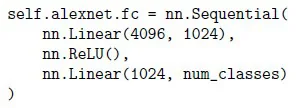
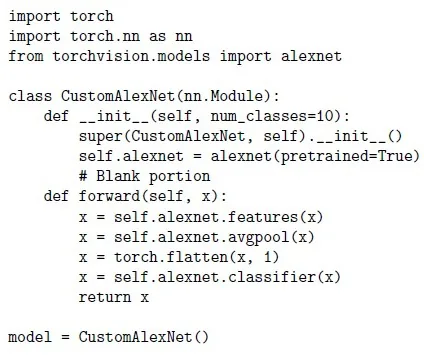 Which of the following code snippets correctly fills the blank portion to modify the AlexNet classifier while preserving the pretrained feature extraction layers?
- A

- B

- C
- D

- A
- Q2MCQ5 Marks·Choose one option
An RGB image of size 227 × 227 × 3 is first converted to grayscale and then passed through a 2D Convolutional Neural Network (CNN) layer with the following parameters: – Kernel size: 3 × 3 – Stride: 1 – Padding: 1 – Number of filters: 16 What will be the shape of the output feature map?
- A(227, 227, 3)
- B(227, 227, 16)
- C(225, 225, 16)
- D(114, 114, 16)
- Q3MCQ5 Marks·Choose one option

- A0.25
- B0.29
- C0.45
- D0.21
- Q4MCQ5 Marks·Choose one option
Consider a Convolutional Neural Network (CNN) where the feature map after the convolutional and pooling layers has a shape of (8, 8, 64). This feature map is flattened and connected to a fully connected layer with 256 output neurons. How many parameters (weights and biases) are in this fully connected layer?
- A524, 544
- B65, 536
- C258, 048
- D10, 48, 832
- Q5MCQ5 Marks·Choose one option
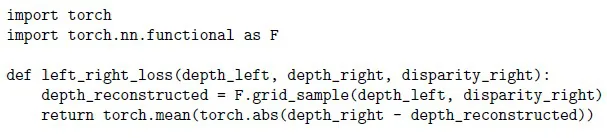
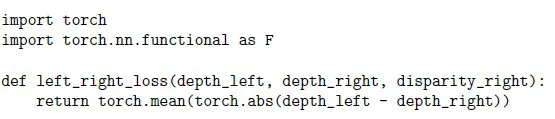
In self-supervised depth estimation, left-right consistency loss is often used to ensure that the depth maps from stereo images agree with each other. Which of the following code snippets correctly implements a left-right consistency loss by reconstructing the left depth map from the right depth map using disparity?
- A
- B
- C
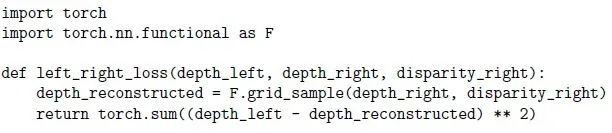
- D
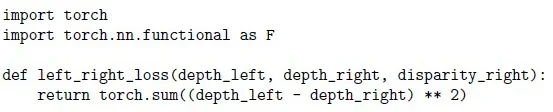
- A
- Q6MCQ5 Marks·Choose one option
In the Fast R-CNN object detection pipeline, which of the following steps is NOT part of the preprocessing process?
- AResize the input image to a fixed size.
- BExtract region proposals using Selective Search.
- CApply a Region Proposal Network (RPN) to generate region proposals.
- DExtract features from the entire image using a CNN backbone before classifying region proposals.
- Q7MCQ5 Marks·Choose one option
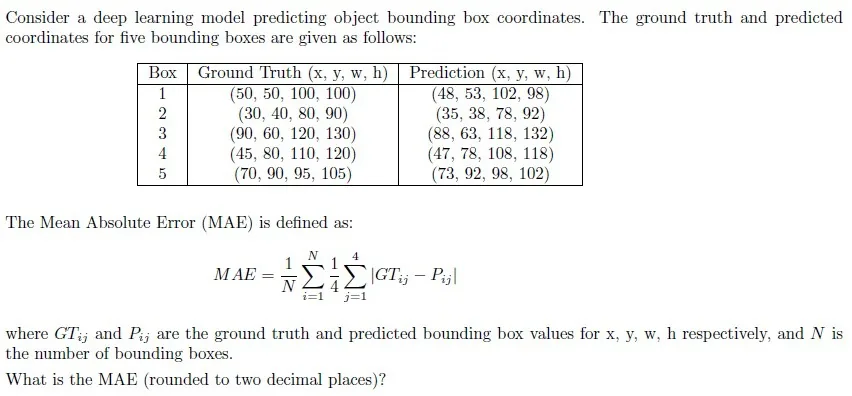
- A2.00
- B2.25
- C2.40
- D2.75
- Q8MCQ5 Marks·Choose one option
The following code snippets attempt to implement an Inception module in PyTorch. Identify the correct snippet(s):
- A
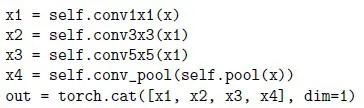
- B
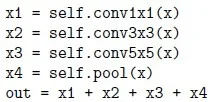
- C
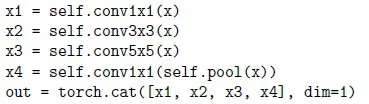
- D
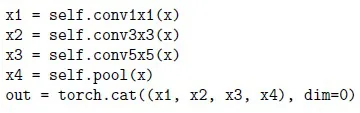
- A
- Q9MCQ5 Marks·Choose one option
LAKDNet is designed to enhance feature extraction and knowledge distillation in deep neural networks. Which of the following best describes its core architectural improvement?
- AIt employs a Dual Attention Mechanism (Spatial and Channel Attention) to improve feature aggregation.
- BIt uses Graph Convolutional Networks (GCNs) to capture hierarchical dependencies in spatial features.
- CIt integrates Recurrent Neural Networks (RNNs) to enhance temporal feature extraction.
- DIt relies on Transformer-based self-attention to capture global contextual dependencies.
- Q10MCQ5 Marks·Choose one option
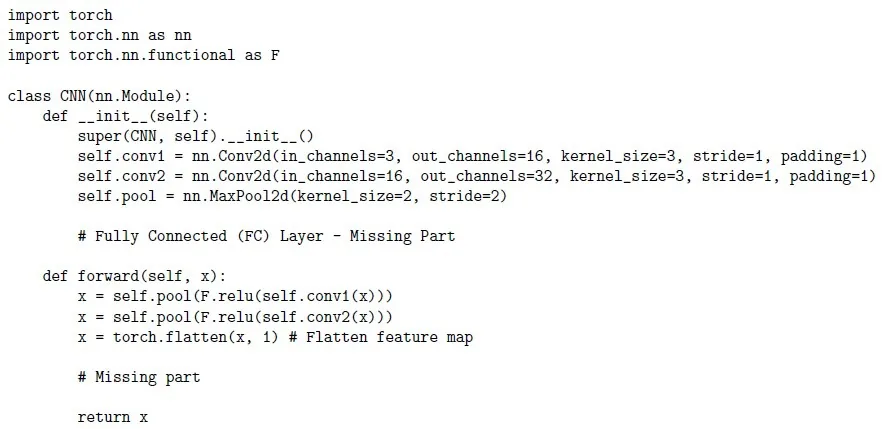
The following PyTorch code implements a simple Convolutional Neural Network (CNN). However, some of the layers are incomplete. Select the correct option to complete the layers.
- A
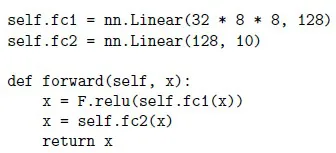
- B
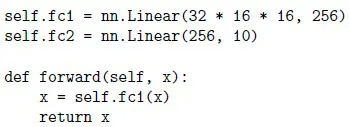
- C
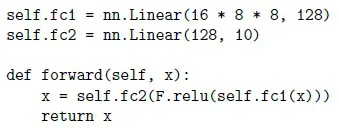
- D
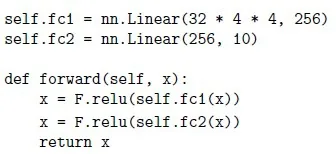
- A
- Q11MCQ5 Marks·Choose one option
SRGAN is a deep learning-based approach for image super-resolution that improves the perceptual quality of upscaled images. Which of the following best describes the role of the adversarial loss in SRGAN?
- AIt minimizes the pixel-wise difference between the super-resolved and high- resolution images to ensure pixel accuracy.
- BIt encourages the generator to produce high-resolution images that are perceptually similar to real images by fooling the discriminator.
- CIt directly optimizes the Structural Similarity Index (SSIM) to improve texture and detail preservation.
- DIt ensures that the generated high-resolution images have better Peak Signal- to-Noise Ratio (PSNR) compared to traditional interpolation methods.
- Q12MCQ5 Marks·Choose one option
In the U-Net architecture, downsampling is performed using pooling layers to reduce spatial dimensions while preserving important features. Which of the following code snippets correctly implement the pooling layer in U-Net?
- A
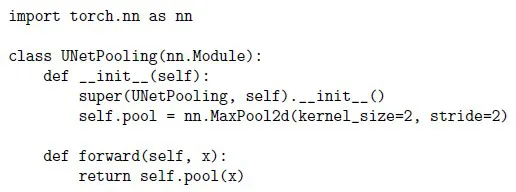
- B
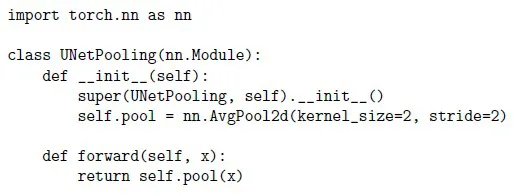
- C
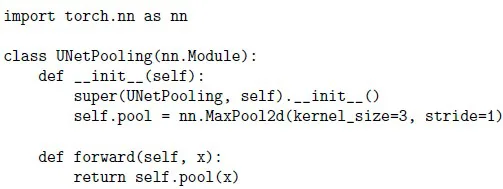
- D
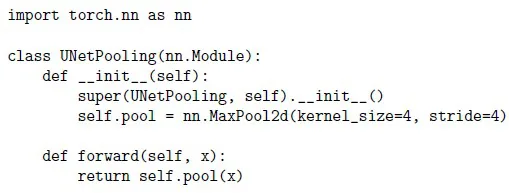
- A
- Q13MCQ5 Marks·Choose one option
Consider the following code snippet, which generates predictions and ground truth for an object detection task:
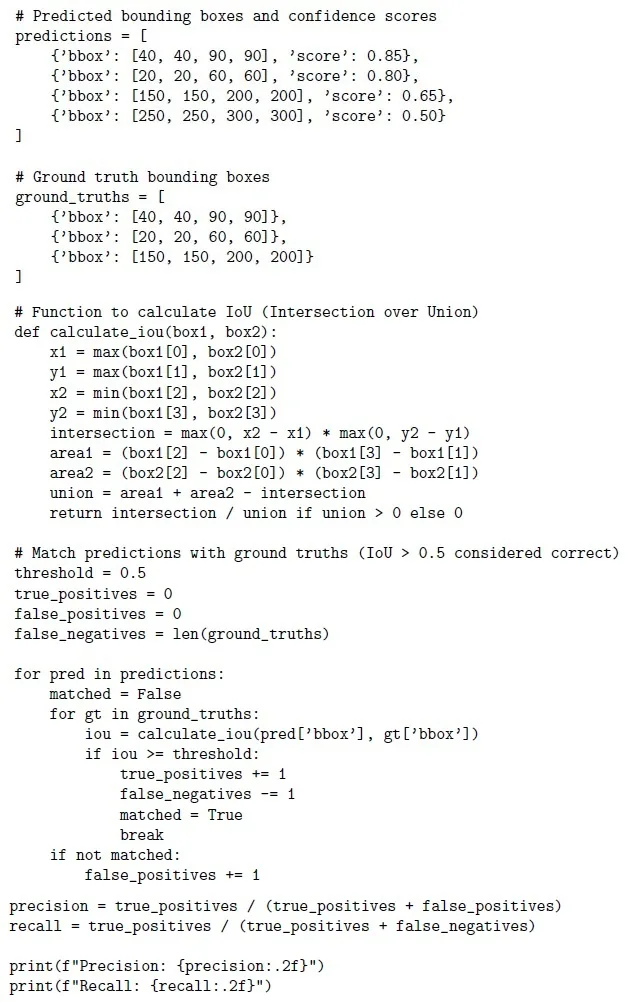 Given the predictions and ground truths, what are the precision and recall values?
- APrecision: 0.75, Recall: 1.00
- BPrecision: 0.75, Recall: 0.75
- CPrecision: 1.00, Recall: 0.75
- DPrecision: 0.60, Recall: 1.00
- Q14MCQ5 Marks·Choose one option
Consider the following code snippet, which calculates the F1-score for an object detection task:
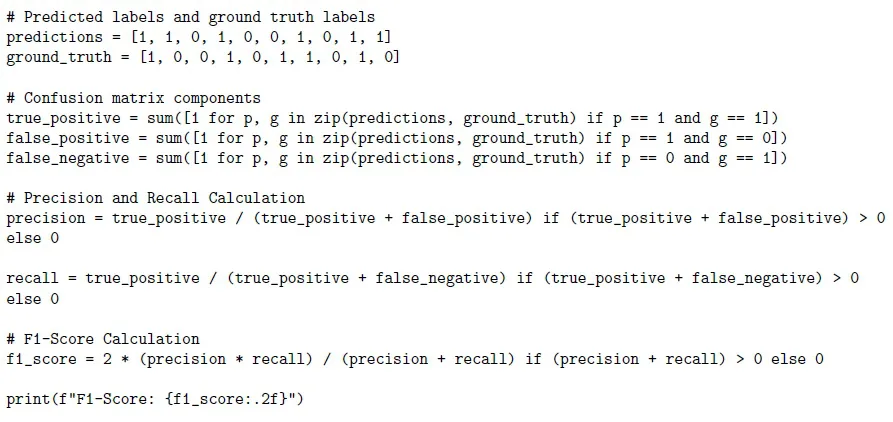 Given the predictions and ground truth, what is the calculated F1-score?
- A0.67
- B0.71
- C0.73
- D0.75
- Q15MCQ5 Marks·Choose one option
In VGGNet, which part of the architecture contributes the most to memory utilization during training, and which part contains the **highest number of parameters?
- AThe early convolutional layers have the highest memory utilization, while the fully connected layers** have the highest number of parameters.
- BThe fully connected layers have the highest memory utilization, while the convolutional layers have the highest number of parameters.
- CThe deeper convolutional layers have the highest memory utilization, while the **pooling layers** have the highest number of parameters.
- DThe batch normalization layers have the highest memory utilization, while the skip connections have the highest number of parameters.
- Q16MSQ5 Marks·Choose all correct options
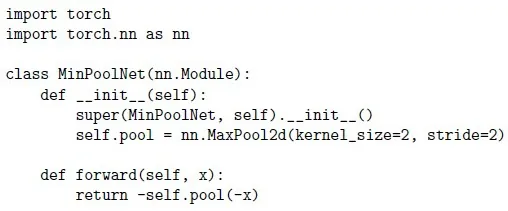
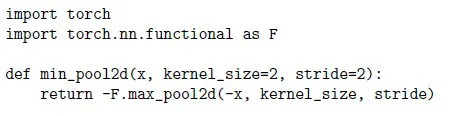
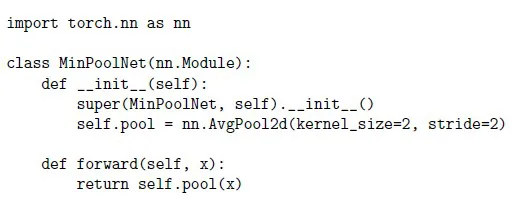
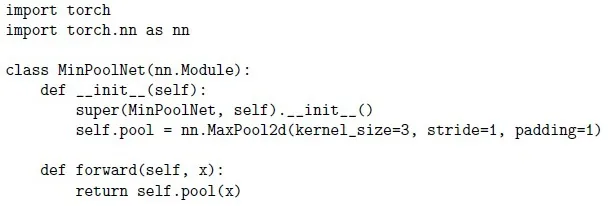
Which of the following code snippets correctly implement Min Pooling in PyTorch?
- A
- B
- C
- D
- A
- Q17MSQ5 Marks·Choose all correct options
In deep convolutional neural networks, 1 x 1 convolutions play a significant role in optimizing computation and feature extraction. Which of the following statements correctly describe their role in modern CNN architectures?
- A1 x 1 convolutions can be used to perform dimensionality reduction by reducing the number of channels before applying computationally expensive convolutions.
- BThey introduce non-linearity into the network, even when used without activation functions.
- C1 x 1 convolutions enable cross-channel interactions by linearly combining feature maps from different channels.
- DIn ResNet architectures, 1 x 1 convolutions are used in bottleneck blocks to match the dimensions when applying skip connections.
- EWhen applied after a max pooling layer, 1 x 1 convolutions help recover lost spatial information by increasing the resolution of the feature maps.
- Q18MSQ5 Marks·Choose all correct options
Consider the following PyTorch code snippet for a custom ResNet block.
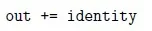
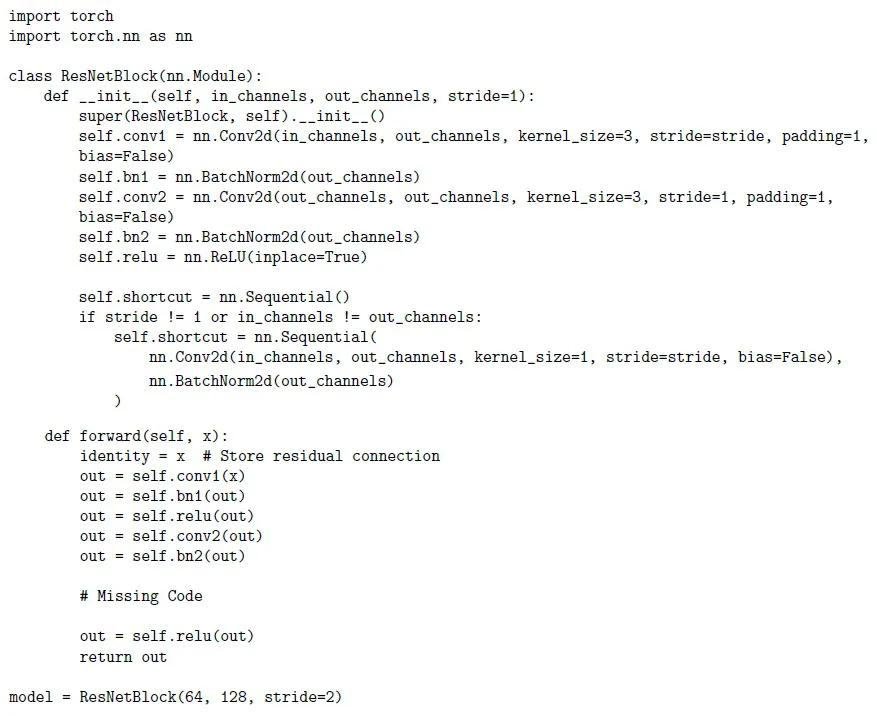 Which of the following options correctly fill in the missing code snippet?
- A
- B

- C

- D

- E

- A
- Q19MSQ5 Marks·Choose all correct options
Estimating depth from a single image using a multiscale deep neural network presents several challenges. Which of the following correctly describe these challenges?
- AUnderstanding global context and handling variations in scene geometry and textureless regions.
- BDealing with scale ambiguity and the lack of absolute depth reference in monocular images.
- CReducing computational complexity while matching points across two images.
- DHandling occlusions and depth discontinuities, especially at object boundaries.
- EAccurately aligning stereo image pairs and computing disparity for depth estimation.
- Q20MSQ5 Marks·Choose all correct options
Monocular depth estimation using a multiscale deep neural network presents several challenges due to the lack of direct depth cues. Which of the following is a primary challenge specific to monocular depth estimation?
- AHandling scale ambiguity and the absence of absolute depth reference in single images.
- BAccurately computing depth by triangulating matching keypoints between two images.
- CEstimating depth consistently in textureless regions and under varying lighting conditions.
- DUsing LiDAR or structured light to obtain precise depth values instead of predicting them.