Indian Institute of Technology Madras
BS Degree Programme · Examination & Study Paper
Deep Learning for Computer Vision
End Term · 31 Aug 2025 (Forenoon)
Examination Instructions & Guidelines
- Solve on notebook/paper first before checking solutions.
- MCQ: Exactly 1 option is correct. Negative marking applies.
- MSQ: One or more options correct. Select all to score.
- NAT: Numerical response. No negative marking.
- Scientific calculator allowed for all calculations.
- Official answer key is sealed at the end of this sheet.
- Q1MCQ2 Marks·Choose one option
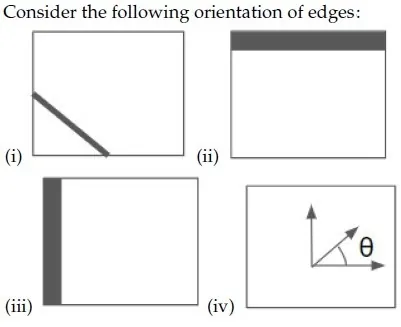 Choose the correct matching:
- A

- B

- C

- D

- A
- Q2MCQ2 Marks·Choose one option
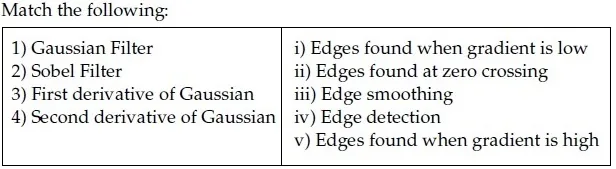
- A1→ iii, 2→ iv, 3→ i, 4 → ii
- B1→ iii, 2→ i, 3 → ii, 4 → v
- C1→ iii, 2→ iv, 3→ v, 4 → ii
- D1→ iv, 2→ iii, 3→ i, 4 → ii
- Q3MCQ2 Marks·Choose one option
Identify the correct sequence of steps in a Canny edge detection pipeline. Steps are listed below: 1. Compute gradient magnitude and direction 2. Connect individual components 3. Smoothen the image 4. Threshold into strong, weak, or no edge 5. Gaussian Filter and Hysteresis 6. Non-maximum suppression 7. Apply derivative to get edges
- A6→ 1→ 4→ 5 → 2
- B3→ 1→ 6→ 4 → 2
- C3→ 5→ 1→ 4 → 2
- D6→ 3→ 5→ 7 → 2
- Q4MCQ2 Marks·Choose one option
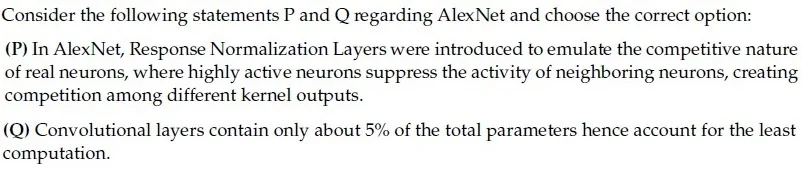
- AOnly statement P is true
- BOnly statement Q is true
- CBoth statements are true
- DNone of these statements is true
- Q5MCQ2 Marks·Choose one option
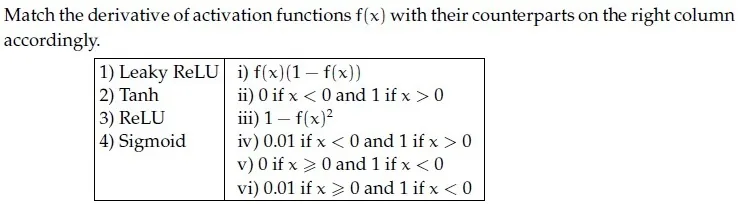
- A1→ vi, 2→ iii, 3 →v, 4 → i
- B1→ i, 2→ iv, 3 → iii, 4→ ii
- C1→ i, 2→ v, 3 → iii, 4→ iv
- D1→ iv, 2→ iii, 3→ ii, 4 → i
- Q6MCQ2 Marks·Choose one option
Which of the following is the correct sequence of steps of the SIFT algorithm? 1. Using the Taylor series expansion of the scale-space function, lo-calize the key points. 2. Estimate the orientation of keypoints using the local image gra-dients. 3. Find the edge points using the eigenvalues of the Hessian and reject these points. 4. Find a raw SIFT descriptor vector using the gradient orientations of the neighborhood around the key points. 5. Detect extreme points in scale space using an approximation of the Laplacian of Gaussian.
- A5, 2, 1, 3, 4
- B5, 1, 3, 2, 4
- C1, 3, 2, 4, 5
- D1, 5, 3, 2, 4
- Q7MCQ2 Marks·Choose one option

- ASigmoid of alignment scores
- BReLU of alignment scores
- CSoftmax of alignment scores
- DLinear projections of alignment scores
- Q8MCQ2 Marks·Choose one option
Which one of the following statements is true?
- AAttention mechanisms cannot be applied to the bidirectional RNN model
- BAn image captioning network cannot be trained end-to-end even though we are using 2 different modalities to train the network
- COne of the key components in the vanilla transformer are the recurrent connections that help them to deal with variable input length.
- DNone of these
- Q9MCQ2 Marks·Choose one option
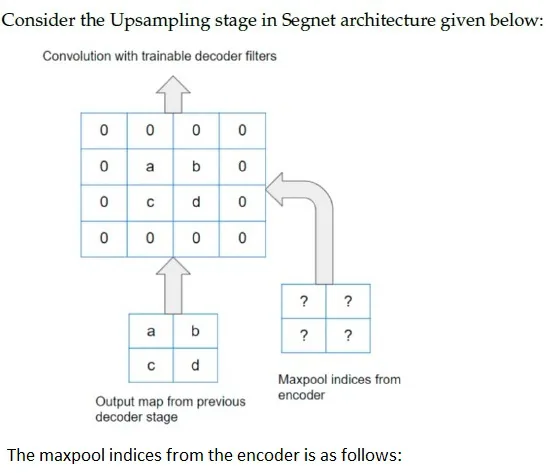
- A

- B

- C

- D

- A
- Q10MCQ2 Marks·Choose one option
Which one of the following statements regarding hyperparameter tuning is false?
- AValidation set is the best choice for tuning hyperparameters
- BPicking hyperparameters that perform the best on the training set leads to overfitting
- CTuning hyperparameters on the test set is an acceptable approach to find the most powerful model for generalization performance
- DTest set performance, with hyperparameters tuned on the validation set, would be a realistic measure of how the model will generalize to new data.
- Q11MCQ2 Marks·Choose one option

- A
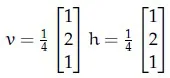
- B
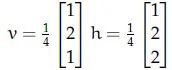
- C
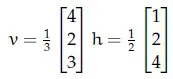
- D
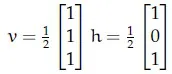
- A
- Q12MCQ2 Marks·Choose one option
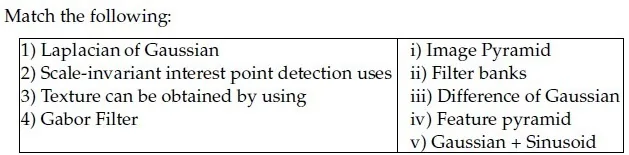
- A1→ iii, 2→ iv, 3→ ii, 4 → i
- B1→ i, 2→ iv, 3 → iii, 4→ ii
- C1→ iv, 2→ iii, 3→ ii, 4 → i
- D1→ iii, 2→ i, 3 → ii, 4 →v
- Q13MCQ2 Marks·Choose one option
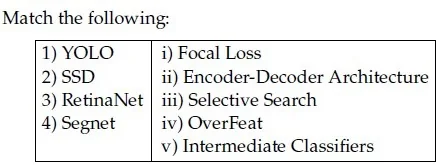
- A1→ iv, 2→ v, 3→ i, 4 → ii
- B1→ iii, 2→ i, 3 → v, 4→ ii
- C1→ iv, 2→ iii, 3→ ii, 4 → i
- D1→ iii, 2→ i, 3 → ii, 4→ v
- Q14MCQ2 Marks·Choose one option
What makes the Segment Anything Model (SAM) particularly advantageous for image annotation tasks compared to conventional segmentation approaches?
- AIt has perfect segmentation accuracy
- BIt has minimal hardware requirements for operation
- CIt can generalize to segment objects it wasn’t specifically trained on
- DIt automatically identifies and labels all objects in an image without user prompts
- Q15MCQ2 Marks·Choose one option
Statement 1: The Segment Anything Model (SAM) demonstrates zero-shot generalization capabilities across various downstream tasks. Statement 2: SAM’s training involves a largescale, diverse mask dataset using a prompt-based segmentation approach. Which one of the following options is most appropriate?
- ABoth statements are correct, and Statement 2 correctly explains Statement 1.
- BBoth statements are correct, but Statement 2 does not correctly explain Statement 1.
- CStatement 1 is correct, but Statement 2 is incorrect.
- DStatement 1 is incorrect, but Statement 2 is correct.
- EBoth statements are incorrect.
- Q16MCQ2 Marks·Choose one option
Why does DETR typically exhibit poor performance in detecting small objects compared to larger ones?
- AThe CNN backbone used in DETR has a fixed receptive field that’s too large for small objects
- BThe global self-attention mechanism in DETR tends to dilute the signal from small objects across all image locations
- CDETR’s loss function actively discards all detections smaller than 50x50 pixels
- DThe object queries in DETR are programmed to ignore any object smaller than 10
- EDETR’s encoder-decoder architecture was specifically designed to only detect large objects
- Q17MSQ2 Marks·Choose all correct options
Which of the following statements are false? (Select all that apply)
- AGenerative adversarial networks (GANs) generate sharper images compared to Variational AutoEncoders (VAE)
- BGAN is an example of an implicit density estimation model
- CFully connected layers in mapping network of Style-GAN do not change the dimension of its input
- DThe generator and discriminator are always trained together in a GAN
- Q18MSQ2 Marks·Choose all correct options
Which of the following statements are true? (Select all possible correct options)
- AAutoencoder are equivalent to Principal Component Analysis (PCA) provided we don’t use of non-linear activation functions
- BWhen using global attention on temporal data, alignment weights are learnt for encoder hidden representations for all time steps
- CPositional encoding is an important component of the transformer architecture as it conveys information about order in a given sequence
- DIt is not possible to generate different captions for the same image that have similar meaning but different tone/style
- EAutoencoders can not be used for data compression as its input and output dimensions are different
- Q19MSQ2 Marks·Choose all correct options
Which of the following statements about CLIP are TRUE? (Select ALL that apply)
- ACLIP uses a contrastive loss function to align text and image embeddings.
- BCLIP requires image labels for training.
- CCLIP is trained to maximize cosine similarity between embeddings of matching text-image pairs.
- DCLIP model is trained with pretext tasks such as rotation prediction and inpainting to learn effective feature representations.
- ETo use the CLIP model for image classification, it is imperative to finetune it on downstream datasets.
- Q20MSQ2 Marks·Choose all correct options
Which one of the following statements is true:
- AWeight change criterion is a method of ‘early stopping’ that checks whether or not the error is dropping over epochs to decide whether to continue training or stop.
- BL1 norm tends to create more sparse weights than L2 norm.
- CDuring the training phase, for each iteration, Dropout ignores a random fraction, p, of nodes, and accounts for it in the test phase by scaling down the activations by a factor of p.
- DA single McCulloch-Pitts neuron is capable of modeling AND, OR, XOR, NOR, and NAND functions.
- Q21MSQ2 Marks·Choose all correct options
Which of the following are examples of a high-pass filter?
- A

- B
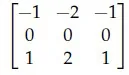
- C
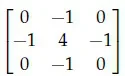
- D

- A
- Q22MSQ2 Marks·Choose all correct options
Which of the following statements are true? (Select all that apply)
- A

- B

- C

- D

- A
- Q23MSQ2 Marks·Choose all correct options
Which of the following techniques help control the exploding or vanishing gradient problem in recurrent neural networks?
- AGradient clipping
- BUse ReLU activation funtion to control exploding gradient and sigmoid activation to control vanishing gradients
- CUse Long Short-Term Memory (LSTM)
- DUse data augmentation methods (for example, reversing the input sequence)
- Q24NAT2 Marks·Write the number
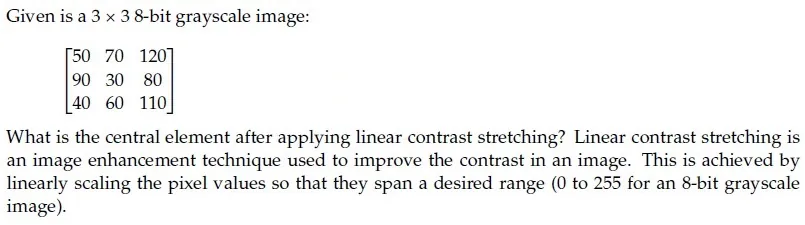 Your answer:
 - Q25NAT2 Marks·Write the number
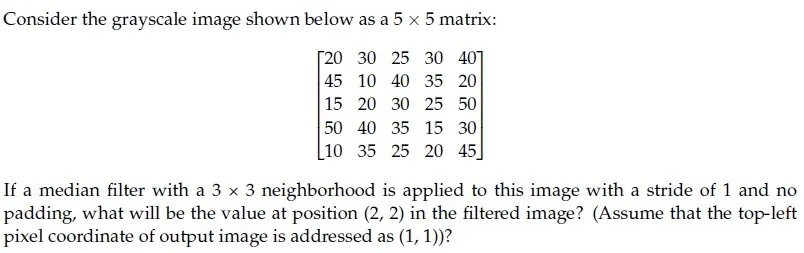 Your answer:
 - Q26NAT2 Marks·Write the number
 Your answer:
 - Q27NAT2 Marks·Write the number
 Your answer:
 - Q28NAT2 Marks·Write the number
 Your answer:
 - Q29NAT2 Marks·Write the number
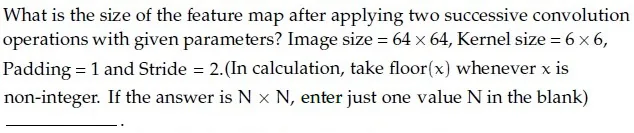 Your answer:
 Read the passage below, then answer Q30–Q31
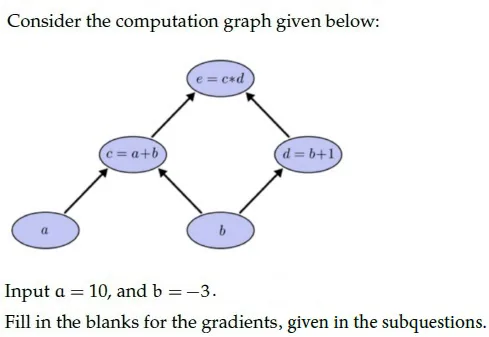 Q30NAT1 Mark·Write the number
 Your answer:
- Q31NAT1 Mark·Write the number
 Your answer:
 Read the passage below, then answer Q32–Q35

Based on the above data, answer the given subquestions.
Q32NAT1 Mark·Write the numberElement 1: _______________
Your answer:- Q33NAT1 Mark·Write the number
Element 2: _______________
Your answer: - Q34NAT1 Mark·Write the number
Element 3: _______________
Your answer: - Q35NAT1 Mark·Write the number
Element 4: _______________
Your answer: Read the passage below, then answer Q36–Q41
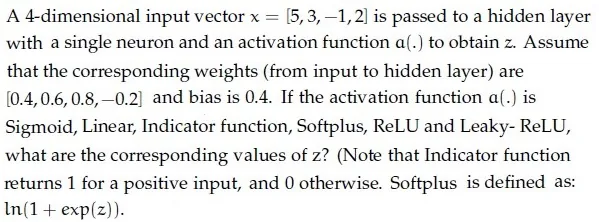
Based on the above data, answer the given subquestions.
Q36NAT1 Mark·Write the numberSigmoid _______________
Your answer:- Q37NAT1 Mark·Write the number
Linear _______________
Your answer: - Q38NAT1 Mark·Write the number
Indicator Function _______________
Your answer: - Q39NAT1 Mark·Write the number
Softplus _______________
Your answer: - Q40NAT1 Mark·Write the number
ReLu _______________
Your answer: - Q41NAT1 Mark·Write the number
Leaky-ReLu _______________
Your answer: Read the passage below, then answer Q42–Q52
Consider the BLIP model architecture with an input (image-text pair) as shown below: For each of the given entities, enter the appropriate number from the figure that corresponds to it:
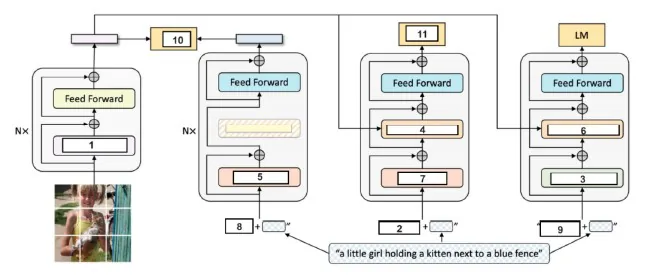
Based on the above data, answer the given subquestions.
Q42NAT0.55 Marks·Write the number Your answer:
- Q43NAT0.55 Marks·Write the number
 Your answer:
 - Q44NAT0.55 Marks·Write the number
 Your answer:
 - Q45NAT0.55 Marks·Write the number
 Your answer:
 - Q46NAT0.55 Marks·Write the number
 Your answer:
 - Q47NAT0.55 Marks·Write the number
 Your answer:
 - Q48NAT0.54 Marks·Write the number
 Your answer:
 - Q49NAT0.54 Marks·Write the number
 Your answer:
 - Q50NAT0.54 Marks·Write the number
 Your answer:
 - Q51NAT0.54 Marks·Write the number
 Your answer:
 - Q52NAT0.54 Marks·Write the number
 Your answer:
Official KeyMaster Answer Key & Explanations
Official answer keys from IIT Madras BS past papers. Click any question to review.
Reveal KeyCollapse Key
Master Answer Key & Explanations
Official answer keys from IIT Madras BS past papers. Click any question to review.