Indian Institute of Technology Madras
BS Degree Programme · Examination & Study Paper
Deep Learning for Computer Vision
Most repeated questions
Examination Instructions & Guidelines
- Solve on notebook/paper first before checking solutions.
- MCQ: Exactly 1 option is correct. Negative marking applies.
- MSQ: One or more options correct. Select all to score.
- NAT: Numerical response. No negative marking.
- Scientific calculator allowed for all calculations.
- Official answer key is sealed at the end of this sheet.
Type 1 · asked 22 times · Vision-language: CLIP & BLIP
Label the parts of the BLIP architecture from the figure
Read the passage below, then answer Q1–Q11
Consider the BLIP model architecture with an input (image-text pair) as shown below:
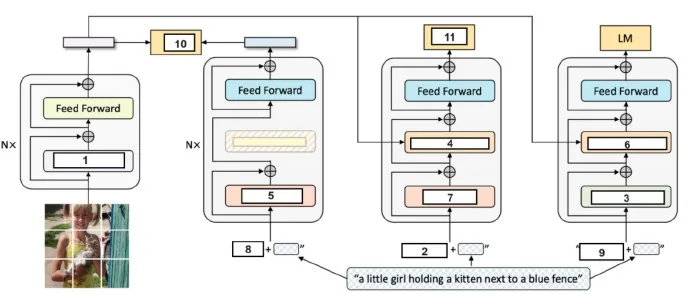
For each of the entities given, enter the appropriate number from the figure that corresponds to it:
Based on the above data, answer the given subquestions.
Q1NAT1 Mark·Write the numberEnd Term · 31 Aug 2025 (AN)Key ↓Self-Attention _______________
Your answer:- Q2NAT0.5 Marks·Write the numberEnd Term · 31 Aug 2025 (AN)Key ↓
BERT Text Encoder Bi Self Attention:__________________
Your answer: - Q3NAT0.5 Marks·Write the numberEnd Term · 31 Aug 2025 (AN)Key ↓
Image-Text Matching Loss (LITM ):__________________
Your answer: - Q4NAT0.5 Marks·Write the numberEnd Term · 31 Aug 2025 (AN)Key ↓
Image Grounded Text Encoder Bi Self Attention: ___________________
Your answer: - Q5NAT0.5 Marks·Write the numberEnd Term · 31 Aug 2025 (AN)Key ↓
 Your answer:
 - Q6NAT0.5 Marks·Write the numberEnd Term · 31 Aug 2025 (AN)Key ↓
Image Grounded Text Encoder Cross Attention: _________________
Your answer: - Q7NAT0.5 Marks·Write the numberEnd Term · 31 Aug 2025 (AN)Key ↓
Image-Text Contrastive Loss (LITC): ____________
Your answer: - Q8NAT0.5 Marks·Write the numberEnd Term · 31 Aug 2025 (AN)Key ↓
 Your answer:
 - Q9NAT0.5 Marks·Write the numberEnd Term · 31 Aug 2025 (AN)Key ↓
Causal Self Attention: _____________
Your answer: - Q10NAT0.5 Marks·Write the numberEnd Term · 31 Aug 2025 (AN)Key ↓
 Your answer:
 - Q11NAT0.5 Marks·Write the numberEnd Term · 31 Aug 2025 (AN)Key ↓
Image Grounded Text Decoder Cross Attention: _____________
Your answer: Read the passage below, then answer Q12–Q22
Consider the BLIP model architecture with an input (image-text pair) as shown below: For each of the given entities, enter the appropriate number from the figure that corresponds to it:
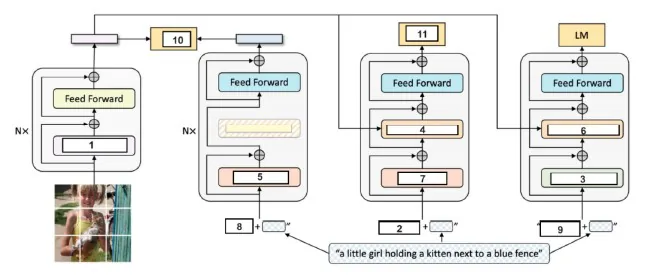
Based on the above data, answer the given subquestions.
Q12NAT0.55 Marks·Write the numberEnd Term · 31 Aug 2025 (FN)Key ↓ Your answer:
- Q13NAT0.55 Marks·Write the numberEnd Term · 31 Aug 2025 (FN)Key ↓
 Your answer:
 - Q14NAT0.55 Marks·Write the numberEnd Term · 31 Aug 2025 (FN)Key ↓
 Your answer:
 - Q15NAT0.55 Marks·Write the numberEnd Term · 31 Aug 2025 (FN)Key ↓
 Your answer:
 - Q16NAT0.55 Marks·Write the numberEnd Term · 31 Aug 2025 (FN)Key ↓
 Your answer:
 - Q17NAT0.55 Marks·Write the numberEnd Term · 31 Aug 2025 (FN)Key ↓
 Your answer:
 - Q18NAT0.54 Marks·Write the numberEnd Term · 31 Aug 2025 (FN)Key ↓
 Your answer:
 - Q19NAT0.54 Marks·Write the numberEnd Term · 31 Aug 2025 (FN)Key ↓
 Your answer:
 - Q20NAT0.54 Marks·Write the numberEnd Term · 31 Aug 2025 (FN)Key ↓
 Your answer:
 - Q21NAT0.54 Marks·Write the numberEnd Term · 31 Aug 2025 (FN)Key ↓
 Your answer:
 - Q22NAT0.54 Marks·Write the numberEnd Term · 31 Aug 2025 (FN)Key ↓
 Your answer:
Type 2 · asked 13 times · Neural networks & training
Compute outputs of sigmoid, ReLU, softplus etc. for a given input
Read the passage below, then answer Q23–Q28
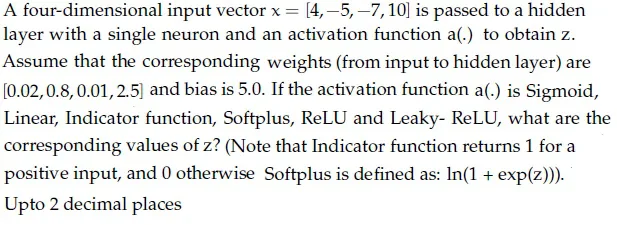
Based on the above data, answer the given subquestions.
Q23NAT1 Mark·Write the numberEnd Term · 31 Aug 2025 (AN)Key ↓Sigmoid ______________
Your answer:- Q24NAT1 Mark·Write the numberEnd Term · 31 Aug 2025 (AN)Key ↓
Linear ______________
Your answer: - Q25NAT1 Mark·Write the numberEnd Term · 31 Aug 2025 (AN)Key ↓
Indicator Function ______________
Your answer: - Q26NAT1 Mark·Write the numberEnd Term · 31 Aug 2025 (AN)Key ↓
Softplus _____________
Your answer: - Q27NAT1 Mark·Write the numberEnd Term · 31 Aug 2025 (AN)Key ↓
ReLU _______________
Your answer: - Q28NAT1 Mark·Write the numberEnd Term · 31 Aug 2025 (AN)Key ↓
Leaky-ReLU _____________
Your answer: Read the passage below, then answer Q29–Q34
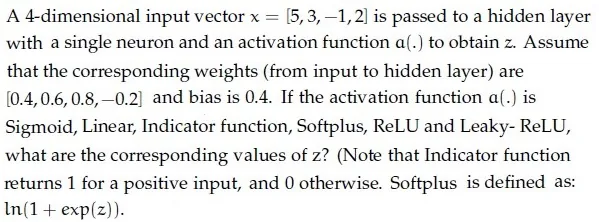
Based on the above data, answer the given subquestions.
Q29NAT1 Mark·Write the numberEnd Term · 31 Aug 2025 (FN)Key ↓Sigmoid _______________
Your answer:- Q30NAT1 Mark·Write the numberEnd Term · 31 Aug 2025 (FN)Key ↓
Linear _______________
Your answer: - Q31NAT1 Mark·Write the numberEnd Term · 31 Aug 2025 (FN)Key ↓
Indicator Function _______________
Your answer: - Q32NAT1 Mark·Write the numberEnd Term · 31 Aug 2025 (FN)Key ↓
Softplus _______________
Your answer: - Q33NAT1 Mark·Write the numberEnd Term · 31 Aug 2025 (FN)Key ↓
ReLu _______________
Your answer: - Q34NAT1 Mark·Write the numberEnd Term · 31 Aug 2025 (FN)Key ↓
Leaky-ReLu _______________
Your answer: - Q35MCQ2 Marks·Choose one optionQuiz 1 · 26 Oct 2025 (AN)Key ↓

- A0.9829, 4.05, 1, 4.0673, 4.05, 4.05
- B0.8808, 3.50, 1, 3.54, 3.50, 3.50
- C0.7311, 2.00, 1, 2.13, 2.00, 2.00
- D0.5000, 0.00, 0, 0.69, 0.00, 0.00
Type 3 · asked 4 times · Neural networks & training
Backpropagation: compute de/da and de/db for a small graph
Read the passage below, then answer Q36–Q37
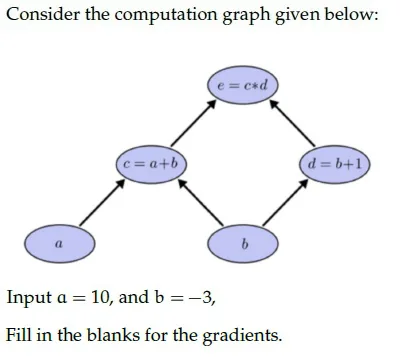
Based on the above data, answer the given subquestions.
Q36NAT1 Mark·Write the numberEnd Term · 31 Aug 2025 (AN)Key ↓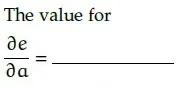 Your answer:
- Q37NAT1 Mark·Write the numberEnd Term · 31 Aug 2025 (AN)Key ↓
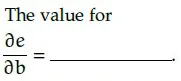 Your answer:
 Read the passage below, then answer Q38–Q39
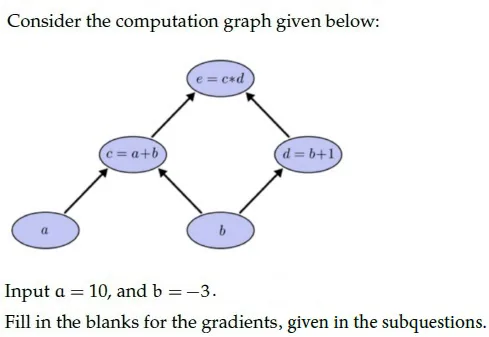 Q38NAT1 Mark·Write the numberEnd Term · 31 Aug 2025 (FN)Key ↓
 Your answer:
- Q39NAT1 Mark·Write the numberEnd Term · 31 Aug 2025 (FN)Key ↓
 Your answer:
Type 4 · asked 4 times · RNNs, attention & transformers
True/false on attention in BiRNNs, captioning and transformers
- Q40MCQ2 Marks·Choose one optionQuiz 2 · 3 Aug 2025 (AN)Key ↓
Which one of the following statements is True?
- AAttention mechanisms can be applied to the bidirectional RNN model
- BAn image captioning network cannot be trained end-to-end even though we are using 2 different modalities to train the network
- COne of the key components in the vanilla transformer are the recurrent connections that help them to deal with variable input length.
- DAll of these.
- Q41MCQ2 Marks·Choose one optionQuiz 2 · 3 Aug 2025 (AN)Key ↓
Which one of the following statements is false? (Pick the most appropriate one.)
- AAttention mechanisms cannot be applied to the bidirectional RNN model
- BAn image captioning network cannot be trained end-to-end even though we are using 2 different modalities to train the network
- COne of the key components in the vanilla transformer is the recurrent connection that help them to deal with variable input length.
- DAll of these
- Q42MCQ2 Marks·Choose one optionEnd Term · 31 Aug 2025 (AN)Key ↓
Which one of the following statements is false? (Pick the most appropriate one.)
- AAttention mechanisms can be applied to the bidirectional RNN model
- BAn image captioning network can be trained end-to-end even though we are using 2 different modalities to train the network
- COne of the key components in the vanilla transformer is the recurrent connection that help them to deal with variable input length.
- DAll of these.
- Q43MCQ2 Marks·Choose one optionEnd Term · 31 Aug 2025 (FN)Key ↓
Which one of the following statements is true?
- AAttention mechanisms cannot be applied to the bidirectional RNN model
- BAn image captioning network cannot be trained end-to-end even though we are using 2 different modalities to train the network
- COne of the key components in the vanilla transformer are the recurrent connections that help them to deal with variable input length.
- DNone of these
Type 5 · asked 3 times · Image processing & filtering
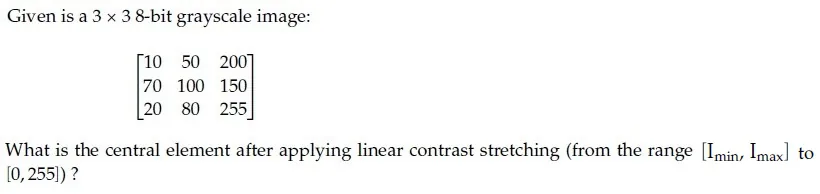
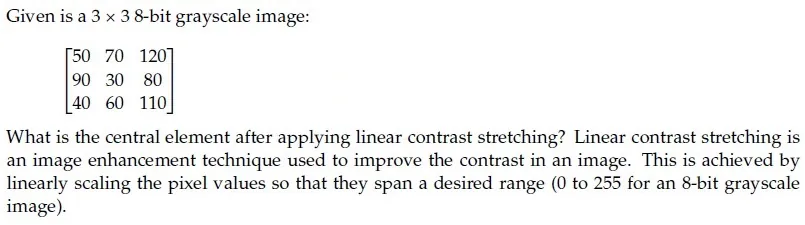
Apply linear contrast stretching to a small grayscale image

Type 6 · asked 3 times · Image processing & filtering
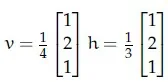
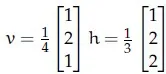
Separate a 2D kernel into 1D kernels / pick separable kernels

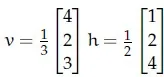
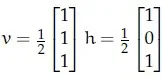

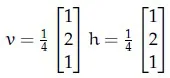
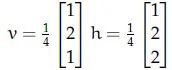
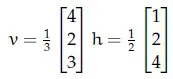
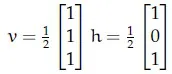


Type 7 · asked 3 times · Edges, corners & SIFT features
Match Gaussian, Sobel and derivative-of-Gaussian filters to their roles
- Q50MCQ2 Marks·Choose one optionEnd Term · 31 Aug 2025 (AN)Key ↓
You are designing an edge detection pipeline for noisy grayscale images. For each of the following goals, choose the most appropriate filter or method: 1. Smooth out noise before any edge detection step 2. Detect edges by finding zero-crossings in the second derivative 3. Highlight regions with a strong intensity gradient 4. Perform basic edge detection with a simple directional gradient filter
- A1 → Gaussian filter, 2 → Laplacian of Gaussian, 3 → First derivative of Gaussian, 4 → Sobel operator
- B1 → Sobel operator, 2 → Gaussian filter, 3 → Laplacian of Gaussian, 4 → First derivative of Gaussian
- C1 → First derivative of Gaussian, 2 → Sobel operator, 3 → Gaussian filter, 4 → Laplacian of Gaussian
- D1→Laplacian of Gaussian, 2→First derivative of Gaussian, 3→Sobel operator, 4→Gaussian filter
- Q51MCQ2 Marks·Choose one optionEnd Term · 31 Aug 2025 (FN)Key ↓
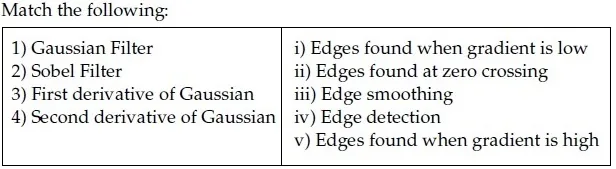
- A1→ iii, 2→ iv, 3→ i, 4 → ii
- B1→ iii, 2→ i, 3 → ii, 4 → v
- C1→ iii, 2→ iv, 3→ v, 4 → ii
- D1→ iv, 2→ iii, 3→ i, 4 → ii
- Q52MCQ2 Marks·Choose one optionQuiz 1 · 26 Oct 2025 (AN)Key ↓
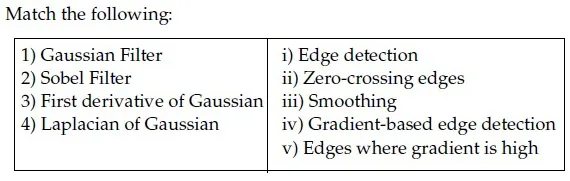
- A1→iii, 2→i, 3→v, 4→iv
- B1→i, 2→iii, 3→v, 4→ii
- C1→iii, 2→iv, 3→v, 4→ii
- D1→iii, 2→iv, 3→ii, 4→v
Type 8 · asked 3 times · Neural networks & training
One momentum gradient descent update of a parameter


 NOTE: Enter your answer in three decimal places.
Type 9 · asked 3 times · CNN layers & architectures
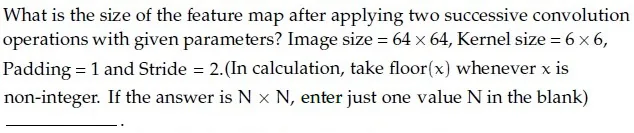
Feature map size after two successive convolutions
- Q56NAT2 Marks·Write the numberEnd Term · 31 Aug 2025 (AN)Key ↓
What is the size of the feature map after applying two successive convolution operations with given parameters? Image size = 72×72, Kernel size = 5×5, Padding = 2 and Stride = 3. (In calculation, take floor(x) whenever x is non-integer.If the answer is N × N, write just one value N in the blank) __________________ .
Your answer: - Q57NAT2 Marks·Write the numberEnd Term · 31 Aug 2025 (FN)Key ↓
 Your answer:
 - Q58NAT3 Marks·Write the numberQuiz 1 · 26 Oct 2025 (AN)Key ↓
Two successive convolutions each with: kernel 7 x 7, padding 3, stride 2. Input is 100 x 100. The final feature-map side length F is _________________.
Your answer:
Type 10 · asked 3 times · RNNs, attention & transformers
Techniques that fix vanishing/exploding gradients in RNNs
- Q59MCQ2 Marks·Choose one optionQuiz 2 · 3 Aug 2025 (AN)Key ↓
Which of the following techniques help mitigate the vanishing gradient problem in recurrent neural networks? 1. Gradient clipping 2. Use of ReLU activation to preserve gradient flow 3. Use of LSTM units 4. Data augmentation (e.g., reversing input sequence)
- A1 and 2 only
- B2 and 3 only
- C3 and 4 only
- D1, 2, and 3 only
- Q60MCQ2 Marks·Choose one optionQuiz 2 · 3 Aug 2025 (AN)Key ↓
Which of the following techniques help mitigate the exploding gradient problem in recurrent neural networks? 1. Gradient clipping 2. Use of Sigmoid activation to prevent gradient growth 3. Use of LSTM units 4. Data augmentation (e.g., reversing input sequence)
- A1 and 2 only
- B1 and 3 only
- C1, 2, and 3
- DAll of these
- Q61MSQ2 Marks·Choose all correct optionsEnd Term · 31 Aug 2025 (FN)Key ↓
Which of the following techniques help control the exploding or vanishing gradient problem in recurrent neural networks?
- AGradient clipping
- BUse ReLU activation funtion to control exploding gradient and sigmoid activation to control vanishing gradients
- CUse Long Short-Term Memory (LSTM)
- DUse data augmentation methods (for example, reversing the input sequence)
Type 11 · asked 2 times · Image processing & filtering
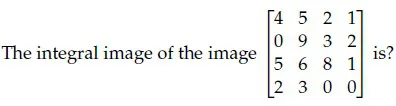
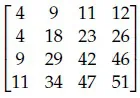
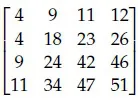
Compute an integral image or recover pixel values from it
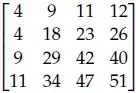
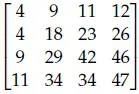
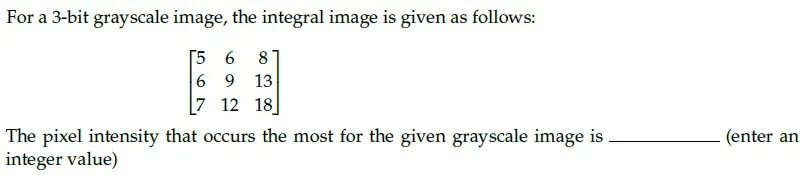
Type 12 · asked 2 times · Image processing & filtering
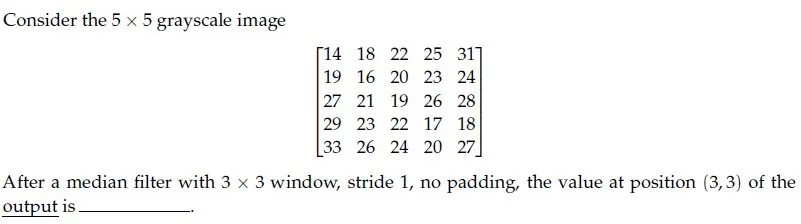
Apply a 3x3 median filter and find the output value at a position
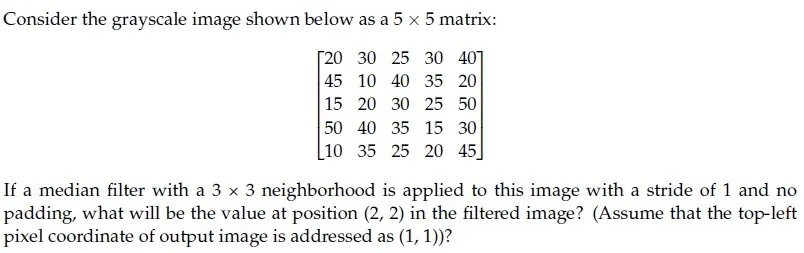
Type 13 · asked 2 times · Image processing & filtering
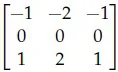
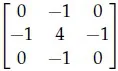
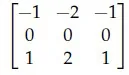
Pick the high-pass filters from given 3x3 kernels



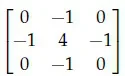

Type 14 · asked 2 times · Edges, corners & SIFT features
Order the steps of the Canny edge detector
- Q68MCQ2 Marks·Choose one optionEnd Term · 31 Aug 2025 (FN)Key ↓
Identify the correct sequence of steps in a Canny edge detection pipeline. Steps are listed below: 1. Compute gradient magnitude and direction 2. Connect individual components 3. Smoothen the image 4. Threshold into strong, weak, or no edge 5. Gaussian Filter and Hysteresis 6. Non-maximum suppression 7. Apply derivative to get edges
- A6→ 1→ 4→ 5 → 2
- B3→ 1→ 6→ 4 → 2
- C3→ 5→ 1→ 4 → 2
- D6→ 3→ 5→ 7 → 2
- Q69MCQ2 Marks·Choose one optionQuiz 1 · 26 Oct 2025 (AN)Key ↓
Choose the correct sequence for Canny edge detection: 1. Smooth with Gaussian 2. Compute gradient magnitude & direction 3. Non-maximum suppression 4. Double thresholding (strong/weak) 5. Edge tracking by hysteresis
- A2 → 1 → 3 → 4 → 5
- B1 → 2 → 3 → 4 → 5
- C1 → 3 → 2 → 4 → 5
- D3 → 1 → 2 → 5 → 4
Type 15 · asked 2 times · Edges, corners & SIFT features
Order the stages of the SIFT algorithm
- Q70MCQ2 Marks·Choose one optionEnd Term · 31 Aug 2025 (FN)Key ↓
Which of the following is the correct sequence of steps of the SIFT algorithm? 1. Using the Taylor series expansion of the scale-space function, lo-calize the key points. 2. Estimate the orientation of keypoints using the local image gra-dients. 3. Find the edge points using the eigenvalues of the Hessian and reject these points. 4. Find a raw SIFT descriptor vector using the gradient orientations of the neighborhood around the key points. 5. Detect extreme points in scale space using an approximation of the Laplacian of Gaussian.
- A5, 2, 1, 3, 4
- B5, 1, 3, 2, 4
- C1, 3, 2, 4, 5
- D1, 5, 3, 2, 4
- Q71MCQ2 Marks·Choose one optionQuiz 1 · 26 Oct 2025 (AN)Key ↓
Correct order of SIFT stages is:
- AOrientation→ Descriptor → Localization → Extrema Detection
- BExtrema Detection → Localization→ Orientation→ Descriptor
- CExtrema Detection → Descriptor → Localization → Orientation
- DNone of these
Type 16 · asked 2 times · Edges, corners & SIFT features
Match LoG, scale-invariant detection, texture and Gabor filter
- Q72MCQ2 Marks·Choose one optionEnd Term · 31 Aug 2025 (AN)Key ↓
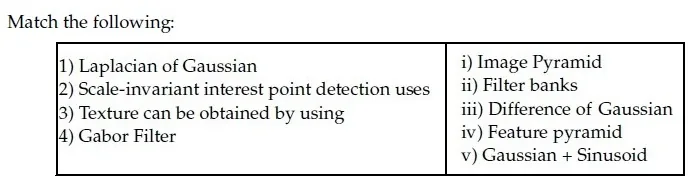
- A1→ iii, 2→ iv, 3→ ii, 4 → i
- B1→ i, 2→ iv, 3 → iii, 4→ ii
- C1→ iv, 2→ iii, 3→ ii, 4 → i
- D1→ iii, 2→ i, 3 → ii, 4 →v
- Q73MCQ2 Marks·Choose one optionEnd Term · 31 Aug 2025 (FN)Key ↓
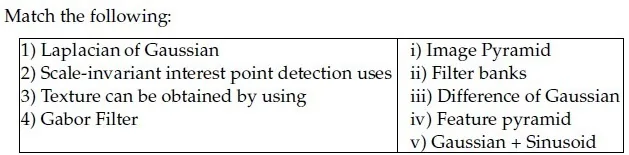
- A1→ iii, 2→ iv, 3→ ii, 4 → i
- B1→ i, 2→ iv, 3 → iii, 4→ ii
- C1→ iv, 2→ iii, 3→ ii, 4 → i
- D1→ iii, 2→ i, 3 → ii, 4 →v
Type 17 · asked 2 times · Neural networks & training
Match activation functions to their derivatives
- Q74MCQ2 Marks·Choose one optionEnd Term · 31 Aug 2025 (FN)Key ↓
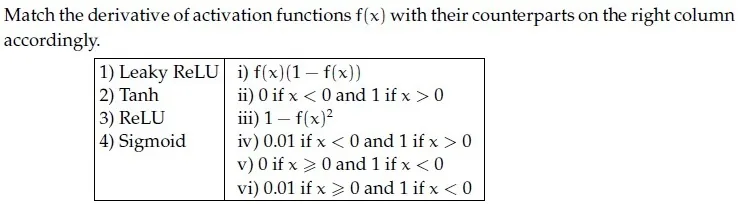
- A1→ vi, 2→ iii, 3 →v, 4 → i
- B1→ i, 2→ iv, 3 → iii, 4→ ii
- C1→ i, 2→ v, 3 → iii, 4→ iv
- D1→ iv, 2→ iii, 3→ ii, 4 → i
- Q75MCQ2 Marks·Choose one optionQuiz 1 · 26 Oct 2025 (AN)Key ↓
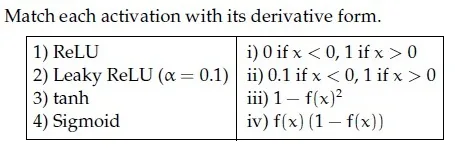
- A1→ii, 2→i, 3→iii, 4→iv
- B1→i, 2→ii, 3→iii, 4→iv
- C1→i, 2→iv, 3→ii, 4→iii
- D1→iv, 2→ii, 3→i, 4→iii
Type 18 · asked 2 times · Neural networks & training
False statement about hyperparameter tuning with train/val/test sets
- Q76MCQ2 Marks·Choose one optionEnd Term · 31 Aug 2025 (AN)Key ↓
Which one of the following statements regarding hyperparameter tuning is false?
- AValidation set is the best choice for tuning hyperparameters
- BPicking hyperparameters that perform the best on the training set leads to overfitting
- CTuning hyperparameters on the test set is an acceptable approach to find the most powerful model for generalization performance
- DTest set performance, with hyperparameters tuned on the validation set, would be a realistic measure of how the model will generalize to new data.
- Q77MCQ2 Marks·Choose one optionEnd Term · 31 Aug 2025 (FN)Key ↓
Which one of the following statements regarding hyperparameter tuning is false?
- AValidation set is the best choice for tuning hyperparameters
- BPicking hyperparameters that perform the best on the training set leads to overfitting
- CTuning hyperparameters on the test set is an acceptable approach to find the most powerful model for generalization performance
- DTest set performance, with hyperparameters tuned on the validation set, would be a realistic measure of how the model will generalize to new data.
Type 19 · asked 2 times · Neural networks & training
Statements on early stopping, L1 vs L2, dropout and McCulloch-Pitts
- Q78MSQ2 Marks·Choose all correct optionsEnd Term · 31 Aug 2025 (AN)Key ↓
Which one of the following statements is true:
- AWeight change criterion is a method of ‘early stopping’ that checks whether or not the error is dropping over epochs to decide whether to continue training or stop.
- BL1 norm tends to create more sparse weights than L2 norm.
- CDuring the training phase, for each iteration, Dropout ignores a random fraction, p, of nodes, and accounts for it in the test phase by scaling down the activations by a factor of p.
- DA single McCulloch-Pitts neuron is capable of modeling AND, OR, XOR, NOR, and NAND functions.
- Q79MSQ2 Marks·Choose all correct optionsEnd Term · 31 Aug 2025 (FN)Key ↓
Which one of the following statements is true:
- AWeight change criterion is a method of ‘early stopping’ that checks whether or not the error is dropping over epochs to decide whether to continue training or stop.
- BL1 norm tends to create more sparse weights than L2 norm.
- CDuring the training phase, for each iteration, Dropout ignores a random fraction, p, of nodes, and accounts for it in the test phase by scaling down the activations by a factor of p.
- DA single McCulloch-Pitts neuron is capable of modeling AND, OR, XOR, NOR, and NAND functions.
Type 20 · asked 2 times · CNN layers & architectures
Count the parameters of a standard convolution layer
Read the passage below, then answer Q80
Let input have size D_f × D_f × M where D_f = 10 and M = 256 and output feature map (after passing input through conv layer) has D_f × D_f × N size where N = 512. Assume padded convolution. Let width of the square kernel in conv layer be k where k = 7 (Ignore the bias term in the calculation). Calculate the number of parameters and computational cost for this convolution layer. Based on the above data, answer the given subquestions.
Q80NAT2 Marks·Write the numberQuiz 2 · 3 Aug 2025 (AN)Key ↓Number of Parameters:_____________
Your answer:- Q81NAT3 Marks·Write the numberQuiz 1 · 26 Oct 2025 (AN)Key ↓
 Your answer:
Type 21 · asked 2 times · CNN layers & architectures
AlexNet statements on response normalization and conv parameters
- Q82MCQ2 Marks·Choose one optionQuiz 2 · 3 Aug 2025 (AN)Key ↓
Consider the following statements P and Q regarding AlexNet and choose the correct option: (P) In AlexNet, a trainable Local Response Normalization Layers were introduced to emulate the competitive nature of real neurons, where highly active neurons suppress the activity of neighboring neurons, creating competition among different kernel outputs. (Q) In AlexNet, a total of 8 Convolutional layers contain only about 6-7% of the total parameters hence account for the least computation.
- AOnly statement P is true
- BOnly statement Q is true
- CBoth statements are true
- DNone of these statements is true
- Q83MCQ2 Marks·Choose one optionEnd Term · 31 Aug 2025 (FN)Key ↓
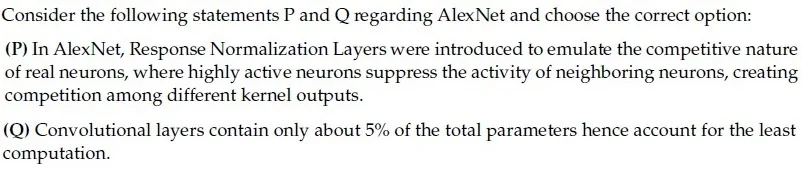
- AOnly statement P is true
- BOnly statement Q is true
- CBoth statements are true
- DNone of these statements is true
Type 22 · asked 2 times · Object detection & segmentation
Match YOLO, SSD, RetinaNet and SegNet to their key ideas
- Q84MCQ2 Marks·Choose one optionEnd Term · 31 Aug 2025 (AN)Key ↓
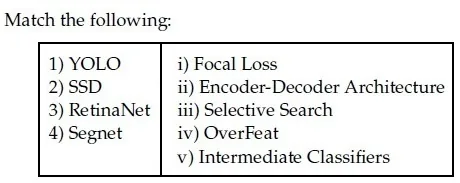
- A1→ iv, 2→ v, 3→ i, 4 → ii
- B1→ iii, 2→ i, 3 → v, 4→ ii
- C1→ iv, 2→ iii, 3→ ii, 4 → i
- D1→ iii, 2→ i, 3 → ii, 4→ v
- Q85MCQ2 Marks·Choose one optionEnd Term · 31 Aug 2025 (FN)Key ↓
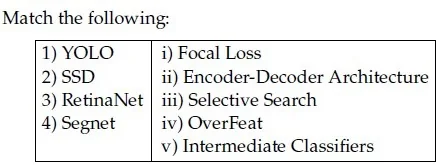
- A1→ iv, 2→ v, 3→ i, 4 → ii
- B1→ iii, 2→ i, 3 → v, 4→ ii
- C1→ iv, 2→ iii, 3→ ii, 4 → i
- D1→ iii, 2→ i, 3 → ii, 4→ v
Type 23 · asked 2 times · Object detection & segmentation
Why DETR performs poorly on small objects
- Q86MCQ2 Marks·Choose one optionEnd Term · 31 Aug 2025 (AN)Key ↓
Why does DETR typically exhibit poor performance in detecting small objects compared to larger ones? Choose the best answer in your opinion.
- AThe CNN backbone used in DETR has a fixed receptive field that’s too large for small objects.
- BThe global self-attention mechanism in DETR tends to dilute the signal from small objects across all image locations.
- CDETR’s loss function actively discards all detections smaller than 50 × 50 pixels.
- DThe object queries in DETR are programmed to ignore any object smaller than 10% of the image size.
- EDETR’s encoder-decoder architecture was specifically designed to only detect objects larger than a cat.
- Q87MCQ2 Marks·Choose one optionEnd Term · 31 Aug 2025 (FN)Key ↓
Why does DETR typically exhibit poor performance in detecting small objects compared to larger ones?
- AThe CNN backbone used in DETR has a fixed receptive field that’s too large for small objects
- BThe global self-attention mechanism in DETR tends to dilute the signal from small objects across all image locations
- CDETR’s loss function actively discards all detections smaller than 50x50 pixels
- DThe object queries in DETR are programmed to ignore any object smaller than 10
- EDETR’s encoder-decoder architecture was specifically designed to only detect large objects
Type 24 · asked 2 times · Object detection & segmentation
Why Segment Anything (SAM) helps data annotation
- Q88MCQ2 Marks·Choose one optionEnd Term · 31 Aug 2025 (AN)Key ↓
Why might Segment Anything (SAM) be particularly useful in data annotation tasks compared to traditional segmentation models?
- AIt produces perfect segmentation masks.
- BIt can adapt to segment any object, even those not seen during training
- CIt requires less computational resources
- DIt automatically labels all objects in an image without user input
- Q89MCQ2 Marks·Choose one optionEnd Term · 31 Aug 2025 (FN)Key ↓
What makes the Segment Anything Model (SAM) particularly advantageous for image annotation tasks compared to conventional segmentation approaches?
- AIt has perfect segmentation accuracy
- BIt has minimal hardware requirements for operation
- CIt can generalize to segment objects it wasn’t specifically trained on
- DIt automatically identifies and labels all objects in an image without user prompts
Type 25 · asked 2 times · RNNs, attention & transformers
Match RNN architectures (many-to-one etc.) to applications
- Q90MCQ2 Marks·Choose one optionQuiz 2 · 3 Aug 2025 (AN)Key ↓
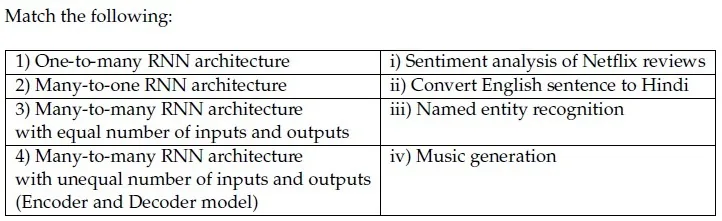
- A

- B

- C

- D

- A
- Q91MCQ2 Marks·Choose one optionEnd Term · 31 Aug 2025 (AN)Key ↓
In which one of the following applications would you use a many- to-one RNN architecture? Choose the most appropriate answer.
- AInput is a review of a movie and output is the sentiment of the given review
- BInput is an image and output is the textual description of the given image
- CInput is an image and output is the class to which the given image belongs
- DInput is a sentence in English language and output is the same sentence translated to Hindi language
Type 26 · asked 2 times · Generative models
True/false statements on VAE, GAN and StyleGAN
- Q92MSQ2 Marks·Choose all correct optionsEnd Term · 31 Aug 2025 (AN)Key ↓
Which of the following statements are true? (Select all possible correct options)
- AVariational AutoEncoders (VAE) generate sharper images compared to Generative adversarial networks (GANs)
- BGAN is an example of an implicit density estimation model
- CFully connected layers in mapping network of Style-GAN change the dimension of its input
- DIn a GAN, the generator and discriminator are trained in an alternating fashion, each using the other’s output to improve.
- Q93MSQ2 Marks·Choose all correct optionsEnd Term · 31 Aug 2025 (FN)Key ↓
Which of the following statements are false? (Select all that apply)
- AGenerative adversarial networks (GANs) generate sharper images compared to Variational AutoEncoders (VAE)
- BGAN is an example of an implicit density estimation model
- CFully connected layers in mapping network of Style-GAN do not change the dimension of its input
- DThe generator and discriminator are always trained together in a GAN
Type 27 · asked 2 times · Generative models
True/false on autoencoders, PCA, attention and positional encoding
- Q94MSQ2 Marks·Choose all correct optionsEnd Term · 31 Aug 2025 (AN)Key ↓
Which of the following statements are true? (Select all possible correct options)
- AAutoencoder are equivalent to Principal Component Analysis (PCA) provided we don’t use of non-linear activation functions
- BWhen using global attention on temporal data, alignment weights are learnt for encoder hidden representations for all time steps
- CPositional encoding is an important component of the trans- former architecture as it conveys information about order in a given sequence
- DIt is not possible to generate different captions for the same image that have similar meaning but different tone/style
- EAutoencoders can not be used for data compression as its input and output dimensions are different
- Q95MSQ2 Marks·Choose all correct optionsEnd Term · 31 Aug 2025 (FN)Key ↓
Which of the following statements are true? (Select all possible correct options)
- AAutoencoder are equivalent to Principal Component Analysis (PCA) provided we don’t use of non-linear activation functions
- BWhen using global attention on temporal data, alignment weights are learnt for encoder hidden representations for all time steps
- CPositional encoding is an important component of the transformer architecture as it conveys information about order in a given sequence
- DIt is not possible to generate different captions for the same image that have similar meaning but different tone/style
- EAutoencoders can not be used for data compression as its input and output dimensions are different
Type 28 · asked 2 times · Vision-language: CLIP & BLIP
True/false statements about CLIP training and use
- Q96MSQ2 Marks·Choose all correct optionsEnd Term · 31 Aug 2025 (AN)Key ↓
Which of the following statements about CLIP are TRUE? (Select ALL that apply)
- ACLIP uses a cross-entropy loss function to align text and image embeddings.
- BCLIP requires image labels for training.
- CCLIP is trained to maximize cosine similarity between embeddings of matching text-image pairs.
- DCLIP model is trained with pretext tasks such as rotation prediction and inpainting to learn effective feature representations.
- ETo use the CLIP model for image classification, it is imperative to finetune it on downstream datasets.
- Q97MSQ2 Marks·Choose all correct optionsEnd Term · 31 Aug 2025 (FN)Key ↓
Which of the following statements about CLIP are TRUE? (Select ALL that apply)
- ACLIP uses a contrastive loss function to align text and image embeddings.
- BCLIP requires image labels for training.
- CCLIP is trained to maximize cosine similarity between embeddings of matching text-image pairs.
- DCLIP model is trained with pretext tasks such as rotation prediction and inpainting to learn effective feature representations.
- ETo use the CLIP model for image classification, it is imperative to finetune it on downstream datasets.
Type 29 · asked 2 times · Generative models
Diffusion reverse process: steps to reduce noise variance


Type 30 · asked 2 times · Generative models
Diffusion forward process: total noise variance with linear beta


Official KeyMaster Answer Key & Explanations
Official answer keys from IIT Madras BS past papers. Click any question to review.
Reveal KeyCollapse Key
Master Answer Key & Explanations
Official answer keys from IIT Madras BS past papers. Click any question to review.