Indian Institute of Technology Madras
BS Degree Programme · Examination & Study Paper
BSHS1001 · English I
Reading comprehension
Examination Instructions & Guidelines
- Solve on notebook/paper first before checking solutions.
- MCQ: Exactly 1 option is correct. Negative marking applies.
- Scientific calculator allowed for all calculations.
- Official answer key is sealed at the end of this sheet.
Quiz 1 · 26 Oct 2025 (AN)Quiz 1
Read the passage below, then answer Q1–Q7
Read the following passage and answer the given subquestions.
My father, Janakinath Bose, had migrated to Orissa in the eighties of the last century and had settled down at Cuttack as a lawyer. There I was born on Saturday, the 23rd January, 1897. My father was descended from the Boses of Mahinagar, while my mother, Prabhabati (or rather Prabhavati) belonged to the family of the Dutts of Hatkhola. I was the sixth son and the ninth child of my parents.
In these days of rapid communication, a night’s journey by train southwards along the eastern coast takes one from Calcutta to Cuttack and on the way there is neither adventure nor romance. But things were not quite the same sixty years ago. One had to go either by cart and encounter thieves and robbers on the road, or by sea and brave the wrath of the winds and the waves. Since it was safer to trust in God than in brother man, it was more common to travel by boat. Sea-going vessels would carry passengers up to Chandbali where transhipment would take place and from Chandbali, steamers would get to Cuttack through a number of rivers and canals. The description I used to hear from my mother since childhood of the rolling and pitching and the accompanying discomfort during the voyage would leave no desire in me to undergo such an experience. At a time when distances were long and journey by no means safe, my father must have had plenty of pluck to leave his village home and go far away in search of a career. Fortune favours the brave even in civil life and, by the time I was born, my father had already made a position for himself and was almost at the top of the legal profession in his new domicile.
Though a comparatively small town with a population in the neighbourhood of 20,000, Cuttack had an importance of its own owing to a variety of factors. It had an unbroken tradition since the days of the early Hindu Kings of Kalinga. It was the de facto capital of Orissa which could boast of such a famous place of pilgrimage as Puri (or Jagannath) and such glorious art-relics as those of Konarak, Bhuvaneswar, and Udaigiri. It was the headquarters not only for the British administration in Orissa, but also for the numerous ruling chiefs in that province. Altogether, Cuttack afforded a healthy environment for a growing child, and it had some of the virtues of both city and country life.
Ours was not a rich, but what might be regarded as a well-to-do, middle-class family. Naturally, I had no personal experience of what want and poverty meant and had no occasion to develop those traits of selfishness, greed, and the rest which are sometimes the unwelcome heritage of indigent circumstances in one’s early life. At the same time, there was not that luxury and lavishness _____ our home which has been the ruin _____ so many promising but pampered young souls or has helped to foster a supercilious, highbrow mentality in them. In fact, considering their worldly means, my parents always erred– and, I daresay, rightly too– on the side of simplicity in the upbringing of their children.
Excerpted from: Bose, Subhas Chandra. An Indian Pilgrim: An Unfinished Autobiography and Collected Letters 1897-1921.
Q1MCQ2 Marks·Choose one optionIn the sentence given below, the word in bold is used as _____. Naturally, I had no personal experience of what want and poverty meant.
- AA verb
- BA noun
- CAn adverb
- DAn adjective
- Q2MCQ2 Marks·Choose one option
What was the vocation of the narrator’s father?
- ALawyer
- BDoctor
- CMerchant
- DTeacher
- Q3MCQ2 Marks·Choose one option
Indigent means _____.
- AVery rich
- BVery skilled
- CVery angry
- DVery poor
- Q4MCQ2 Marks·Choose one option
Which, according to the passage, is NOT a glorious art-relic that Orissa could boast of?
- AKonarak
- BBhuvaneswar
- CChandbali
- DUdaigiri
- Q5MCQ2 Marks·Choose one option
Choose the incorrect statement.
- AThe narrator’s father was one of the top lawyers in Cuttack
- BHearing stories of boat journeys from his mother, the narrator had a strong desire to go on a voyage
- CThe narrator came from a well-to-do, middle-class family
- DCuttack afforded a healthy environment for a growing child
- Q6MCQ2 Marks·Choose one option
At a time when distances were long and journey by no means safe, my father must have had plenty of pluck to leave his village home and go far away in search of a career. What does the word in bold mean in this context?
- APoverty and desperation
- BCourage and determination
- CHunger and hardship
- DLove and support
- Q7MCQ2 Marks·Choose one option
Fill in the blanks with appropriate prepositions. At the same time, there was not that luxury and lavishness _____ our home which has been the ruin _____ so many promising but pampered young souls or has helped to foster a supercilious, highbrow mentality in them.
- Ain…of
- Bon…in
- Cof…at
- Dwith…through
End Term · 31 Aug 2025 (FN)End Term
Read the passage below, then answer Q8–Q17
Read the following passage and answer the given subquestions:
During the Depression, when milk supply exceeded demand, the US government bought milk to keep its price stable and support dairy farmers. Then, trying to find a way to store or get rid of the surplus, it started stockpiling cheese, which lasts longer than milk.
The government bought so much cheese that it eventually filled every cold storage in the country. But there was still more excess milk. The US Department of Agriculture (USDA) rented half an acre in a Kansas cave and filled it floor to ceiling with blocks of cheese. At its height, the US had 2lbs of stored cheese for every resident.
Eventually, the USDA turned to its nutrition programs to dispose of excess cheese. Despite most Indigenous peoples’ inability to digest milk, commodity cheese became the centerpiece of the Food Distribution Program on Indian Reservations (FDPIR). Musician Wade Fernandez, a member of the Menominee nation, sings Commodity Cheese Blues, lamenting, “I went downtown to the commod shop / Met the blues ’cause they were out of stock. Tell me please when I’ll get my commod cheese.”
Nicknamed “pasteurized gold”, the bright orange cheese bricks sometimes operate as currency to buy other foods or goods. The irony of this treasure is not lost on critics. In 2006, an Indian Country Today article observed: “Some Lakota still say to this day that the only brick of gold the Lakota people got out of the Black Hills is the brick of cheese rationed out on commodity day.” Funneling surplus cheese into nutrition programs like FDPIR and school lunches was not enough to save the dairy industry, which accounts for 3.5% of the US gross domestic product – half a percentage more than the auto industry. President Jimmy Carter vowed to increase the price of milk by six cents a gallon in 1977 and committed to buying as much dairy as necessary to prop up the industry. When government-purchased cheese began to mold, the plan to get it out of storage became urgent.
In 1981, a USDA official told the Washington Post: “We’ve looked and looked at ways to deal with this, but the distribution problems are incredible ... Probably the cheapest and most practical thing would be to dump it in the ocean.”
Instead, President Reagan’s administration came up with a way to solve the problem without affecting the demand for or price of cheese. It created the Dairy Distribution Program, sending truckloads of cheese blocks to poor neighborhoods around the country.
Inevitably, government cheese entered popular culture as a marker of poverty.
Q8MCQ2 Marks·Choose one optionThe USDA filled a Kansas cave with excess cheese.
- ATrue
- BFalse
- Q9MCQ2 Marks·Choose one option
Eventually, the USDA turned to its _____ to dispose of excess cheese.
- AOverseas programs
- BPasteurization programs
- CNutrition programs
- DKansas programs
- Q10MCQ2 Marks·Choose one option
Commodity cheese became the centerpiece of the Food Distribution Program on Indian Reservations (FDPIR) despite _____.
- AMost Indigenous peoples' ability to digest milk
- BMost Indigenous peoples' inability to digest milk
- CThe abundance of indigenous varieties of cheese already available to them
- DThe cheese bricks being bright orange in colour
- Q11MCQ2 Marks·Choose one option
Commodity cheese is sometimes used as currency to buy other foods or goods.
- ATrue
- BFalse
- Q12MCQ2 Marks·Choose one option
What was the purpose of President Carter’s 1977 plan regarding dairy products?
- ATo increase the price of milk
- BTo export excess dairy products
- CTo decrease the amount of dairy in the market
- DTo eliminate cheese production
- Q13MCQ2 Marks·Choose one option
Which of the following is a major criticism against President Reagan's Dairy Distribution Program?
- AIt increased cheese prices too much.
- BIt was ineffective in improving dairy industry conditions.
- CIt led to the perception of government cheese as a symbol of poverty.
- DIt led to widespread health issues.
- Q14MCQ2 Marks·Choose one option
What is the main purpose of the paragraph describing the use of cheese in FDPIR?
- ATo explain the nutritional benefits of cheese.
- BTo show how excess cheese was utilized despite its poor fit with Indigenous diets.
- CTo highlight the popularity of cheese among Indigenous peoples.
- DTo describe the process of cheese distribution.
- Q15MCQ2 Marks·Choose one option
The irony of this treasure is not lost on critics. What is the definition of "irony"?
- AThe use of exaggerated statements to express strong feelings.
- BA situation where the opposite of what is expected occurs.
- CA direct and sincere statement of one's true thoughts.
- DA comparison using "like" or "as".
- Q16MCQ2 Marks·Choose one option
What problem did the USDA face with the government-purchased cheese that began to mold?
- ADifficulty in transportation
- BDifficulty in distribution
- CLow cheese quality
- DHigh cheese production costs
- Q17MCQ2 Marks·Choose one option
What did the Indian Country Today article observe about the cheese?
- AIt was a high-quality product
- BIt was seen as a valuable commodity
- CIt was considered a valuable resource in exchange for gold
- DIt was a disappointing substitute for gold
Read the passage below, then answer Q18–Q27
Read the following passage and answer the given subquestions
In the village of Chandpur, Munshi Ramsevak was a very rich man and he was full of all the special qualities of very rich men. The foibles of human nature provided the foundation of his living. He could be seen every day seated on a broken bench under a neem tree within the precincts of the open-air small-pleas court, his satchel crammed with papers opened up in front of him. Nobody had ever seen him presenting a brief before the tribunal or arguing a case; but everyone called him ‘attorney’. It might blow up a storm, rain or hail, but the attorney could not be budged from his bench. Whenever he made his way to the open court the villagers crowded after him. He was regarded by everyone with respect and trust, and he was renowned for possessing the eloquence of the divine Saraswati herself. Call it an attorneyship or a legal practice, but it was only maintaining a family tradition. He had no very great income; people might talk about silver coins but even copper coins rarely came his way. Though there was no doubt about Ramsevak’s legal knowledge, he was compelled by complications to forgo a real lawyer’s job. Anyway, whatever it was, his profession was kept up only for the sake of continuing the family tradition. In actual fact his real means of livelihood was provided by widows without family but rich in the good things of life and by old men with lots of money and little sense. The widows handed over their money to him for safe-keeping and old men who feared their wastrel sons entrusted their wealth to him. But once any money went into his fist it forgot the way to come out again. When the need arose he himself would borrow — after all, without borrowing whose work would make any headway? He borrowed in the morning to give back by evening, but the evening never came. In brief, Munshi Ramsevak knew how to borrow but not to give.
(From The Power of a Curse, by Munshi Premchand)
Q18MCQ2 Marks·Choose one optionWhy did Munshi Ramsevak carry on the legal practice?
- ATo earn a living
- BTo help people in need
- CTo continue the family tradition
- DAll of these
- Q19MCQ2 Marks·Choose one option
What did everyone call Munshi Ramsevak?
- ASaraswati
- BAttorney
- CA wastrel
- DNone of these
- Q20MCQ2 Marks·Choose one option
What is the meaning of eloquence?
- AFluent and persuasive speaking
- BStuttering speech
- CMuffled speaking
- DUnclear speaking
- Q21MCQ2 Marks·Choose one option
In the precincts of what facility could Munshi Ramsevak be seen seated every day on a broken bench?
- AThe houses of widows who are without family but are rich in the good things of life
- BThe houses of old men with lots of money
- CThe open-air small-pleas court
- DNone of these
- Q22MCQ2 Marks·Choose one option
Any money that once went into Munshi Ramsevak’s fist _____
- Awas entrusted to his wastrel son
- Bforgot the way to come out again
- Ccould not be budged from his bench
- DNone of these
- Q23MCQ2 Marks·Choose one option
State true or false. Nobody had ever seen Munshi Ramsevak present a brief before the tribunal or argue a case.
- ATrue
- BFalse
- Q24MCQ2 Marks·Choose one option
State true or false. Munshi Ramsevak always returned borrowed money on time.
- ATrue
- BFalse
- Q25MCQ2 Marks·Choose one option
Why did widows hand over their money to Munshi Ramsevak?
- AFor safekeeping
- BBecause they feared their wastrel sons
- CBecause they respected family traditions
- DIn payment for his eloquence
- Q26MCQ2 Marks·Choose one option
What did Munshi Ramsevak do when he needed money?
- ASold property
- BWithdrew from bank account
- CBorrowed from others
- DNone of these
- Q27MCQ2 Marks·Choose one option
Fill in the blank with the right answer: Though there was no doubt about Ramsevak’s legal knowledge, he was compelled by complications to ______.
- AForgo a real lawyer’s job
- BMaintain a family tradition
- CTalk about silver coins though even copper coins rarely came his way
- DLearn how to borrow, but not to give
Quiz 2 · 3 Aug 2025 (AN)Quiz 2
Read the passage below, then answer Q28–Q37
Read the following passage and answer the given subquestions
My father and mother should have stayed in New York where they met and married and where I was born. Instead, they returned to Ireland when I was four, my brother, Malachy, three, the twins, Oliver and Eugene, barely one, and my sister, Margaret, dead and gone. When I look back on my childhood I wonder how I survived at all. It was, of course, a miserable childhood: the happy childhood is hardly worth your while. Worse than the ordinary miserable childhood is the miserable Irish childhood, and worse yet is the miserable Irish Catholic childhood.
People everywhere brag and whimper about the woes of their early years, but nothing can compare with the Irish version: the poverty; the shiftless loquacious alcoholic father; the pious defeated mother moaning by the fire; pompous priests; bullying schoolmasters; the English and the terrible things they did to us for eight hundred long years. Above all—we were wet. Out in the Atlantic Ocean great sheets of rain gathered to drift slowly up the River Shannon and settle forever in Limerick.The rain dampened the city from the Feast of the Circumcision to New Year’s Eve. It created a cacophony of hacking coughs, bronchial rattles, asthmatic wheezes, consumptive croaks. It turned noses into fountains, lungs into bacterial sponges. It provoked cures galore; to ease the catarrh you boiled onions in milk blackened with pepper; for the congested passages you made a paste of boiled flour and nettles, wrapped it in a rag, and slapped it, sizzling, on the chest.
From October to April the walls of Limerick glistened with the damp. Clothes never dried: tweed and woolen coats housed living things, sometimes sprouted mysterious vegetations. In pubs, steam rose from damp bodies and garments to be inhaled with cigarette and pipe smoke laced with the stale fumes of spilled stout and whiskey and tinged with the odor of piss wafting in from the outdoor jakes where many a man puked up his week’s wages.
The rain drove us into the church—our refuge, our strength, our only dry place. At Mass, Benediction, novenas, we huddled in great damp clumps, dozing through priest-drone, while steam rose again from our clothes to mingle with the sweetness of incense, flowers and candles. Limerick gained a reputation for piety, but we knew it was only the rain.
Excerpted from: McCourt, Frank. Angela’s Ashes: A Memoir. E-book ed., Scribner, 1996, pp.11-12.
Q28MCQ2 Marks·Choose one optionWhere did the narrator’s mother and father meet?
- AEngland
- BNew York
- CThe River Shannon
- DIreland
- Q29MCQ2 Marks·Choose one option
Woes refer to _____.
- ASorrows
- BJoys
- CRetributions
- DDilemmas
- Q30MCQ2 Marks·Choose one option
Which of the following is NOT a part of the cacophony created by the rain?
- AHacking coughs
- BConsumptive croaks
- CPompous priests
- DBronchial rattles
- Q31MCQ2 Marks·Choose one option
During the months of rain, mysterious vegetations sometimes sprouted from _____.
- ALiving things
- BTweed and woolen coats
- CHouses
- DPubs
- Q32MCQ2 Marks·Choose one option
The rain drove the residents of Limerick into _____, which acted as their only dry place.
- AThe pub
- BThe outdoor jakes
- CThe Atlantic Ocean
- DThe church
- Q33MCQ2 Marks·Choose one option
State true or false. The narrator’s sister Margaret was four years old when his parents moved back to Ireland.
- ATRUE
- BFALSE
- Q34MCQ2 Marks·Choose one option
On the basis of your reading of the passage, which of the following is NOT true? i. To prepare a home remedy for clearing congested passages, a paste is made out of boiled flour and nettles. ii. The paste is wrapped in a rag while still hot. iii. The rag with the paste is slapped on the chest after it has cooled down.
- Ai only
- Bii only
- Ciii only
- DBoth i and ii
- Q35MCQ2 Marks·Choose one option
What, according to the narrator, figuratively settles forever in Limerick?
- AGreat sheets of rain
- BThe twins, Oliver and Eugene
- CThe sweetness of incense
- DCigarette and pipe smoke
- Q36MCQ2 Marks·Choose one option
The happy childhood is hardly worth your while. What does it mean for an activity to be worth someone’s while?
- AThe activity tarnishes the image of the doer or the experiencer
- BThe activity is tiring or draining for the doer or the experiencer
- CThe activity is morally or legally questionable
- DThe activity is good or rewarding for the doer or the experiencer
- Q37MCQ2 Marks·Choose one option
In the phrase the stale fumes of spilled stout, the word stout is used as:
- AAn adjective
- BA noun
- CA verb
- DAn adverb
End Term · 13 Apr 2025 (AN)End Term
Read the passage below, then answer Q38–Q47
Read the following passage and answer the given subquestions:
The Easy ‘A’
As opposed to the ‘true sciences,’ the social sciences are often seen as an “extra,” like an appendage to the main body. Even the content in liberal arts and humanities courses is considered to be supplementary. Such biases stem from the colonial mindset of “empiricism” as the metric for “good” or valuable research. Shibashis Chatterjee, a senior professor at the Department of International Relations at Jadavpur University states that the study of humanities and social sciences has been in a state of worldwide crisis for a while now: “Subjects that do not use quantification are labelled as easy.” However, the professor feels that the idea of a competition amongst arts, science and technology is wrong. “These are complementary fields. To me, it is an identification problem. If natural sciences set the bar and humanities must measure up to it, there is no way they can meet the standards. Unless we agree to create our own standards, these accusations would never end. Hence, we must stop making these comparisons,” he states. The professor of political thought and critical theory also adds that how society looks at knowledge is a political question. “From resource allocation to salaries, the logic of instrumentality trumps everything else,” Chatterjee states. The narratives through which liberal arts courses are shunned are all too familiar. Social sciences never had democratic equality with the
natural/biological sciences and technological education. They are dismissed either as questionable or as useless. Modern education is predicated upon science and technology. It has increasingly reduced the space for criticality and reflective variations on the theme of instrumentality, and humanities and social sciences are automatically downgraded.
In capitalist societies, education is just another financial sector and the loftier philosophical goals of education – the pursuance of knowledge and happiness in knowing – lie discarded. It is significant that the students who pursue humanities do not study for the money. Humanities cannot be made more appealing by tying it to vocational needs. “That would be sounding the death knell to liberal education,” states Chatterjee. Humanities can flourish when democratic values thrive in society, the spirit of questioning is highly regarded, and liberalism enjoys legitimacy. In other words, if philosophy matters to our lives, humanities is indispensable. But most researchers and students of humanities do not think that any autocratic state would be fundamentally interested in reviving humanities and social sciences since these disciplines encourage critical thinking and questioning of authority structures. The more authoritarian states become, the less tolerant they will be of humanities and social sciences.
Excerpted from:
Bose, Rakhi. “The Easy ‘A’.” Outlook, 11 Jul. 2023, pp. 46-50.
Q38MCQ2 Marks·Choose one optionWhich of the following is NOT similar to “appendage” in meaning?
- AAddition
- BAttachment
- CApprobation
- DAccessory
- Q39MCQ2 Marks·Choose one option
“Biases” is a _____.
- ASingular noun
- BPlural noun
- CVerb that agrees with a singular subject
- DVerb that agrees with a plural subject
- Q40MCQ2 Marks·Choose one option
Why, according to Shibashis Chatterjee, must we stop comparing the humanities with the natural sciences?
- AArts, science and technology are complementary fields
- BThe humanities cannot measure up to the standard set by the natural sciences; it can only create its own standards
- CBoth of Arts, science and technology are complementary fields and The humanities cannot measure up to the standard set by the natural sciences; it can only create its own standards.
- DNone of these
- Q41MCQ2 Marks·Choose one option
According to the colonial mindset, what is the metric for “good” research?
- AEmpiricism
- BSocialism
- CMaterialism
- DUtilitarianism
- Q42MCQ2 Marks·Choose one option
Which of the following is a political consequence of how society looks at knowledge?
- AFrom resource allocation to salaries, everything follows the logic of instrumentality
- BThe social sciences are not deemed equal to the natural sciences and technological education and are dismissed as questionable or useless
- CThe space for criticality and reflective variations of instrumentality are reduced
- DAll of these
- Q43MCQ2 Marks·Choose one option
If “loftier” is the comparative form of an adjective, what is its positive form?
- ALoft
- BLoftiest
- CLofty
- DNone of these
- Q44MCQ2 Marks·Choose one option
Humanities can be made more appealing by tying it to vocational needs. Is the statement true or false according to Shibashis Chatterjee?
- ATRUE
- BFALSE
- Q45MCQ2 Marks·Choose one option
Under which of these conditions does humanities flourish in society?
- AWhen democratic values thrive and the spirit of questioning is highly regarded
- BWhen the state becomes more autocratic
- CBoth When democratic values thrive and the spirit of questioning is highly regarded and When the state becomes more autocratic
- DNeither When democratic values thrive and the spirit of questioning is highly regarded nor When the state becomes more autocratic
- Q46MCQ2 Marks·Choose one option
What is the fundamental reason why an authoritarian state would be uninterested in reviving the humanities?
- ABecause the subjects that do not use quantification are easy
- BBecause modern education is predicated upon science and technology
- CBecause it encourages critical thinking and questioning of authority structures
- DBecause the content in liberal arts and humanities courses is supplementary at best
- Q47MCQ2 Marks·Choose one option
In other words, if philosophy matters to our lives, humanities is indispensable. What does “indispensable” mean?
- AEasy to get rid of
- BAbsolutely important and necessary
- CInconsequential
- DUnintentional
End Term · 22 Dec 2024 (AN)End Term
Read the passage below, then answer Q48–Q62
Read the following passage and answer the given subquestions:
The young man slumps against a lamp post.
A buzzing aura of insects around his face.
Some spiral down to their deaths, scorched by the heat of the lamp. Rasping, they fall on his chest, arms and legs. He doesn’t throw them off. Or make an attempt to move away. He lies, staring at the makeshift shop in front of him.
The shop: a broken cot with a board nailed to it. Small, fat mangoes heaped in a corner. Bottles of sticky boiled sweets sitting uncertainly on the edge. From a distance, they look filled with colour. Like a palm fan, the old cot-shop woman’s thin hand, laden with bangles, flaps this way and that, trying to keep the flies away.
Peanuts heaped in a cone. He stares intently at them. A still mess of tiny worms, glistening in the lamplight. He feels a mad desire. Brush that thin waving hand out of the way. Grab the peanuts and run. But to do this, he must get up. He knows he cannot. His legs have gone to sleep. Heavy, wooden.
He looks around him. Dead insects on both sides of his body. What if his body goes stiff forever? He tries to swallow the thick gob of saliva pushing at the walls of his cheeks. It is an effort. In the end, the saliva stays stuck to the roof of his mouth. He tightens his lips into a stitch.
A massive back cuts his line of vision and hides the cot-shop. He feels relieved, even thankful. He closes his eyes.
His stomach, worn thin like a cotton rag, pulls into a spasm. His limbs feel like straw. He must find something to eat. How long can this go on? But then, get up—and do what? Maybe he should stretch out and go to sleep.
A hoarse, loud voice startles the evening, shattering its twilight calm. A song. From the film showing in the theatre outside which he lies. The hairs on his forearms rise. His body jerks into tremors. It’s a while before it dies down, accepting the blare that hits it.
(From Current Show by Perumal Murugan, translated by V. Geetha)
Q48MCQ2 Marks·Choose one optionBased on the given passage, what does the word ‘buzzing’ imply?
- ASound that bees make when flying
- BThe sound of rain
- CA very loud sound
- DNone of these
- Q49MCQ2 Marks·Choose one option
‘Makeshift’ in the given passage means?
- AA hand-built shelter
- BA temporary arrangement
- CA permanent arrangement
- DNone of these
- Q50MCQ2 Marks·Choose one option
In the passage, the word ‘stiff’ means ______.
- AExtremely flexible
- BSoft and malleable
- CExtremely pliable
- DDifficult to bend or move
- Q51MCQ2 Marks·Choose one option
The word ‘hoarse’ in the given context means _____.
- AA pleasing sound
- BAn inaudible sound
- CRough sound
- DA pleasant sound
- Q52MCQ2 Marks·Choose one option
‘Tremors’ here refers to ____.
- ABrash movement
- BSlight, shaky movement
- CSudden movement
- DNone of these
- Q53MCQ2 Marks·Choose one option
The young man was startled by a song from the movie theatre.
- ATrue
- BFalse
- Q54MCQ2 Marks·Choose one option
The young man is sleeping, satisfied, after a full meal.
- ATrue
- BFalse
- Q55MCQ2 Marks·Choose one option
Why did the young man want to run away with the peanuts?
- ATo sell them
- BTo plant them
- CTo satisfy his hunger
- DAll of these
- Q56MCQ2 Marks·Choose one option
What stopped the young man from running away with the peanuts?
- AHe did not want to steal from an old person
- BHe did not like peanuts
- CThere was police nearby
- DHe was unable to get himself to move
- Q57MCQ2 Marks·Choose one option
Fill in the blank with the correct answer: His stomach, worn thin like a cotton rag, pulls into a spasm. His limbs feel like straw. He must find _______________ .
- Asomething to do
- Bsomething to eat
- Csomething to watch
- Dsomething to drink
- Q58MCQ2 Marks·Choose one option
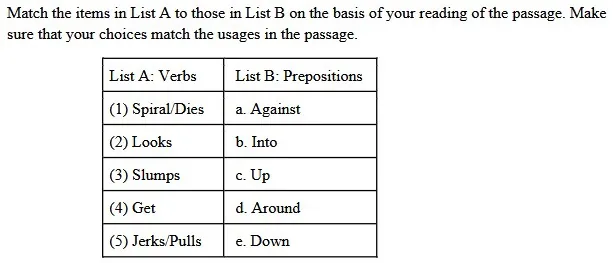 Spiral/Dies
- AAgainst
- BInto
- CUp
- DAround
- EDown
- Q59MCQ2 Marks·Choose one option
Looks
- AAgainst
- BInto
- CUp
- DAround
- EDown
- Q60MCQ2 Marks·Choose one option
Slumps
- AAgainst
- BInto
- CUp
- DAround
- EDown
- Q61MCQ2 Marks·Choose one option
Get
- AAgainst
- BInto
- CUp
- DAround
- EDown
- Q62MCQ2 Marks·Choose one option
Jerks/Pulls
- AAgainst
- BInto
- CUp
- DAround
- EDown
Qualifier · May 2024Qualifier
Read the passage below, then answer Q63–Q72
Read the following passage and answer the given subquestions.
User traffic on Twitter has slowed since the launch of Meta’s text-based platform Threads, which has already surpassed 100 million sign-ups since its debut last week.
Threads launched in the U.S. on Wednesday and is being touted by Meta executives like Instagram chief Adam Mosseri as a more positive “public square” for communities “that never really embraced Twitter.” So far, users seem to be on board.
“Threads reached 100 million sign ups over the weekend. That’s mostly organic demand and we haven’t even turned on many promotions yet. Can’t believe it’s only been 5 days!” Meta CEO Mark Zuckerberg said in a post Monday.
Twitter appears to have taken a hit. Matthew Prince, CEO of Cloudflare, shared a screenshot to Twitter Sunday showing that traffic on the platform was “tanking.”
According to Similarweb, a data company that specializes in web analytics, web traffic to Twitter was down 5% for the first two full days. Threads was generally available compared with the previous week. The company said Twitter’s web traffic is down 11% compared with the same days in 2022.
Twitter responded to CNBC’s request for comment with an automated response. Meta didn’t offer additional comment beyond Zuckerberg’s post.
Source: cnbc.com - Twitter traffic is ‘tanking’ as Meta’s Threads hits 100 million users - Ashley Capoot
Q63MCQ2 Marks·Choose one optionWhat is the synonym of the word surpassed?
- AExceed
- BPass through
- CGo under
- DCome second to
- Q64MCQ2 Marks·Choose one option
Choose an appropriate option to replace the word touted.
- AChanged paths
- BPromoted
- CCriticized
- DEdited
- Q65MCQ2 Marks·Choose one option
That’s mostly organic demand and we haven’t even turned on many promotions yet. What meaning do the phrases organic demand and [not many] promotions convey here?
- AMeta has been mindful of climate change in meeting demands.
- BThe company Meta hasn’t tried many marketing tactics to popularize Threads.
- CMeta has withheld any promotions to employees in its company.
- Q66MCQ2 Marks·Choose one option
Twitter appears to have taken a hit. What is the meaning of the phrase taken a hit?
- ABe affected badly
- BBe popular among its users
- CHas made a huge profit
- Q67MCQ2 Marks·Choose one option
What is the synonym of the word tanking?
- AShooting
- BWeighing
- CGrateful
- DFailing
- Q68MCQ2 Marks·Choose one option
The company said Twitter’s web traffic is down 11% compared with the same days in 2022 What is the meaning of the phrase down 11%?
- AThe traffic has reduced to 11%
- BThe traffic has reduced from 11%
- CThe traffic has reduced by 11%
- Q69MCQ2 Marks·Choose one option
What is the meaning of the phrase automated response?
- APredetermined reply
- BResponsible driving of automobiles
- CHighly private message
- Q70MCQ2 Marks·Choose one option
Meta didn’t offer additional comment beyond Zuckerberg’s post. What part of speech is the word beyond here?
- AAdjective
- BInterjection
- CPreposition
- DAdverb
- Q71MCQ2 Marks·Choose one option
…users seem to be on board. What is the meaning of the phrase on board here?
- AEnter a vehicle
- BBe available
- CAgree with
- Q72MCQ2 Marks·Choose one option
What is the meaning of the word debut?
- AReply in opposite
- BFirst appearance
- CAlternative
- DMomentum
Qualifier · January 2024Qualifier
Read the passage below, then answer Q73–Q82
Read the following passage and answer the given subquestions.
These stories are all from the Andaman and Nicobar archipelago.
Ignesious was the manager of a cooperative society in Katchall. His wife woke him up at 6 a.m. because she felt an earthquake. Ignesious carefully took his television set off its table and put it down on the ground so that it would not fall and break. Then the family rushed out of the house.
When the tremors stopped, they saw the sea rising. In the chaos and confusion, two of his children caught hold of the hands of their mother’s father and mother’s brother, and rushed in the opposite direction. He never saw them again. His wife was also swept away. Only the three other children who came with him were saved.
Sanjeev was a policeman, serving in the Katchall island of the Nicobar group of islands. He somehow managed to save himself, his wife and his baby daughter from the waves. But then he heard cries for help from the wife of John, the guesthouse cook. Sanjeev jumped into the water to rescue her, but they were both swept away.
Thirteen year-old Meghna was swept away along with her parents and seventy-seven other people. She spent two days floating in the sea, holding on to a wooden door. Eleven times she saw relief helicopters overhead, but they did not see her. She was brought to the shore by a wave, and was found walking on the seashore in a daze.
Almas Javed was ten years old. She was a student of Carmel Convent in Port Blair where her father had a petrol pump. Her mother Rahila’s home was in Nancowry island. The family had gone there to celebrate Christmas.
When the tremors came early in the morning, the family was sleeping. Almas’s father saw the sea water recede. He understood that the water would come rushing back with great force. He woke everyone up and tried to rush them to a safer place.
As they ran, her grandfather was hit on the head by something and he fell down. Her father rushed to help him. Then came the first giant wave that swept both of them away.
Almas’s mother and aunts stood clinging to the leaves of a coconut tree, calling out to her. A wave uprooted the tree, and they too were washed away.
Almas saw a log of wood floating. She climbed on to it. Then she fainted. When she woke up, she was in a hospital in Kamorta. From there she was brought to Port Blair. The little girl does not want to talk about the incident with anyone. She is still traumatised.
The Tsunami - Sonali Deraniyagala
Q73MCQ2 Marks·Choose one optionWhat is the meaning of ‘archipelago’?
- AA collection of jewellery
- BA collection of Islands
- CA collection of stamps
- DA collection of coins
- Q74MCQ2 Marks·Choose one option
Fill in the blank with the appropriate option. Ignesious was the manager of a cooperative society in ______________.
- ALucknow
- BKatchall
- CCoimbatore
- DKanpur
- Q75MCQ2 Marks·Choose one option
Which among the following words is the antonym of ‘order’?
- AChaos
- BStructure
- CArrangement
- DSystem
- Q76MCQ2 Marks·Choose one option
Select true or false for the following statement. Sanjeev made it to safety after the tsunami.
- ATrue
- BFalse
- Q77MCQ2 Marks·Choose one option
Fill in the blanks with the correct option. “________________ she saw relief helicopters overhead, but they did not see her.”
- AEleven times
- BTwelve times
- CFourteen times
- DTen times
- Q78MCQ2 Marks·Choose one option
Select true or false for the following statement. Almas’s father realised that a tsunami was going to hit the Island.
- ATrue
- BFalse
- Q79MCQ2 Marks·Choose one option
Select true or false for the following statement. “Meghna was saved by a relief helicopter.”
- ATrue
- BFalse
- Q80MCQ2 Marks·Choose one option
Fill in the blanks. Almas Javed was a _______ old girl.
- ATen year
- BEleven year
- CFive year
- DSeven year
- Q81MCQ2 Marks·Choose one option
Select true or false for the following statement. Ignesious lost his wife, two children, his father-in-law, and his brother-in-law in the tsunami.
- ATrue
- BFalse
- Q82MCQ2 Marks·Choose one option
Fill in the blanks. Sanjeev was a __________.
- ADoctor
- BStudent
- CProfessor
- DPoliceman
Qualifier · September 2023Qualifier
Read the passage below, then answer Q83–Q87
Read the following passage and answer the given subquestions.
When I first visited Gandhi in 1942 at his ashram in Sevagram, in central India, he said, “I will tell you how it happened that I decided to urge the departure of the British. It was in 1917.”
He had gone to the December 1916 annual convention of the Indian National Congress party in Lucknow. There were 2,301 delegates and many visitors. "During the proceedings," Gandhi recounted, “a peasant came up to me looking like any other peasant in India, poor and emaciated, and said, ‘I am Rajkumar Shukla. I am from Champaran, and I want you to come to my district’!’’ Gandhi had never heard of the place. It was in the foothills of the towering Himalayas, near the kingdom of Nepal.
Under an ancient arrangement, the Champaran peasants were sharecroppers. Rajkumar Shukla was one of them. He was illiterate but resolute. He had come to the Congress session to complain about the injustice of the landlord system in Bihar, and somebody had probably said, “Speak to Gandhi.”
Gandhi told Shukla he had an appointment in Cawnpore and was also committed to go to other parts of India. Shukla accompanied him everywhere. Then Gandhi returned to his ashram near Ahmedabad. Shukla followed him to the ashram. For weeks he never left Gandhi’s side.
“Fix a date,” he begged.
Impressed by the sharecropper’s tenacity and story Gandhi said, ‘‘I have to be in Calcutta on such-and-such a date. Come and meet me and take me from there.” Months passed. Shukla was sitting on his haunches at the appointed spot in Calcutta when Gandhi arrived; he waited till Gandhi was free. Then the two of them boarded a train for the city of Patna in Bihar. There Shukla led him to the house of a lawyer named Rajendra Prasad who later became President of the Congress party and of India. Rajendra Prasad was out of town, but the servants knew Shukla as a poor yeoman who pestered their master to help the indigo sharecroppers. So they let him stay on the grounds with his companion, Gandhi, whom they took to be another peasant. But Gandhi was not permitted to draw water from the well lest some drops from his bucket pollute the entire source; how did they know that he was not an untouchable?
Gandhi decided to go first to Muzzafarpur, which was en route to Champaran, to obtain more complete information about conditions than Shukla was capable of imparting. He accordingly sent a telegram to Professor J.B. Kripalani, of the Arts College in Muzzafarpur, whom he had seen at Tagore’s Shantiniketan school. The train arrived at midnight, 15 April 1917. Kripalani was waiting at the station with a large body of students. Gandhi stayed there for two days in the home of Professor Malkani, a teacher in a government school.
- Indigo - Louis Fischer
Q83MCQ2 Marks·Choose one optionAmong the following words, choose the antonym for the word ‘tenacity’.
- APersistence
- BDetermination
- CFirmness
- DTimidity
- Q84MCQ2 Marks·Choose one option
What is the meaning of ‘yeoman’?
- AA farmer who owned and worked on his own land
- BA person who is the owner of a house
- CA person who lends money as a business
- DA person who fits and repairs the pipes
- Q85MCQ2 Marks·Choose one option
Select true or false for the following statement. Gandhi decided to go first to Muzzafarpur, which was en route to Champaran.
- ATRUE
- BFALSE
- Q86MCQ2 Marks·Choose one option
To whom did Gandhi send a telegram?
- ARajendra Prasad
- BJ.B. Kripalani
- CRomesh Chunder Dutt
- DN. R Malkani
- Q87MCQ2 Marks·Choose one option
At whose house did Gandhi stay for two days?
- AProfessor Dutt
- BProfessor Malkani
- CProfessor Chowdhury
- DProfessor Sharma
Qualifier · May 2023Qualifier
Read the passage below, then answer Q88–Q92
Read the following passage and answer the given subquestions.
We all seek happiness but few, very few, indeed, get it. We are unhappy partly because we desire much more than what we can hope to attain. Our countless desires are hard to satisfy. And that is what makes us so sad in life.
The secret of happiness lies in the simplification of life. Simple living encourages high thinking. It leads to contentment. Contentment gives us inner wealth, the wealth of the mind and of the soul. A contented man devotes himself to virtues like truth, beauty, love, goodness, kindness, and charity. By pursuing and inculcating their virtues, a man can feel true happiness.
I do not mean that for simplification of life, a man should become an ascetic. The happiness of sadhu is of a negative kind. I want a positive kind of happiness. For this, I must live in the midst of life, faithfully carrying out my responsibilities to my home and my country. But all of this should be done in the spirit of selfless service. A man who wants to lead a happy life, should also make others happy. In making others happy, he will taste real and lasting happiness. There is a kind of joy in serving others with virtuous motives, in sacrificing what one has for the good of others. An act of goodness is in itself an act of happiness.
The secret of perfect happiness lies in renunciation. Wealth may give us joy for a while and fame may provide us with fleeting excitement. But they cannot give us permanent happiness. Kings have everything to make them happy and yet they feel unhappy. It is because they do not practice renunciation.
There is a sense of joy in doing one’s work honestly and efficiently. A research-worker feels joy in conducting research while a journalist in writing. In doing one’s duty sincerely, one feels a peace of mind, which is an important essence of happiness.
It is only by cultivating a spirit of renunciation, self-sacrifice, contentment, and sincere work that one can really be happy. The strings of misfortune spare none, but they will not cow such a person.
Q88MCQ2 Marks·Choose one optionWhat does a contented man do?
- AHe encounters the strings of misfortunes.
- BHe gives up bad habits effortlessly.
- CHe boldly faces the adversities of life.
- DHe pursues and assimilates the basic virtues of life.
- Q89MCQ2 Marks·Choose one option
Which of the following is the correct chain of things, as mentioned in the passage, leading to happiness?
- AHigh thinking, simple living, inner wealth, contentment
- BInner wealth, simple living, contentment, high thinking
- CSimple living, high thinking, inner wealth, contentment
- DSimple living, high thinking, contentment, inner wealth
- Q90MCQ2 Marks·Choose one option
According to the passage, the essence of happiness lies in ______
- AAvoiding all unfortunate events.
- BAdopting a simple lifestyle.
- CMatching one’s abilities with the work undertaken.
- DWorldly desires.
- Q91MCQ2 Marks·Choose one option
We are unhappy partly because ______
- AWe have countless unfulfilled desires.
- BOur lives have become extremely complicated.
- CWe have lost moral and spiritual values.
- Q92MCQ2 Marks·Choose one option
Which of the following statements is NOT TRUE in the context of the passage?
- AMultiplicity of desires makes us unhappy.
- BMaking others happy makes one happy.
- CRenunciation is the result of perfect happiness.
- DOne feels peace of mind in doing one’s duty sincerely.
Official KeyMaster Answer Key & Explanations
Official answer keys from IIT Madras BS past papers. Click any question to review.
Reveal KeyCollapse Key
Master Answer Key & Explanations
Official answer keys from IIT Madras BS past papers. Click any question to review.