Indian Institute of Technology Madras
BS Degree Programme · Examination & Study Paper
Tools in Data Science
RAG & multi-modal RAG pipelines
Examination Instructions & Guidelines
- Solve on notebook/paper first before checking solutions.
- MCQ: Exactly 1 option is correct. Negative marking applies.
- Scientific calculator allowed for all calculations.
- Official answer key is sealed at the end of this sheet.
End Term · 31 Aug 2025 (FN)End Term
Read the passage below, then answer Q1–Q2
Scenario 4: Academic Research RAG System with Multi-Modal Analysis
A research university implements an advanced RAG system that processes academic papers, datasets, code repositories, and experimental results to support interdisciplinary research across STEM fields.
Advanced Multi-Modal RAG Architecture:
● Text Processing: Research papers, grants, technical documentation
● Code Analysis: GitHub repositories, computational notebooks, algorithm implementations ● Data Integration: Experimental datasets, simulation results, sensor data
● Visual Processing: Figures, charts, experimental images, technical diagrams
● Semantic Linking: Cross-reference relationships between concepts, methods, and findings Based on the above data, answer the given subquestions.
Q1MCQ1 Mark·Choose one optionWhat is the primary advantage of multi-modal RAG systems over text-only approaches in academic research contexts?
- AReduced computational complexity for information retrieval
- BComprehensive understanding through integration of textual concepts, visual data, and computational methods
- CSimplified system architecture and maintenance
- DLower storage requirements for research materials
- Q2MCQ1 Mark·Choose one option
Which processing sequence correctly describes the multi-modal RAG system's comprehensive research synthesis workflow?
- AResearch Query → Text Search Only → Generate Literature Summary
- BResearch Query → Keyword Matching → Return Most Recent Papers
- CResearch Query → Multi-Modal Embedding (text + code + visual + data) → Cross-Disciplinary Retrieval → Concept Mapping → Synthesized Research Insights with Method Integration
- DResearch Query → Database Search → Template Response Generation
End Term · 31 Aug 2025 (AN)End Term
Read the passage below, then answer Q3–Q4
Scenario 4: Supply Chain Optimization RAG System.
A global logistics company implements an advanced RAG system that integrates supplier data, transportation networks, demand forecasting, and regulatory information to optimize supply chain decisions across multiple industries and geographical regions.
Multi-Modal Supply Chain RAG Architecture:
●Supplier Intelligence: Vendor profiles, performance metrics, capacity data, compliance records ●Transportation Networks: Route optimization, carrier performance, fuel costs, delivery tracking ●Market Analysis: Demand forecasting, price volatility, seasonal patterns, economic indicators ●Regulatory Compliance: Trade regulations, customs requirements, sustainability standards ●Risk Assessment: Supply disruptions, geopolitical factors, weather impacts, financial stability Based on the above data, answer the given subquestions.
Q3MCQ1 Mark·Choose one optionWhat is the primary advantage of multi-modal RAG systems for supply chain management compared to traditional ERP systems?
- ALower implementation costs and simpler maintenance
- BReal-time integration of supplier performance, market dynamics, and regulatory changes for adaptive supply chain optimization
- CExclusive focus on historical transaction data
- DReduced data storage requirements
- Q4MCQ1 Mark·Choose one option
Which processing sequence correctly describes the supply chain RAG system's comprehensive optimization workflow?
- ASupply Chain Query → Supplier Database Search → Cost Comparison Report
- BSupply Chain Query → Keyword Matching → Return Cheapest Options
- CSupply Chain Query → Multi-Modal Analysis (supplier performance + market conditions + regulatory requirements + risk factors) → Scenario Modeling → Optimization Recommendations with Risk-Adjusted Trade-offs
- DSupply Chain Query → Historical Data Retrieval → Standard Report Generation
End Term · 13 Apr 2025 (FN)End Term
Read the passage below, then answer Q5
Scenario 4
A climate science professor is developing an AI-powered learning assistant called ClimateBot to help students understand complex climate modeling techniques and computational approaches to environmental data analysis.
Guidelines for ClimateBot:
- Engage students through thought-provoking questions
- Encourage independent problem-solving
- Guide students to discover solutions autonomously
- Provide conceptual insights, not direct answers
- Help students develop robust computational and analytical skills
Based on the above data, answer the given subquestions.
Q5MCQ1 Mark·Choose one optionAssume that the ClimateBot, an advanced learning assistant for climate science students.Its primary mission is to foster critical thinking, scientific reasoning, and deep understanding of complex environmental systems by using a RAG (Retrieval-Augmented Generation) system. The RAG system works as follows: 1. Climate Data Storage: Comprehensive climate research materials (like reports, research papers and notes) are split into smaller chunks. Each chunk is vectorized using an embedding model. 2. Vector Database: The vectorized chunks are stored in a FAISS or Weaviate vector database. 3. Retriever: When a student asks a question, the system retrieves the most relevant content (based on semantic similarity) from the vector database. 4. LLM Contextualization: The retrieved content is added as context in the assistant's prompt, which is then used by the LLM (like GPT-4) to generate a personalized, context-aware response. Which of the following correctly describes the process flow of a RAG-based system for the IITM TDS Teaching Assistant?
- A

- B
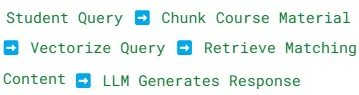
- C
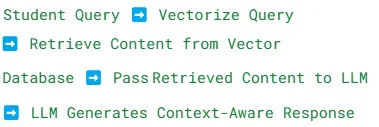
- D
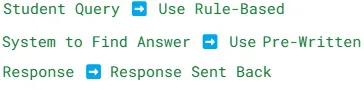
- A
End Term · 22 Dec 2024 (FN)End Term
Read the passage below, then answer Q6
Scenario 4
The course instructor of TDS is developing an LLM-powered learning assistant called EduBot. This assistant is used by students to learn concepts in geospatial analysis, optimization, and data science. This bot will be highly helpful for students in solving the questions given in the context of “Emergency Medical Supply Delivery in Storm-Critical Zones” in this question paper. The goal of the assistant is to help students think critically and solve problems independently without receiving direct answers or step-by-step solutions.
The instructor defines the following constraints for the LLM assistant (EduBot):
1. Do not provide final answers — If a student asks for the solution, the agent must not give the final answer.
2. Do not provide step-by-step code — The agent must avoid giving Python, SQL, or R code directly.
3. Encourage critical thinking — The agent should guide students using reflective questions, sanity checks, and logical reasoning.
4. Use context-aware prompts — The agent should recognize when a student might have made a conceptual mistake (like unit errors) and provide guidance.
The instructor asks you, as part of a course assignment, to design the system prompt that will be sent to OpenAI’s API for creating this LLM-based agent. Your task is to answer the given sub- questions to ensure EduBot works as expected.
Q6MCQ1 Mark·Choose one optionAssume that the EduBot is designed to provide context-aware, personalized guidance to students by using a RAG (Retrieval-Augmented Generation) system. The RAG system works as follows: 1. Course Material Storage: Custom course content (like PDFs, guides, and notes) is split into smaller chunks. Each chunk is vectorized using an embedding model. 2. Vector Database: The vectorized chunks are stored in a FAISS or Weaviate vector database. 3. Retriever: When a student asks a question, the system retrieves the most relevant content (based on semantic similarity) from the vector database. 4. LLM Contextualization: The retrieved content is added as context in the assistant's prompt, which is then used by the LLM (like GPT-4) to generate a personalized, context-aware response. Which of the following correctly describes the process flow of a RAG-based system for the IITM TDS Teaching Assistant?
- A

- B

- C

- D

- A