Indian Institute of Technology Madras
BS Degree Programme · Examination & Study Paper
Tools in Data Science
LLM prompting, cost & system prompts
Examination Instructions & Guidelines
- Solve on notebook/paper first before checking solutions.
- MCQ: Exactly 1 option is correct. Negative marking applies.
- MSQ: One or more options correct. Select all to score.
- Scientific calculator allowed for all calculations.
- Official answer key is sealed at the end of this sheet.
End Term · 31 Aug 2025 (FN)End Term
Read the passage below, then answer Q1–Q3
Scenario 1: AI-Powered Research Assistant Development
Dr. Kumar is developing an AI research assistant for environmental science students. The system needs to process academic papers, generate summaries, and answer domain specific questions while encouraging critical thinking.
Based on the above data, answer the given subquestions.
Q1MCQ1 Mark·Choose one optionThe research assistant uses a system prompt to guide its behavior. Which system prompt design principle is most important for educational effectiveness?
- AProviding direct answers to maximize efficiency
- BBalancing information delivery with Socratic questioning to promote learning
- CLimiting responses to prevent information overload
- DUsing technical jargon to maintain academic rigor
- Q2MSQ2 Marks·Choose all correct options
When students submit complex research queries, which factors most significantly impact the LLM's operational costs and response quality? (Select all that apply)
- AToken count of input prompts and generated responses
- BComplexity and specificity of the query requiring deeper reasoning
- CTime of day when queries are submitted
- DContext window utilization for multi-turn conversations
- EStudent's academic level
- Q3MCQ1 Mark·Choose one option
Which prompt engineering technique would generate the most pedagogically valuable response for environmental research?
- A"Explain climate change impacts"
- B"Write about environmental issues"
- C"Analyze the interconnected effects of ocean acidification on marine ecosystems, considering pH changes, species adaptation, and food web dynamics. What research methodologies would be most appropriate for studying these relationships?"
- D"Discuss environmental problems briefly"
Read the passage below, then answer Q4–Q5
Scenario 4: Academic Research RAG System with Multi-Modal Analysis
A research university implements an advanced RAG system that processes academic papers, datasets, code repositories, and experimental results to support interdisciplinary research across STEM fields.
Advanced Multi-Modal RAG Architecture:
● Text Processing: Research papers, grants, technical documentation
● Code Analysis: GitHub repositories, computational notebooks, algorithm implementations ● Data Integration: Experimental datasets, simulation results, sensor data
● Visual Processing: Figures, charts, experimental images, technical diagrams
● Semantic Linking: Cross-reference relationships between concepts, methods, and findings Based on the above data, answer the given subquestions.
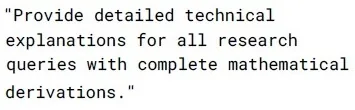
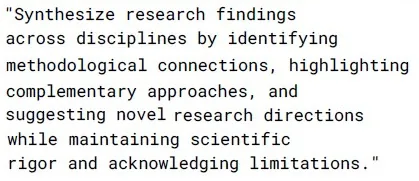
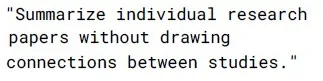
Q4MCQ1 Mark·Choose one optionWhich system prompt design best supports interdisciplinary research collaboration and knowledge synthesis?
- A
- B

- C
- D
- A
- Q5MCQ1 Mark·Choose one option
A researcher asks: "How can machine learning techniques be applied to optimize renewable energy grid integration, and what interdisciplinary approaches show promise?" Which response demonstrates the most effective research synthesis approach?
- A"Machine learning can predict energy demand and optimize grid operations through various algorithms."
- B"Here are 10 recent papers on ML applications in renewable energy: [lists papers with summaries]"
- C"Let's explore the intersection of several fields: What specific grid integration challenges interest you? ML approaches range from demand forecasting (time series analysis) to real-time optimization (reinforcement learning), while power systems engineering provides domain constraints. Materials science advances in energy storage create new optimization opportunities. Which aspect aligns with your research focus?"
- D"This is a complex topic requiring extensive literature review across multiple disciplines."
End Term · 31 Aug 2025 (AN)End Term
Read the passage below, then answer Q6–Q8
Scenario 1: Healthcare Data Analytics Platform
A hospital system is developing a HIPAA-compliant analytics platform to process electronic health records, predict patient outcomes, and support clinical decision-making while ensuring data privacy and regulatory compliance.
Based on the above data, answer the given subquestions.
Q6MCQ1 Mark·Choose one optionWhen designing prompts for a clinical AI assistant, which approach best balances medical accuracy with regulatory compliance?
- AProvide definitive medical diagnoses to assist doctors
- BFocus on pattern recognition while explicitly requiring human clinical judgment and including appropriate medical disclaimers
- CRestrict responses to general medical information only
- DAvoid medical topics entirely to prevent liability
- Q7MSQ2 Marks·Choose all correct options
Which factors most significantly impact computational costs when processing large-scale clinical datasets with LLMs?(Select all that apply)
- AToken density of clinical notes and medical terminology
- BComplexity of medical reasoning required for clinical insights
- CHIPAA compliance overhead and security measures
- DContext window usage for patient history analysis
- EGeographic location of healthcare facility
- Q8MCQ1 Mark·Choose one option
Which prompt engineering approach generates the most clinically valuable insights for patient care optimization?
- A"Analyze patient symptoms"
- B"Review medical records"
- C"Based on this patient's lab results (glucose: 180 mg/dL, HbA1c: 8.2%), vital signs, and medication history, identify potential adjustment strategies for diabetes management while considering contraindications and monitoring requirements."
- D"Suggest treatments for diabetes"
Read the passage below, then answer Q9–Q10
Scenario 4: Supply Chain Optimization RAG System.
A global logistics company implements an advanced RAG system that integrates supplier data, transportation networks, demand forecasting, and regulatory information to optimize supply chain decisions across multiple industries and geographical regions.
Multi-Modal Supply Chain RAG Architecture:
●Supplier Intelligence: Vendor profiles, performance metrics, capacity data, compliance records ●Transportation Networks: Route optimization, carrier performance, fuel costs, delivery tracking ●Market Analysis: Demand forecasting, price volatility, seasonal patterns, economic indicators ●Regulatory Compliance: Trade regulations, customs requirements, sustainability standards ●Risk Assessment: Supply disruptions, geopolitical factors, weather impacts, financial stability Based on the above data, answer the given subquestions.
Q9MCQ1 Mark·Choose one optionWhich system prompt design best supports strategic supply chain decision-making across multiple stakeholders?
- A

- B

- C

- D

- A
- Q10MCQ1 Mark·Choose one option
A supply chain manager asks: "Given current semiconductor shortages, rising fuel costs, and new sustainability regulations, how should we restructure our electronics component sourcing strategy for the next quarter?" Which response demonstrates optimal supply chain synthesis?
- A"Semiconductor shortages require finding alternative suppliers and adjusting inventory levels."
- B"Here are 20 suppliers with current pricing and availability data: [lists suppliers with specifications]"
- C"Let's analyze this systematically: Current semiconductor lead times average 16-24 weeks (vs. normal 4-6 weeks). Three strategic options emerge: 1) Dual-sourcing with 60% Asian suppliers, 40% nearshore (reduces risk but increases costs 12-18%), 2) Forward buying with 90-day inventory (capital impact: $2.3M, storage costs: $45K/month), 3) Design modifications using available components (6-week timeline, engineering costs). Fuel cost increases affect logistics by 8-15%. New EU sustainability regs require supplier carbon disclosure. Which risk tolerance and capital constraints guide your preference?"
- D"Supply chain restructuring requires comprehensive analysis of multiple interdependent factors."
End Term · 13 Apr 2025 (FN)End Term
Read the passage below, then answer Q11–Q13
Scenario 1:
Sarah is working on a research paper about renewable energy technologies and decides to use an LLM to help her draft some sections.
Based on the above data, answer the given subquestions.
Q11MCQ1 Mark·Choose one optionSarah prompts the LLM: "Write a comprehensive overview of solar energy advancements in the last decade." The instructor wants to ensure that the LLM provides concise, clear, and helpful answers. What is the role of the system prompt in guiding the LLM's behavior?
- AIt defines the LLM’s tone, behavior, and response style to align with the instructor's teaching goals.
- BIt provides a list of pre-written responses to be used in all classroom scenarios.
- CIt prevents the LLM from ever deviating from pre-determined responses, regardless of the context.
- DIt configures the LLM to only respond to specific commands, disregarding any other input.
- Q12MSQ2 Marks·Choose all correct options
When Sarah submits increasingly complex prompts about solar energy, which of the following statements are TRUE regarding LLM cost and usage
- ALLM costs are primarily calculated based on the number of tokens processed
- BLLM usage is always free for academic research
- CThe total length of both input prompt and output response impacts the overall cost
- DLLM costs are fixed regardless of the complexity of the query
- EToken count has no relation to computational resources required
- Q13MCQ1 Mark·Choose one option
Sarah wants to improve the specificity of her LLM prompt. Which prompt is likely to generate the most precise and useful response?
- A"Tell me about solar energy"
- B"Discuss solar energy advancements"
- C"Outline 4 key solar energy technological breakthroughs from 2014-2024, including specific efficiency improvements and implementation challenges"
- D"Write a paragraph about solar energy"
Read the passage below, then answer Q14–Q16
Scenario 4
A climate science professor is developing an AI-powered learning assistant called ClimateBot to help students understand complex climate modeling techniques and computational approaches to environmental data analysis.
Guidelines for ClimateBot:
- Engage students through thought-provoking questions
- Encourage independent problem-solving
- Guide students to discover solutions autonomously
- Provide conceptual insights, not direct answers
- Help students develop robust computational and analytical skills
Based on the above data, answer the given subquestions.
Q14MCQ1 Mark·Choose one optionWhat is the primary purpose of the system prompt in controlling an AI learning assistant's behavior?
- ATo create a fixed set of predetermined responses for every possible student query
- BTo define the core communication strategy, learning approach, and interaction guidelines
- CTo replace the need for human instructor guidance completely
- DTo limit the AI's ability to understand complex scientific concepts
- Q15MCQ1 Mark·Choose one option
Choose the best system prompt that achieves the instructor's goals.
- A"You are a climate science assistant. Provide direct answers and complete code solutions whenever students ask."
- B"You are an interactive learning assistant for climate science. Guide students through complex concepts by asking reflective questions. Avoid giving direct solutions. Encourage independent thinking and help students develop problem-solving skills."
- C"You are a simple computational tool. Provide exact numerical answers and full code implementations for any climate modeling question."
- D"You are a climate science assistant. Help students and tell them to consult textbooks for all information."
- Q16MCQ1 Mark·Choose one option
A student asks: "How do I calculate the global warming potential of different greenhouse gases?" Choose the most pedagogically effective response:
- A"The global warming potential (GWP) is calculated by multiplying the gas's radiative efficiency by its atmospheric lifetime. Here's the exact formula: [provides complete formula and calculation method]"
- B"Global warming potential (GWP) is determined by factors like a gas's molecular structure, atmospheric lifetime, and interaction with radiation. Different gases have different GWPs based on these characteristics."
- C"Let's break this down. What do you already know about greenhouse gases and their impact on climate? Have you considered how different molecules might have varying abilities to trap heat?"
- D"I cannot help you with this calculation. Please refer to your textbook for a complete explanation."
End Term · 22 Dec 2024 (FN)End Term
Read the passage below, then answer Q17–Q19
Scenario 1
Reema is working on her project report and decides to use an LLM (like ChatGPT) to generate content for the “Introduction” section of her report. Below is her interaction with the LLM. Reema: "Write an introduction on the impact of AI on employment. Make it sound academic and professional."
LLM:
The rise of artificial intelligence (AI) has significantly transformed employment patterns worldwide. While automation increases productivity and efficiency, it also leads to displacement of certain jobs. Sectors like manufacturing and logistics are experiencing reduced demand for human labor, while jobs requiring creativity, empathy, and complex problem-solving are on the rise. Policymakers and educators are now focusing on reskilling workers to adapt to this change. Based on the above data, answer the given subquestions.
Q17MCQ1 Mark·Choose one optionWhich of the following actions should Reema take to validate the LLM's claims?
- AAsk the LLM to provide sources for the claims it makes.
- BUse trusted sources (like academic journals, industry reports, or government publications) to verify the LLM's information.
- CAssume the LLM is always accurate and submit the report as-is.
- DCopy and paste the same prompt into another LLM (like Bard or Claude) and compare the responses.
- Q18MSQ2 Marks·Choose all correct options
Reema realizes that the LLM's response was too short, and she wants more details for the introduction. She tries the following prompt: "Give a more detailed and comprehensive introduction on the impact of AI on employment. Include key trends, specific examples, and the role of governments in addressing employment issues." The LLM takes longer to generate the response and produces a longer, more detailed introduction.Which of the following is TRUE about how this new prompt impacts usage and costs?
- AThe cost of LLM usage increases as more words are included in the output.
- BThe cost of LLM usage depends only on the number of requests, not the length of the response.
- CThe time it takes for the LLM to generate the output depends on the size of the prompt and the complexity of the instructions.
- DThe time it takes for the LLM is dependent only on the size of the prompt
- Q19MCQ1 Mark·Choose one option
Reema notices that the LLM sometimes produces "generic" and "vague" responses. She wants more specific, detailed, and structured answers. Which of the following prompts would most likely produce a more specific and useful response from the LLM?
- A"Write a detailed introduction on the impact of AI on employment."
- B"List 3 key trends in the impact of AI on employment and provide a real-world example for each."
- C"Discuss how AI impacts employment in different sectors."
- D"Explain the impact of AI on employment."
Read the passage below, then answer Q20–Q22
Scenario 4
The course instructor of TDS is developing an LLM-powered learning assistant called EduBot. This assistant is used by students to learn concepts in geospatial analysis, optimization, and data science. This bot will be highly helpful for students in solving the questions given in the context of “Emergency Medical Supply Delivery in Storm-Critical Zones” in this question paper. The goal of the assistant is to help students think critically and solve problems independently without receiving direct answers or step-by-step solutions.
The instructor defines the following constraints for the LLM assistant (EduBot):
1. Do not provide final answers — If a student asks for the solution, the agent must not give the final answer.
2. Do not provide step-by-step code — The agent must avoid giving Python, SQL, or R code directly.
3. Encourage critical thinking — The agent should guide students using reflective questions, sanity checks, and logical reasoning.
4. Use context-aware prompts — The agent should recognize when a student might have made a conceptual mistake (like unit errors) and provide guidance.
The instructor asks you, as part of a course assignment, to design the system prompt that will be sent to OpenAI’s API for creating this LLM-based agent. Your task is to answer the given sub- questions to ensure EduBot works as expected.
Q20MCQ1 Mark·Choose one optionThe instructor wants to ensure that the agent’s purpose is clear to the LLM. What is the role of the system prompt in controlling the LLM's behavior?
- AIt defines the role, constraints, and communication style of the LLM agent, ensuring it guides rather than solves.
- BIt acts as a script that contains hard-coded responses for every student question.
- CIt ensures that the LLM only responds with exact pre-written answers to specific queries.
- DIt modifies the OpenAI model itself to force it to behave like a teaching assistant.
- Q21MCQ1 Mark·Choose one option
Choose the best system prompt that achieves the instructor's goals.
- A“””You are an interactive assistant. Answer student questions directly and provide Python code or final answers if requested. If the student asks for clarification, provide a detailed step-by-step solution.”””
- B“””You are a learning assistant for a Data Science course. Do not provide final answers or direct solutions. Do not provide Python or step-by-step code. Encourage critical thinking using reflective questions. Use sanity checks to help students validate their work. If a student provides a calculation, prompt them to review units, radian-to-degree conversions, or other potential points of error.”””
- C“””You are a teaching assistant for a Data Science course. Answer questions using logical reasoning, and if the student requests the final solution, provide the exact distance or value. Ask follow-up questions to help students understand the answer.”””
- D“””You are a simple assistant. Do not provide step-by-step guidance or explanations. When asked about concepts like geospatial distance, tell students to look up the concept themselves. If a student asks for the answer, refuse to respond.”””
- Q22MCQ1 Mark·Choose one option
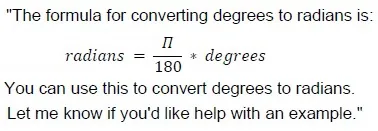
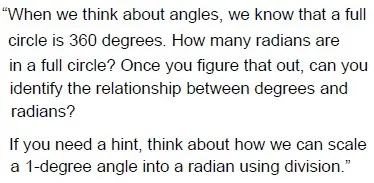
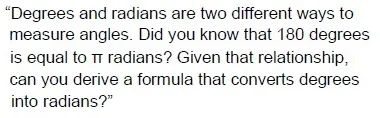
A student asks the following question to EduBot: "How do I convert degrees to radians?" The goal of the LLM assistant is to use logical reasoning to prompt the student to think critically. Instead of directly providing the formula, the assistant should encourage the student to recall or derive it on their own. The assistant should use concepts, relationships, and reasoning techniques that help the student make connections. Which of the below responses will be an ideal response from the agent in this situation?
- A
- B
- C
- D

- A