Indian Institute of Technology Madras
BS Degree Programme · Examination & Study Paper
Machine Learning Techniques
Logistic regression
Examination Instructions & Guidelines
- Solve on notebook/paper first before checking solutions.
- NAT: Numerical response. No negative marking.
- Scientific calculator allowed for all calculations.
- Official answer key is sealed at the end of this sheet.
End Term · 31 Aug 2025 (FN)End Term
Read the passage below, then answer Q1–Q2
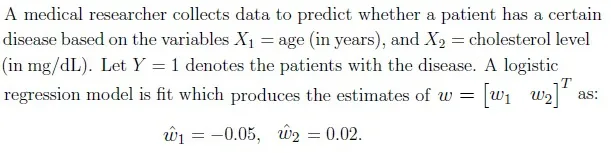
Based on the above data, answer the given subquestions.
Q1NAT3 Marks·Write the numberWhat is the probability that a 60-year-old patient with a cholesterol level of 200 mg/dL has the disease? Enter the answer correct to two decimal places.
Your answer:- Q2NAT3 Marks·Write the number
How high should the cholesterol level be for the patient mentioned in the previous question to have a 50% chance of being diagnosed with the disease?
Your answer:
End Term · 31 Aug 2025 (AN)End Term
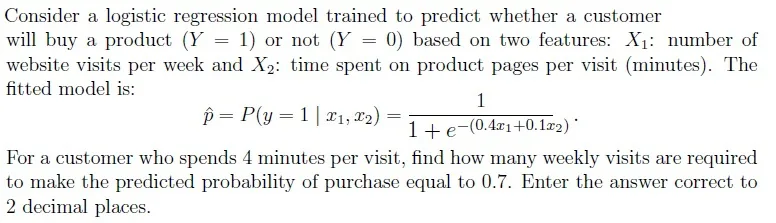
- Q3NAT3 Marks·Write the number
 Your answer:
End Term · 13 Apr 2025 (AN)End Term
- Q4NAT3 Marks·Write the number
 Your answer:
End Term · 22 Dec 2024 (FN)End Term
- Q5NAT3 Marks·Write the number
Consider a logistic regression model trained to detect spam emails. Emails containing harmful phishing links are labeled as spam (1), while regular emails are labeled as not spam (0). A good spam detector should correctly identify almost all emails with phishing links. Even a single phishing email incorrectly classified as not spam could expose users to significant risks. However, the detector may classify some regular emails as spam. This trade-off is acceptable to ensure safety. To ensure user safety, if the threshold is set to a low value to prioritize the detection of phishing emails, type 1. If the threshold is set to a high value to minimize false positives (misclassifying regular emails as spam), type 0.
Your answer:
End Term · 22 Dec 2024 (AN)End Term
- Q6NAT3 Marks·Write the number
Consider a logistic regression model trained to detect spam emails. Emails containing harmful phishing links are labeled as spam (1), while regular emails are labeled as not spam (0). A good spam detector should correctly identify almost all emails with phishing links. Even a single phishing email incorrectly classified as not spam could expose users to significant risks. However, the detector may classify some regular emails as spam. This trade-off is acceptable to ensure safety. To ensure user safety, if the threshold is set to a low value to prioritize the detection of phishing emails, type 1. If the threshold is set to a high value to minimize false positives (misclassifying regular emails as spam), type 0.
Your answer: