Indian Institute of Technology Madras
BS Degree Programme · Examination & Study Paper
Reinforcement Learning
Contextual bandits & LinUCB
Official Paper
Examination Instructions & Guidelines
- Solve on notebook/paper first before checking solutions.
- MCQ: Exactly 1 option is correct. Negative marking applies.
- Scientific calculator allowed for all calculations.
- Official answer key is sealed at the end of this sheet.
Read the passage below, then answer Q1–Q3
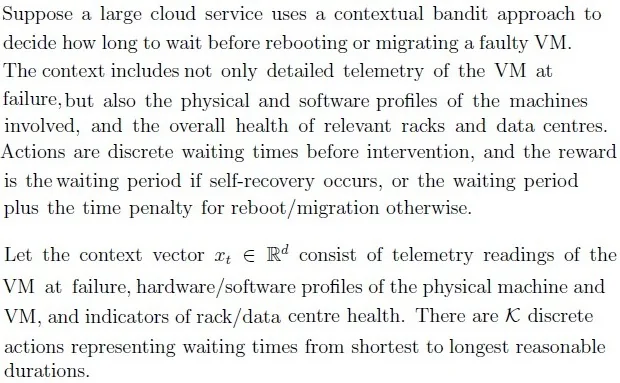
Based on the above data, answer the given subquestions.
Q1MCQ2 Marks·Choose one optionWhich of the following best explains why a contextual bandit approach is preferred over a standard multi-armed bandit in this scenario?
- ABecause the optimal waiting time is the same for all VMs, regardless of their context.
- BBecause contextual bandits can adaptively select actions based on the specific features of each VM failure event, maximising expected reward across diverse situations.
- CBecause multi-armed bandits are unable to balance exploration and exploitation.
- DBecause contextual bandits always guarantee zero regret after every round.
- Q2MCQ4 Marks·Choose one option
- AIt determines the penalty for rebooting or migrating the VM.
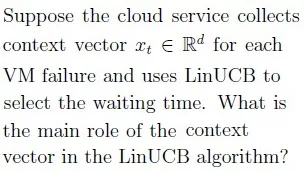
- BIt is used to predict the expected reward for each possible waiting time,allowing the algorithm to personalize decisions for each failure event.
- CIt is ignored by LinUCB, which only uses past rewards.
- DIt is used to randomly select an action to ensure exploration.
- Q3MCQ2 Marks·Choose one option
What is the main optimality goal of a contextual bandit algorithm over many rounds?
- AMaximise the total expected reward by acting as closely as possible to the best policy mapping contexts to actions.
- BAchieve zero regret after every individual round by always picking the empirically best action so far for each context
- CAlways exploit the highest-reward action seen so far
- DMinimise the loss on the worst round