Indian Institute of Technology Madras
BS Degree Programme · Examination & Study Paper
Design Thinking for Data-Driven App Development
Quiz 2 · 3 Aug 2025 (Afternoon)
Examination Instructions & Guidelines
- Solve on notebook/paper first before checking solutions.
- MCQ: Exactly 1 option is correct. Negative marking applies.
- Scientific calculator allowed for all calculations.
- Official answer key is sealed at the end of this sheet.
Useful Reference Data for this Paper
 Q1MCQ1 Mark·Choose one option
The Test phase in Karmic Design Thinking (KDT) corresponds to:
- ANirodha
- BSamudaya
- CDukkha
- DMarga
- Q2MCQ1 Mark·Choose one option
What does "project scope" refer to in the context of Design Thinking & Agile project management?
- AThe duration and timeline of sprints to develop the product
- BThe specific goals, features, and deliverables agreed upon for the product
- CA list of known risks and mitigation strategies during the project
- DThe total financial resources, and project members allocated for the project
- Q3MCQ1 Mark·Choose one option
Which statement best illustrates the iterative nature of Agile and Design Thinking?
- AThe final solution is defined before development begins
- BDesign is done once and then development is iterated
- CRepeatedly test and improve ideas based on user feedback
- DOnce a prototype is iterated, the solution is fixed
- Q4MCQ1 Mark·Choose one option
Which of the following best explains why Agile+Design Thinking are suitable approaches in early- stage app development projects?
- AThey require fully defined user requirements before starting development
- BThey embrace uncertainty and allow teams to adapt as user needs
- CThey eliminate the need for user input by relying on expert intuition
- DThey are suitable for projects with low complexity and short timelines
- Q5MCQ1 Mark·Choose one option
Which of the following is NOT a way to analyze user needs during the design thinking process?
- AAsking open-ended questions to users
- BObserving user behavior
- CCreating user personas
- DMaking assumptions about user needs
- Q6MCQ1 Mark·Choose one option
According to Don Norman in The Design of Everyday Things, which of the following best reflects how Human-Centered Design (HCD) contributes to successful product development and market fit? 1. The understanding of people and the needs that the design is intended to meet primarily comes through observation. 2. The principle is to avoid specifying the problem as long as possible. 3. It promotes early, fixed specification of product requirements to speed up development. Select the correct option using the codes given below:
- A1 only
- B1 and 3 only
- C1 and 2 only
- D1, 2 and 3
- Q7MCQ1 Mark·Choose one option
During the Empathize phase of KDT, how can you minimize assumptions and accurately uncover latent user needs?
- ABy noting problems that users explicitly mention as frequent in their daily routines
- BBy using HMW problem statements to discover friction points that may not be verbally expressed
- CBy mapping end-to-end experiences across multiple users to reveal patterns
- DBy testing a range of proposed solutions to validate which one aligns with the user’s expectations
- Q8MCQ1 Mark·Choose one option
Which of the following best reflects the relationship between design research and marketing research in understanding user needs? 1. Marketing research generate value for the organization, design research generate value for the end user 2. Marketing research offers qualitative depth, while design research scales insights across demographics 3. Design research uncovers deep user needs from small samples; marketing research reveals broad purchasing patterns 4. Designers and marketers should work independently to avoid conflicts in user insights and product positioning Select the correct option using the codes given below:
- A1, 2 and 3 only
- B1, 2 and 4 only
- C1 and 3 only
- D1, 3 and 4 only
- Q9MCQ1 Mark·Choose one option
State whether the following statement is TRUE or FALSE: ‘People who cannot temporarily let go of their role or status or set aside their own expertise or opinion will fail to empathize with others who have conflicting thoughts, experiences, or mental models.’
- ATRUE
- BFALSE
- Q10MCQ1 Mark·Choose one option
Which of the following is NOT a way to test a design during the design thinking process?
- AConducting user research
- BBuilding a prototype
- CTesting with users
- DAnalyzing user feedback
- Q11MCQ1 Mark·Choose one option
Which of the following activities represent appropriate Empathize phase practices in the KDT process? 1. Harish spends a week working at the BS programs office to observe how the exam question paper team handles last-minute requests from the course team. 2. Syed, an employee with the exam logistics team, travels to remote exam centers in rural Telangana to shadow supervisors and document infrastructure pain points. 3. Akshaya, reviews survey responses from 500 students about their satisfaction with campus events after Shaastra, a tech festival at IIT Madras. 4. Avni, a student volunteer, participates in a collegiate festival called Paradox, observing crowd movement and accessibility across venues. 5. Hamsini, a data scientist, builds a machine learning model to predict student dropout risk using course clickstream and assignment data. 6. Shriprasad, spends time interacting with student founders at the Research Park and Centre for Innovation (CFI) to learn how the campus supported their startup journeys. Select the correct option using the codes given below:
- A1, 3, 4, 5 and 6 only
- B1,2,4 and 6 only
- C1, 2, 4, 5 and 6 only
- D1, 3, 4, and 6 only
- Q12MCQ1 Mark·Choose one option
According to Don Norman in The Design of Everyday Things, what strategic insights from product development are essential for creating market-ready offerings that ensure customer satisfaction and brand value? 1. The quality of customer service, maintenance, and upgrade support throughout the product lifecycle 2. Consideration of environmental impact across manufacturing, distribution, and end-of-life disposal 3. Cross-functional coordination between technical, business, and social teams to align product features with customer expectations Select the correct option using the codes given below:
- A1 and 2 only
- B1 and 3 only
- C2 and 3 only
- D1, 2 and 3
- Q13MCQ1 Mark·Choose one option
In the Analyze phase of Design Thinking, what is the primary purpose of using the Multi-Whys technique?
- ATo generate a wide range of innovative solutions by repeatedly asking "Why?"
- BTo dig deeper into the root cause of a user’s problem by repeatedly asking "Why?"
- CTo validate the design hypotheses by repeatedly asking "Why?"
- DTo test if the problem has already been solved by a competitor by repeatedly asking "Why?"
- Q14MCQ1 Mark·Choose one option
A common pitfall in applying the Multi-Why technique is:
- AReaching conclusions too rapidly without sufficient depth
- BAsking less than five Why questions to uncover innovative solutions
- CStopping the inquiry process before uncovering the design hypotheses
- DStopping the inquiry process before uncovering the true underlying issue
- Q15MCQ1 Mark·Choose one option
Which of the following best reflects the iterative mindset central to Design Thinking?
- ABuild once, validate quickly, and deploy at scale
- BSolve problems based on expert assumptions to avoid delays
- CEmbrace early failure and refine solutions through cycles of testing
- DFinalize the best solution during the ideation phase to reduce complexity
- Q16MCQ1 Mark·Choose one option
What is a key advantage of using Silent Brainstorming in the Solve phase of Design Thinking?
- AIt allows the facilitator to control idea flow by prioritizing known solutions
- BIt forces the least experienced team members alone contribute during ideation
- CIt encourages individual creativity without group bias or influence
- DIt reduces the number of ideas generated to maintain focus on feasibility
- Q17MCQ1 Mark·Choose one option
In the Design Thinking process, the Test phase is characterized by gathering user feedback to refine and validate solutions. This approach makes the Test phase primarily a ________ phase.
- AConvergent
- BExploratory
- CDivergent
- DAbstract
- Q18MCQ1 Mark·Choose one option
Why are “How Might We” (HMW) questions considered powerful tools in the Design Thinking process?
- AThey help designers avoid complex or ambiguous user problems
- BThey reframe negative problem statements into open-ended opportunities for creative solutions
- CThey translate user feedback into measurable KPIs to track design progress
- DThey enable the transformation of pain points into broad design challenges that promote exploration
- Q19MCQ1 Mark·Choose one option
In the context of iterative design, what is the primary value of using low-fidelity prototypes early in the development process?
- ATo simulate real-world usage conditions and capture precise user interaction metrics
- BTo validate technical feasibility and prepare high-resolution mockups for developers
- CTo encourage rapid experimentation and ideation by focusing on core layout and user flow
- DTo perform detailed usability testing and finalize the design for production
- Q20MCQ1 Mark·Choose one option
In the ENV model for identifying conflicts of interest, which of the following correctly reflects the structure of a well-framed problem introduction?
- A

- B

- C

- D

- A
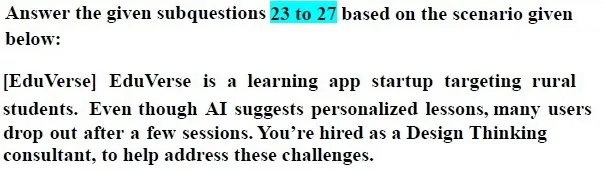
Read the passage below, then answer Q21–Q25
 Q21MCQ2 Marks·Choose one option
[EduVerse] Which of the following activities best represent initial steps in the Empathize phase of Karmic Design Thinking when addressing rural student challenges? 1.Talk to local teachers of rural schools 2.Analyze drop-out reports of rural students 3.Conduct field interviews with rural students Select the correct option using the codes given below:
- A1, 2 and 3 only
- B1 and 3 only
- C2 and 3 only
- D3 only
- Q22MCQ2 Marks·Choose one option
[EduVerse] After empathizing, how do you identify patterns in student pain points?
- AMulti-Why analysis
- BConflict of interest
- CJourney mapping
- DA/B testing
- Q23MCQ2 Marks·Choose one option
[EduVerse] You discover dropouts happen due to poor UX & no human contact. Which phase of Karmic Design Thinking are you in?
- AEmpathize
- BAnalyze
- CTest
- DSolve
- Q24MCQ2 Marks·Choose one option
[EduVerse] The team has brainstormed “gamified quizzes” and “teacher nudges via WhatsApp” as final ideas. What’s your next step?
- ARoll both ideas to market
- BVote and launch best
- CPrototype and test with students
- DAdd 10 more ideas
- Q25MCQ2 Marks·Choose one option
[EduVerse] The EduVerse team finalizes their learning app prototype based on your recommendation and begins developing key features like personalized dashboards, gamified quizzes, and AI-based feedback systems. They allocate tasks across teams, manage dependencies, and begin implementing the core functionality while tracking deliverables. Which phase of the project management cycle does this represent?
- APlanning
- BExecution
- CMonitoring & Control
- DClosure