Indian Institute of Technology Madras
BS Degree Programme · Examination & Study Paper
Deep Learning
Regularization & generalization
Examination Instructions & Guidelines
- Solve on notebook/paper first before checking solutions.
- MCQ: Exactly 1 option is correct. Negative marking applies.
- MSQ: One or more options correct. Select all to score.
- NAT: Numerical response. No negative marking.
- Scientific calculator allowed for all calculations.
- Official answer key is sealed at the end of this sheet.
End Term · 31 Aug 2025 (FN)End Term
- Q1MCQ2 Marks·Choose one option
Based on the two statements provided choose the correct option? Statement 1: Optimization’s primary goal is to reduce the training error. Statement 2: Regularization helps to prevent overfitting, which in turn reduces the training error.
- ABoth Statement 1 and Statement 2 are false.
- BStatement 1 is true, but Statement 2 is false.
- CStatement 1 is false, but Statement 2 is true.
- DBoth Statement 1 and Statement 2 are true.
End Term · 31 Aug 2025 (AN)End Term
- Q2MCQ2 Marks·Choose one option
Consider the following two statements regarding model performance: Statement 1: A model achieving zero training loss is guaranteed to perform well on unseen data. Statement 2: Incorporating a regularization term in the loss function may lead to higher training loss but lower generalization error. Which of the following options is correct?
- ABoth Statement 1 and Statement 2 are true.
- BStatement 1 is true, but Statement 2 is false.
- CNone of these.
- DStatement 1 is false, but Statement 2 is true.
- Q3MCQ2 Marks·Choose one option
How does unsupervised layerwise pretraining help in alleviating the vanishing gradient problem?
- AIt allows the network to learn a better representation of the data in each layer, which leads to better- initialized weights for subsequent supervised training.
- BIt adds skip connections to the network, which are then removed before the supervised training.
- CIt replaces the sigmoid functions with ReLU functions during the pretraining phase.
- DIt regularizes the network’s weights, making them smaller and less likely to cause the gradients to explode.
Quiz 2 · 3 Aug 2025 (AN)Quiz 2
- Q4MCQ3 Marks·Choose one option
Consider four training experiments, each involving a neural network trained on the same dataset for 50 epochs using gradient descent. The loss curves for these models are shown below. The model obtained at the end of 50 epochs is retained in each of the four cases. The solid curve is the training loss and the dashed curve is the validation loss.
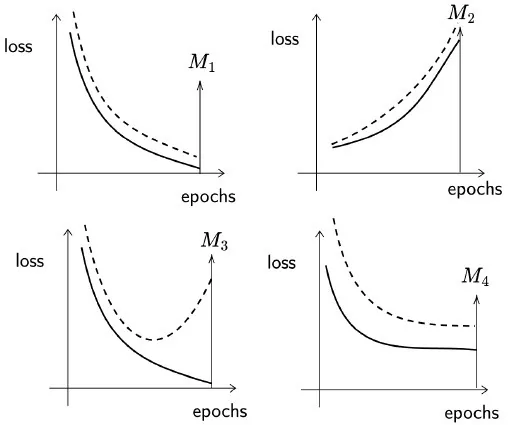 Now consider these four statements.
(A) Learning rate used is too high
(B) Low bias and high variance
(C) Low bias and low variance
(D) High bias and low variance
Choose the most appropriate pairing of models with the statements.
Now consider these four statements.
(A) Learning rate used is too high
(B) Low bias and high variance
(C) Low bias and low variance
(D) High bias and low variance
Choose the most appropriate pairing of models with the statements.- A

- B

- C

- D

- A
- Q5NAT2 Marks·Write the number
 Your answer:
 - Q6NAT4 Marks·Write the number
 Your answer:
 Read the passage below, then answer Q7–Q9
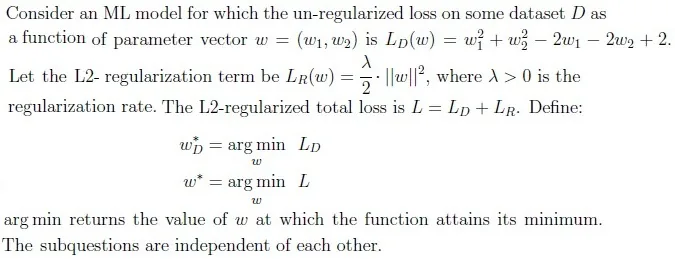
Based on the above data, answer the given subquestions.
Q7MCQ3 Marks·Choose one option
- A(1, 1)
- B(0, 0)
- C(−1,−1)
- D(1,−1)
- E(−1, 1)
- Q8NAT3 Marks·Write the number
 Your answer:
 - Q9MCQ3 Marks·Choose one option
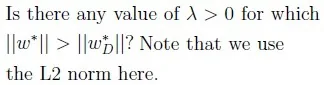
- AYes, there is at least one such value for which this happens.
- BYes, there are infinitely many values for which this happens.
- CYes, there are finitely many values from which this happens.
- DNo, there is no such λ> 0 for which this happens.
End Term · 13 Apr 2025 (AN)End Term
- Q10MSQ2 Marks·Choose all correct options
Consider applying dropout to a hidden layer with p = 0.5. Which of the following are true?
- ADuring training, a randomly chosen set of neurons in the layer are dropped out. The neurons to be dropped are determined dynamically during each iteration.
- BDuring inference (testing), no neurons are dropped out. Instead, the activation of each neuron in the layer is scaled by 0.5.
- CDuring training, a fixed set of neurons in the layer are dropped out. This set remains the same in every iteration and the neurons to be dropped are determined before the training begins.
- DDuring inference (testing), a randomly chosen set of neurons in the layer are dropped out.
- Q11MSQ3 Marks·Choose all correct options
Consider the following plot of error versus model complexity. Models of varying complexity are evaluated on the same training and test datasets. Model complexity increases from left to right:
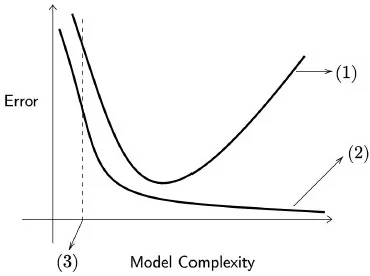 Select all true options.
- A(1) corresponds to the test error.
- B(2) corresponds to the training error.
- C(3) corresponds to a model with high bias and low variance.
- D(1) corresponds to the training error.
- E(2) corresponds to the test error.
- F(3) corresponds to a model with low bias and high variance.