Indian Institute of Technology Madras
BS Degree Programme · Examination & Study Paper
Deep Learning
Feedforward networks & output layers
Examination Instructions & Guidelines
- Solve on notebook/paper first before checking solutions.
- MCQ: Exactly 1 option is correct. Negative marking applies.
- MSQ: One or more options correct. Select all to score.
- NAT: Numerical response. No negative marking.
- Scientific calculator allowed for all calculations.
- Official answer key is sealed at the end of this sheet.
Quiz 1 · 26 Oct 2025 (AN)Quiz 1
- Q1MSQ3 Marks·Choose all correct options
You are adapting a neural network that was originally designed for a 10-class image classification problem to perform a regression task, specifically to predict the price of a car. Which of the following modifications are essential or standard practice for this conversion?
- AChange the activation function of the final output layer to a linear function.
- BSet the number of neurons in the output layer to one.
- CChange the loss function from Categorical Cross-Entropy to Mean Squared Error (MSE).
- DUse accuracy as the primary metric to evaluate the model’s performance.
- EKeep the softmax activation function in the output layer to scale the predicted price.
Read the passage below, then answer Q2–Q5
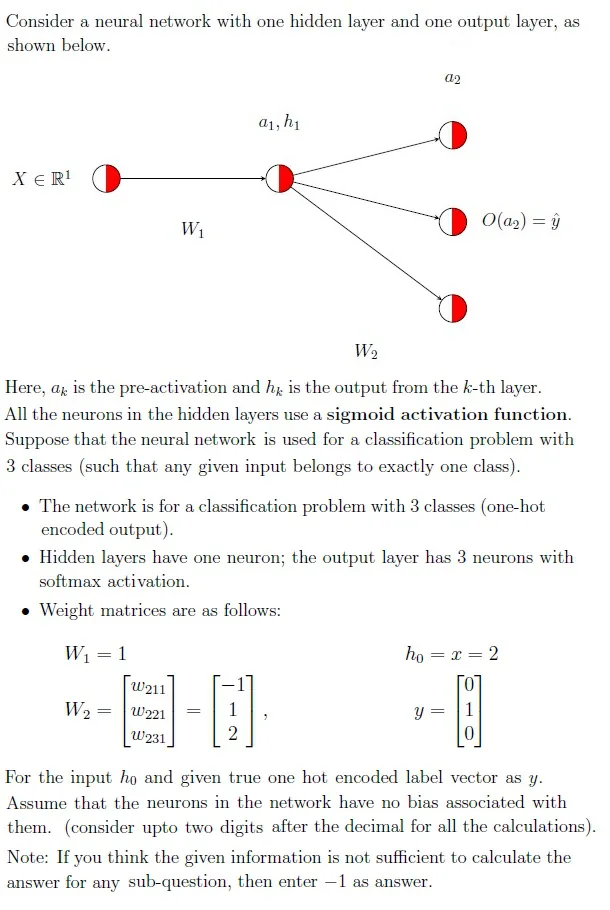
Based on the above data, answer the given subquestions.
Q2NAT1 Mark·Write the numberWhat is the value of the output of the hidden layer? (Answer correct upto two digits after the decimal)
Your answer:- Q3NAT1 Mark·Write the number
What is the value of the cross entropy loss? (use natural log). (Answer correct upto two digits after the decimal)
Your answer: - Q4NAT2 Marks·Write the number
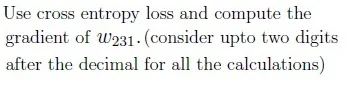 Your answer:
 - Q5NAT2 Marks·Write the number
Use cross entropy loss and compute the gradient of W_1 which is the weight between input and hidden layer. (consider upto two digits after the decimal for all the calculations)
Your answer: Read the passage below, then answer Q6–Q7
Suppose you build a neural network with one hidden layer that uses sigmoid as an activation function and an output layer with a softmax activation function. You initialize the hidden layer weights W_1 randomly and set the output layer weights W_2 to all zeros. Assume the bias is set to be zero. You train the network using stochastic gradient descent.
Based on the above data, answer the given subquestions.
Q6MCQ2 Marks·Choose one optionAfter one iteration of gradient descent, will the new weight for W_1 be the same as the previous weight?
- AYes
- BNo
- Q7MCQ2 Marks·Choose one option
After one iteration of gradient descent, will the new weight for W_2 be the same as the previous weight?
- AYes
- BNo
Quiz 2 · 3 Aug 2025 (AN)Quiz 2
Read the passage below, then answer Q8–Q10
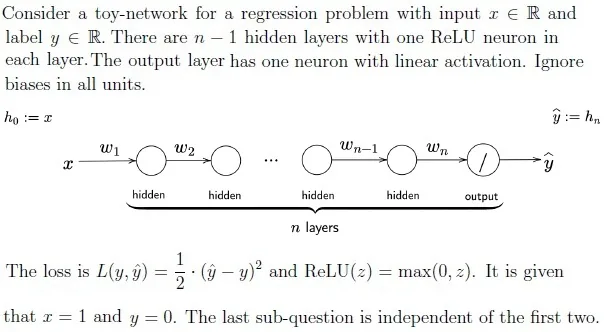
Based on the above data, answer the given subquestions.
Q8MCQ3 Marks·Choose one option
- A

- B

- C

- A
- Q9MCQ3 Marks·Choose one option
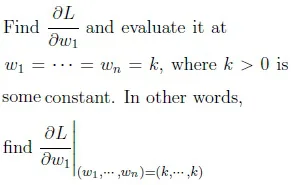
- A

- B

- C

- D

- E

- A
- Q10MCQ4 Marks·Choose one option
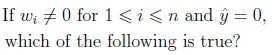
- A

- B

- C

- A
End Term · 13 Apr 2025 (AN)End Term
- Q11MCQ1 Mark·Choose one option
A neural network is being trained for a regression problem in which the target is in the interval (−1, 1). Which of the following is NOT a good choice for the activation function at the output layer?
- AReLU
- BLinear (identity)
- CTanh