Indian Institute of Technology Madras
BS Degree Programme · Examination & Study Paper
Deep Learning Practice
All 2025 papers
Examination Instructions & Guidelines
- Solve on notebook/paper first before checking solutions.
- MCQ: Exactly 1 option is correct. Negative marking applies.
- MSQ: One or more options correct. Select all to score.
- NAT: Numerical response. No negative marking.
- Scientific calculator allowed for all calculations.
- Official answer key is sealed at the end of this sheet.
Quiz 1 · 26 Oct 2025 (AN)Quiz 1
- Q1MCQ2 Marks·Choose one option
Which of the following statements best describes the primary advantage of the SentencePiece tokenizer compared to a standard BPE implementation?
- AIt is significantly faster to train because it does not need to count pairs.
- BIt results in a smaller vocabulary size by always merging the shortest tokens first.
- CIt is inherently language-agnostic, treating text as a raw stream of Unicode characters, which is ideal for languages without clear word delimiters like Japanese or Thai.
- DIt is deterministic and always produces the same tokenization for a given string,unlike BPE which can be probabilistic.
- Q2MCQ2 Marks·Choose one option
When performing full fine-tuning of a large language model (e.g., 10B parameters) using Adam, which component consumes the most GPU memory?
- AThe model’s weights (parameters).
- BThe gradients calculated for each parameter.
- CThe optimizer states (e.g., momentum and variance).
- DThe vocabulary and embedding matrix.
- Q3MCQ2 Marks·Choose one option
A company wants to align its chatbot with values of being helpful, harmless, and honest. Human labelers provide ideal responses and rank AI-generated outputs. Which adaptation technique is designed for this?
- AInstruction Tuning
- BZero-shot prompting
- CReinforcement Learning from Human Feedback (RLHF)
- DContinued pre-training
- Q4MCQ3 Marks·Choose one option

- A

- B

- C

- D

- A
- Q5MCQ3 Marks·Choose one option
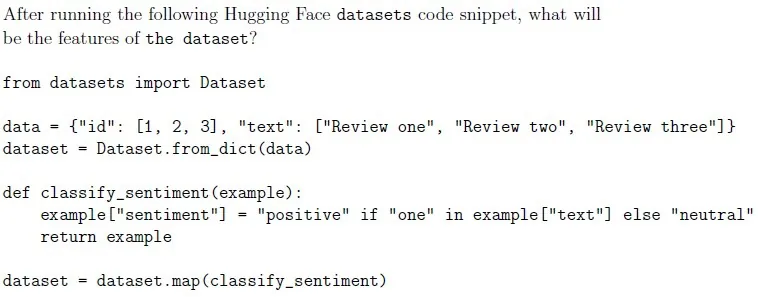
- A

- B

- C

- D

- A
- Q6MCQ3 Marks·Choose one option
What is a key implication of using a Parameter-Efficient Fine-Tuning (PEFT) method like LoRA when adapting a large language model for a new task?
- AInference speed is 10x faster.
- BOnly a small number of new parameters are trained while freezing original weights.
- CIt eliminates the need for labeled data.
- DModel must be retrained from scratch.
- Q7MCQ4 Marks·Choose one option
The WordPiece tokenization algorithm, unlike BPE, does not merge the pair with the highest frequency. Instead, it merges the pair that maximizes a likelihood score. Which of the following statements accurately describes this score and its implication?
- A

- B

- C

- D

- A
- Q8MSQ4 Marks·Choose all correct options
Which of the following statements accurately describes the Causal Language Modeling (CLM) objective used to pre-train models like GPT? (Select ALL that apply)
- APredicting randomly masked tokens.
- BAuto-regressive next-token prediction.
- CRequires causal attention mask.
- DSuited for encoder-only models.
- EMaximizes joint probability of sequence.
- Q9MSQ4 Marks·Choose all correct options
A research lab has access to a powerful 175B parameter language model. They need to adapt it for a highly specialized legal text analysis task, but they only have about 500 labeled examples and limited access to high-end GPUs for fine-tuning. Which of the following are viable and computationally efficient adaptation strategies? (Select ALL that apply)
- AFull fine-tuning
- BZero-shot prompting
- CFew-shot in-context learning
- DLoRA (PEFT)
- EPre-training from scratch
- Q10MSQ4 Marks·Choose all correct options
A team is fine-tuning a 7B parameter model on a single GPU with 24GB of memory. They are using the Adam optimizer (which stores 2 states per parameter) and 32-bit precision (4 bytes per parameter/ state/gradient). They find that they run out of memory even with a batch size of 1. Which of the following strategies could help them complete the fine-tuning process on this GPU? (Select ALL that apply)
- AIncrease learning rate
- BUse LoRA
- CUse quantization (8/4-bit)
- DSwitch to SGD
- EGradient accumulation
- Q11MSQ4 Marks·Choose all correct options
The evolution of NLP models shows a distinct shift from task-specific architectures to a ”pre-train, finetune” paradigm, and now towards large-scale, general-purpose models. Which of the following accurately represents this evolution and the capabilities at each stage? (Select ALL that apply)
- AThe earliest models (e.g., n-grams) were statistical, required task-specific design, and had limited generalization capacity.
- BThe ”pre-train, fine-tune” era (e.g., BERT, GPT) introduced transfer learning, where a model was first trained on a general language task and then fully adapted to a specific downstream task.
- CModern Large Language Models (LLMs like GPT-4) exhibit ”emerging abilities,” allowing them to perform new tasks with zero or few examples (in-context learning) without any weight updates.
- DWord2vec was a complete language model capable of generating text, similar to GPT.
- EThe primary innovation of transformers over RNNs was the use of recurrent connections, which made them more efficient to train on parallel hardware.
- Q12MSQ4 Marks·Choose all correct options
The three main families of Transformer-based models are Encoder-only (e.g., BERT), Decoder-only (e.g.,GPT), and Encoder-Decoder (e.g., T5, BART). Match the architecture to its most suitable pre- training objective and typical use case. (Select ALL that apply)
- AEncoder-only models are best for natural language understanding tasks (like sentiment classification) and are often pre-trained with a Masked Language Modeling (MLM) objective.
- BDecoder-only models are ideal for text generation tasks and are pre-trained with a Causal Language Modeling (CLM) objective.
- CEncoder-Decoder models are most suitable for sequence-to-sequence tasks like translation or summarization.
- DAll three architectures are pre-trained using the same Causal Language Modeling objective.
- Q13NAT3 Marks·Write the number
 Your answer:
 - Q14NAT4 Marks·Write the number
A single transformer block in a GPT-style model has the following configuration: embedding dimension (d model) = 1024, num attention heads = 16. Each attention head has a dimension of d model /num attention heads. Calculate the total number of parameters (weights and biases) for the self attention mechanism (specifically the Q, K, V, and Output projection layers) within this single block. Report the answer in millions, rounded to one decimal place.(in M)
Your answer: - Q15NAT4 Marks·Write the number
You are given a GPT-style model with a vocabulary size of 50,257, a context length of 1024, and an embedding dimension of 768. The model learns its positional embeddings rather than using fixed sinusoidal ones. Calculate the total number of parameters in the model’s embedding layer, which includes both token embeddings and positional embeddings. Report your answer in millions, rounded to one decimal place.(in M)
Your answer:
End Term · 31 Aug 2025 (FN)End Term
- Q16MCQ5 Marks·Choose one option
Consider the task of applying a convolutional layer with a stride of 1 to an image of size 227 × 227 (Grayscale), while ensuring that the output feature map retains the same spatial dimensions. Which of the following code snippets correctly implements this using PyTorch?
- A

- B

- C

- D

- A
- Q17MCQ5 Marks·Choose one option

- AOutput size: 8 × 8; Effective receptive field: 5 × 5
- BOutput size: 10 × 10; Effective receptive field: 5 × 5
- COutput size: 10 × 10; Effective receptive field: 3 × 3
- DOutput size: 12 × 12; Effective receptive field: 7 × 7
- Q18MCQ5 Marks·Choose one option
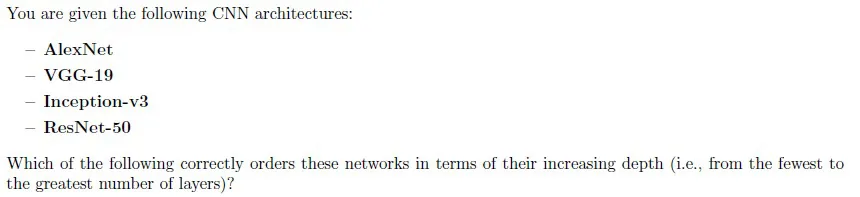
- AAlexNet < InceptionNet-v3 < VGG-19 < ResNet-50
- BAlexNet < VGG-19 < Inception-v3 < ResNet-50
- CInception-v3 < AlexNet < VGG-19 < ResNet-50
- DAlexNet < Inception-v3 < ResNet-50 < VGG-19
- Q19MCQ5 Marks·Choose one option
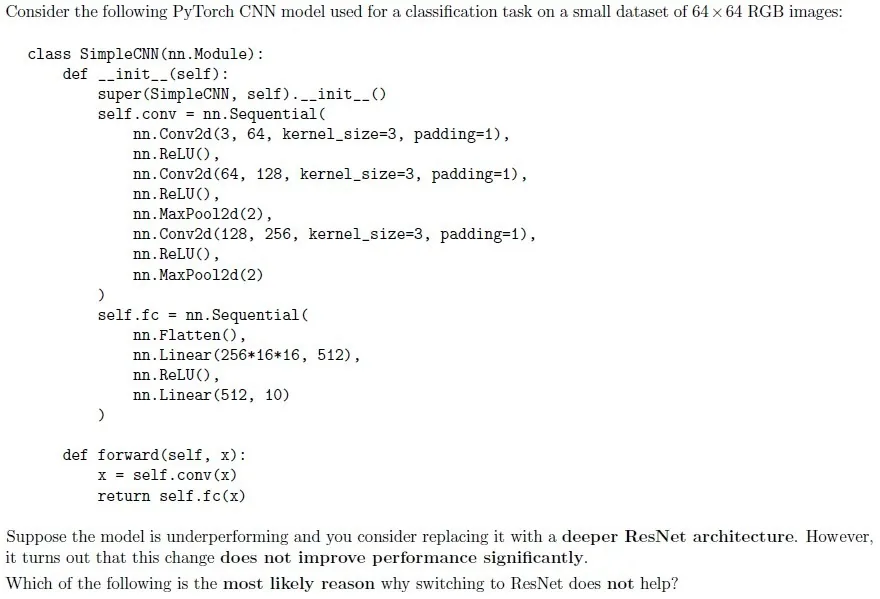
- AResNet has too many parameters for this simple task.
- BResidual connections are only useful when training very deep networks, and this task does not require such depth.
- CResNet architectures perform poorly on low-resolution inputs due to their reliance on fixed feature scales.
- DInceptionNet would have been better because it uses multiple receptive fields in parallel.
- Q20MCQ5 Marks·Choose one option
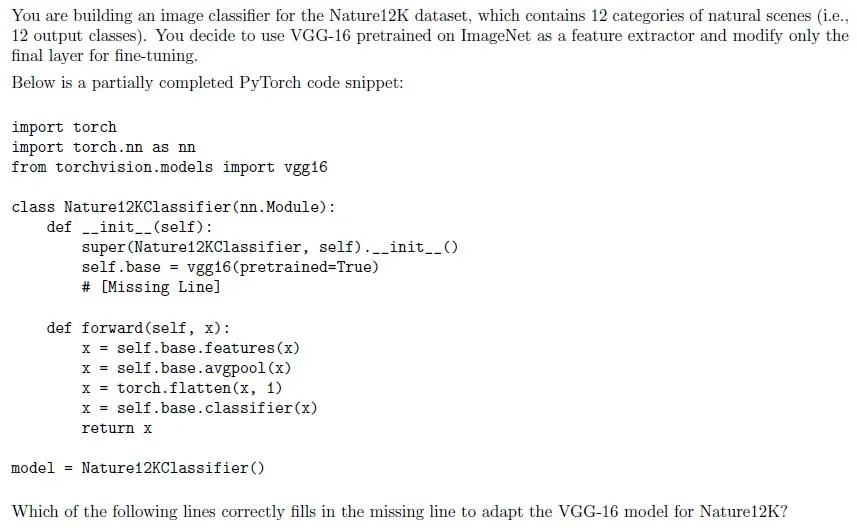
- A

- B

- C

- D

- A
- Q21MCQ5 Marks·Choose one option
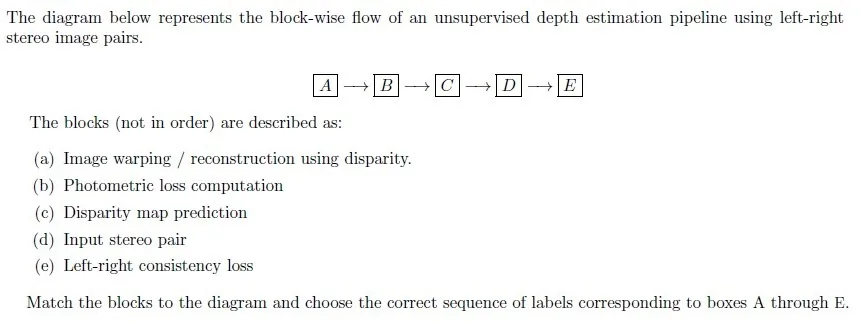
- AA–(e), B–(c), C–(a), D–(d), E–(b)
- BA–(e), B–(b), C–(c), D–(a), E–(d)
- CA–(e), B–(a), C–(c), D–(d), E–(b)
- DA–(c), B–(e), C–(a), D–(b), E–(d)
- Q22MCQ5 Marks·Choose one option
Consider the original U-Net architecture. Which of the following statements about the convolutional and pooling operations is correct?
- AU-Net uses 5 × 5 convolutional filters and 2 × 2 max pooling filters with stride 2 in the encoder path.
- BU-Net uses 3 × 3 convolutional filters and 2 × 2 average pooling filters with stride 1 in both encoder and decoder.
- CU-Net uses 3 × 3 convolutional filters (with padding) and 2 × 2 max pooling filters with stride 2 to halve the spatial resolution in the encoder.
- DU-Net uses 3 × 3 filters and 1 × 1 pooling to preserve spatial dimensions between contracting and expanding paths.
- Q23MSQ5 Marks·Choose all correct options
Which of the following are valid advantages of using Convolutional Neural Networks (CNNs) instead of fully connected Multilayer Perceptrons (MLPs) for image-based tasks?
- ACNNs require significantly fewer parameters than MLPs for high-dimensional image inputs.
- BCNNs are better at capturing spatial hierarchies due to weight sharing and local connectivity.
- CCNNs can approximate any function with fewer layers than MLPs due to the universal approximation theorem.
- DCNNs are translation invariant by design, making them robust to object position shifts in images.
- ECNNs do not require any activation functions since convolutions are linear operators.
- FCNNs are computationally faster than MLPs on image data due to sparse connections and weight sharing.
- Q24MSQ5 Marks·Choose all correct options
In the Faster R-CNN architecture, the Region Proposal Network (RPN) plays a critical role in object detection. Which of the following statements correctly describe the role of the RPN?
- AThe RPN generates a set of class-agnostic region proposals likely to contain objects.
- BThe RPN performs classification and bounding box regression to output object classes and their exact locations.
- CThe RPN uses anchor boxes of different scales and aspect ratios to slide over convolutional feature maps.
- DThe RPN replaces traditional region proposal methods like selective search, making the pipeline faster and end-to-end trainable.
- EThe RPN outputs fixed-size feature maps that are directly used for object classification.
- FThe RPN filters out background regions by assigning objectness scores to anchors.
- Q25MSQ5 Marks·Choose all correct options
Which of the following are valid advantages of YOLO compared to Fast R-CNN or Faster R-CNN?
- AYOLO performs object classification and localization in a single forward pass, making it faster than two-stage detectors like Fast R-CNN and Faster R-CNN.
- BYOLO does not require region proposal generation, making the entire pipeline fully end-to-end trainable.
- CYOLO achieves higher localization accuracy than Faster R-CNN on small objects due to its coarse grid-based prediction.
- DYOLO treats bounding box coordinates and objectness score as regression outputs, while computing class probabilities through classification.
- EYOLO achieves higher precision by using a large number of anchor boxes per region.
- FYOLO treats object detection as a regression problem, which simplifies the detection pipeline and reduces computational overhead.
- Q26MSQ5 Marks·Choose all correct options
Which of the following are advantages of ResNet over VGG-19?
- AResNet requires fewer parameters than VGG-19 while achieving higher accuracy.
- BResNet’s residual connections help mitigate vanishing gradients in very deep networks.
- COn the CIFAR-10 dataset, ResNet achieves higher training and validation accuracy using significantly fewer convolutional layers than VGG-19.
- DResNet models can be trained with depths exceeding 100 layers without suffering from degradation problems.
- EResNet blocks require more memory and training time due to the skip connections compared to VGG-19.
- FVGG-19 is easier to deploy on edge devices because of its lightweight residual architecture.
- Q27MSQ5 Marks·Choose all correct options
Which of the following code snippets can be used for data augmentation during training in PyTorch?
- A
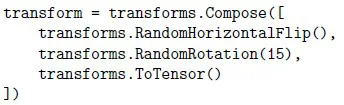
- B
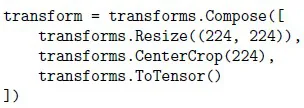
- C
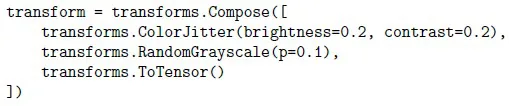
- D

- E
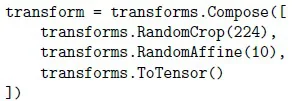
- A
- Q28MSQ5 Marks·Choose all correct options
Which of the following statements are correct regarding Generative Adversarial Networks (GANs)?
- AThe generator tries to minimize the probability that the discriminator correctly classifies fake samples.
- BThe discriminator is trained to maximize the probability of correctly classifying real and generated (fake) data.
- CThe generator directly receives labeled training data to learn the target distribution.
- DDuring training, the generator is updated based on the discriminator’s feedback to improve sample quality.
- EGAN training can suffer from instability due to the adversarial objective, leading to issues like mode collapse.
- FA perfectly trained discriminator ensures faster convergence of the generator.
- Q29MSQ5 Marks·Choose all correct options
SRGAN and ESRGAN are both deep learning architectures designed for single image super- resolution. Which of the following statements correctly describe the key differences between ESRGAN and SRGAN?
- AESRGAN replaces the standard residual blocks in SRGAN with Residual-in- Residual Dense Blocks (RRDB) for better performance.
- BSRGAN employs Perceptual Loss, while ESRGAN removes it to focus only on pixel-wise MSE loss for training stability.
- CESRGAN produces sharper and more realistic textures than SRGAN due to architectural and loss function improvements.
- DBoth SRGAN and ESRGAN use a VGG-based perceptual loss computed on feature maps extracted from deeper and shallower layers, respectively, of a pretrained classifier.
- ESRGAN is trained using only adversarial and perceptual losses, whereas ESRGAN includes a content loss computed using pixel-wise L1 loss.
- Q30MSQ5 Marks·Choose all correct options
The Multi-stage Progressive Image Restoration Network (MPRNet) is a state-of-the-art architecture for tasks like image deblurring and deraining. It follows a multi-stage design where features are progressively refined across stages. how many of the above components are explicitly part of the original MPRNet architecture?
- Aa single layer neural network.
- BUNet
- CSupervised Attention Module
- DChannel Attention Block
- EFast RCNN block
- Q31NAT5 Marks·Write the number
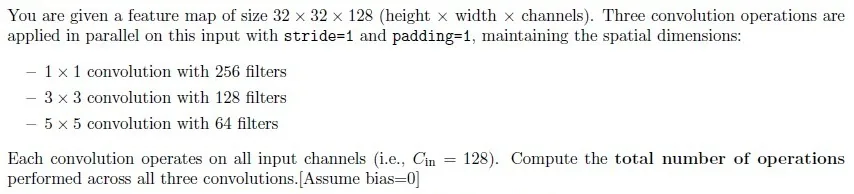 Your answer:
 - Q32NAT5 Marks·Write the number
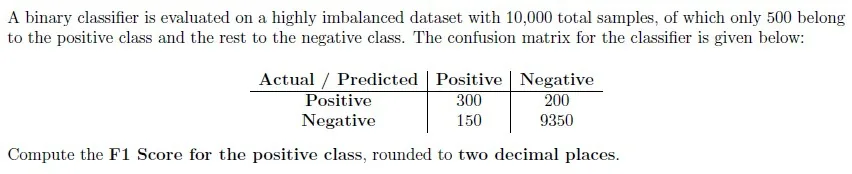 Your answer:
 - Q33NAT5 Marks·Write the number
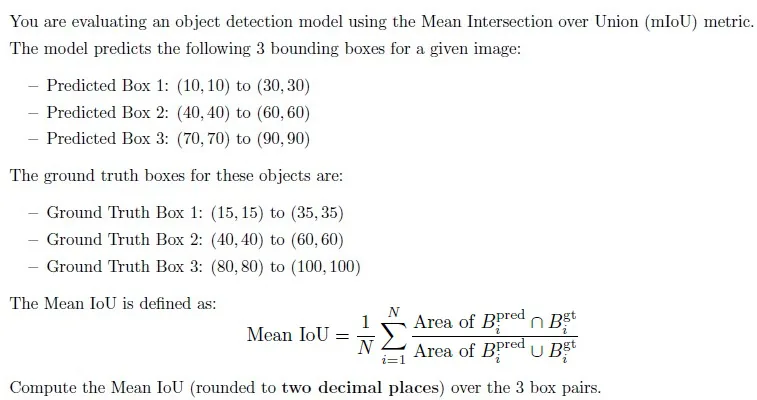 Your answer:
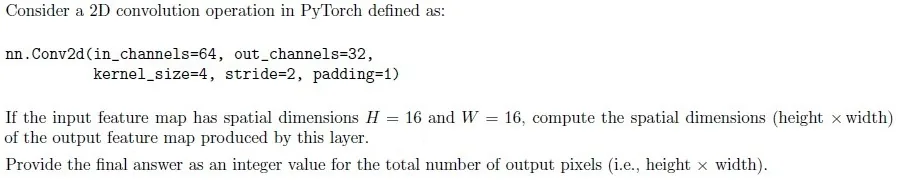
 - Q34NAT5 Marks·Write the number
 Your answer:
 Read the passage below, then answer Q35–Q37
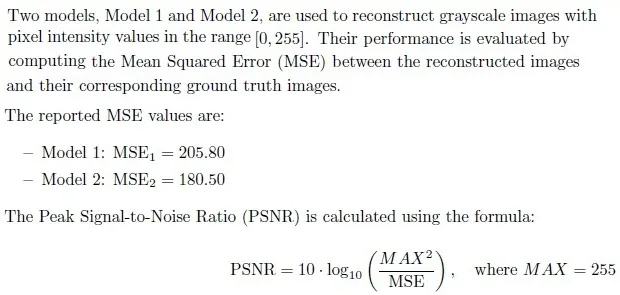
Based on the above data, answer the given subquestions.
Q35NAT1.5 Marks·Write the numberCompute the PSNR for Model 1 (in dB) (rounded to 2 decimal places) :
Your answer:- Q36NAT1.5 Marks·Write the number
Compute the PSNR for Model 2 (in dB) (rounded to 2 decimal places):
Your answer: - Q37NAT2 Marks·Write the number
Which model produces an image more similar to the ground truth?
Your answer:
End Term · 31 Aug 2025 (AN)End Term
- Q38MCQ5 Marks·Choose one option
Consider the task of applying a convolutional layer with a stride of 1 to an image of size 111 × 111 (Grayscale), while ensuring that the output feature map retains the same spatial dimensions. Which of the following code snippets correctly implements this using PyTorch?
- A

- B

- C

- D

- A
- Q39MCQ5 Marks·Choose one option

- AOutput size: 15 × 15; Effective receptive field: 5 × 5
- BOutput size: 17 × 17; Effective receptive field: 5 × 5
- COutput size: 13 × 13; Effective receptive field: 5 × 5
- DOutput size: 15 × 15; Effective receptive field: 3 × 3
- Q40MCQ5 Marks·Choose one option
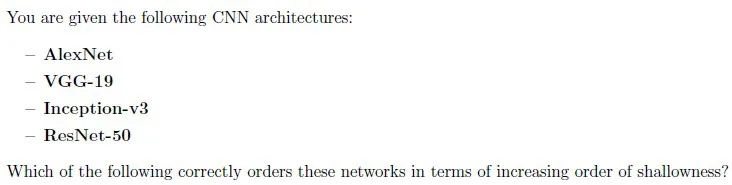
- AResNet-50 > Inception-v3 > VGG-19 > AlexNet
- BResNet-50 > VGG-19 > Inception-v3 > AlexNet
- CInception-v3 > ResNet-50 > VGG-19 > AlexNet
- DVGG-19 > ResNet-50 > Inception-v3 > AlexNet
- Q41MCQ5 Marks·Choose one option
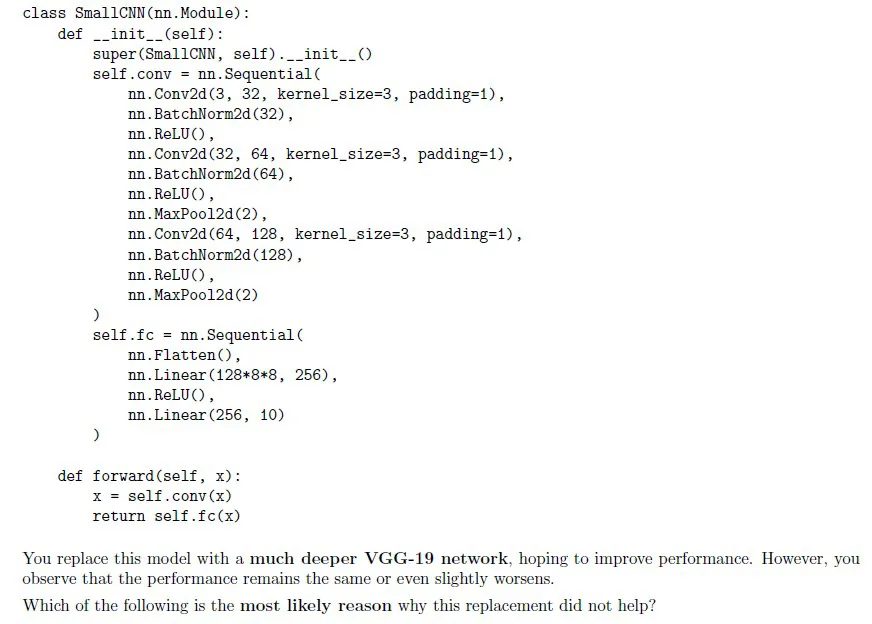
Consider the following PyTorch CNN model used for a classification task on a small dataset of 32 x 32 RGB images:
- AVGG-19 uses too many skip connections, which interfere with shallow patterns.
- BThe original model had batch normalization, and VGG-19 lacks it by default.
- CThe dataset is too small and simple for a deep architecture like VGG-19 to show its advantages, and may even overfit.
- DVGG-19 performs better only on grayscale images, not RGB images.
- Q42MCQ5 Marks·Choose one option
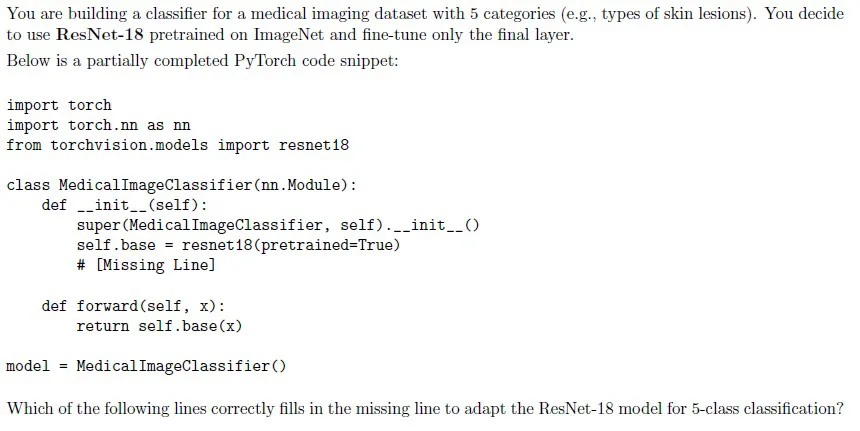
- A

- B

- C

- D

- A
- Q43MCQ5 Marks·Choose one option
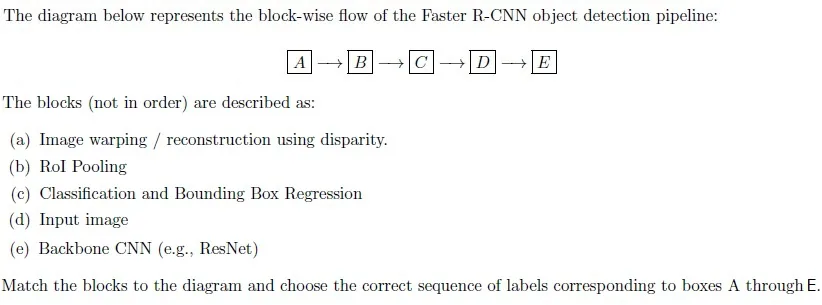
- AA–(d), B–(e), C–(a), D–(b), E–(c)
- BA–(d), B–(a), C–(e), D–(b), E–(c)
- CA–(e), B–(d), C–(a), D–(c), E–(b)
- DA–(d), B–(e), C–(b), D–(a), E–(c)
- Q44MCQ5 Marks·Choose one option
In the original U-Net architecture, which of the following statements about the decoder (expanding) path is correct?
- AThe decoder upsamples the feature maps using 2 x 2 transposed convolutions and concatenates them with corresponding encoder features.
- BThe decoder uses 3 x 3 max pooling to increase the spatial resolution before feature fusion.
- CThe decoder applies 1 x 1 convolutions to increase spatial dimensions and reduce channel depth.
- DThe decoder merges encoder and decoder features using element-wise addition instead of concatenation.
- Q45MSQ5 Marks·Choose all correct options
Which of the following are valid reasons why Convolutional Neural Networks (CNNs) are preferred over fully connected Multilayer Perceptrons (MLPs) for image processing tasks?
- ACNNs reduce the number of parameters by using local connections and weight sharing.
- BCNNs can process images of arbitrary size without any architectural changes.
- CCNNs exploit the spatial structure of images, making them more efficient at recognizing patterns.
- DCNNs perform better than MLPs because they always use deeper networks.
- ECNNs maintain spatial hierarchies by stacking convolution and pooling layers.
- FCNNs can generalize better to unseen data due to their built-in translational invariance.
- Q46MSQ5 Marks·Choose all correct options
In the Faster R-CNN architecture, the Region of Interest (RoI) Pooling layer plays a key role in the object detection pipeline. Which of the following statements correctly describe the function and properties of RoI Pooling?
- ARoI Pooling converts variable-sized region proposals into fixed-size feature maps for the classifier head.
- BRoI Pooling crops the region proposals from the input image and resizes them to a fixed dimension.
- CRoI Pooling enables batching and fully connected layers by standardizing the input dimensions.
- DRoI Pooling uses bilinear interpolation to produce smoother feature maps for each proposal.
- ERoI Pooling operates on convolutional feature maps, not directly on the raw image.
- FRoI Pooling discards proposals with low objectness scores before passing them to the classifier.
- Q47MSQ5 Marks·Choose all correct options
Which of the following are valid advantages of YOLO compared to Fast R-CNN or Faster R-CNN?
- AYOLO is faster at inference time because it predicts bounding boxes and class probabilities in a single pass.
- BYOLO is fully end-to-end trainable and does not rely on external region proposal mechanisms.
- CYOLO achieves higher recall than Faster R-CNN on all types of objects, especially small and overlapping ones.
- DYOLO formulates detection as a combination of regression (for bounding box coordinates and objectness score) and classification (for discrete object categories).
- EYOLO uses multi-scale feature fusion to improve detection of small objects.
- FYOLO’s architecture allows it to be deployed more easily on real-time and edge devices due to its compactness.
- Q48MSQ5 Marks·Choose all correct options
Which of the following are NOT advantages of AlexNet over InceptionNet?
- AAlexNet is simpler and easier to implement compared to the complex multi- branch design of InceptionNet.
- BAlexNet requires fewer parameters than InceptionNet due to its shallow architecture.
- CAlexNet has better accuracy on ImageNet than InceptionNet due to its early adoption of ReLU and dropout.
- DAlexNet is faster to train on small datasets because of its shallow depth and simpler structure.
- EInceptionNet extracts multi-scale features using filters of different sizes in parallel, which improves accuracy.
- FAlexNet lacks 1 x 1 convolutions, which are used in InceptionNet for dimensionality reduction and increased efficiency.
- Q49MSQ5 Marks·Choose all correct options
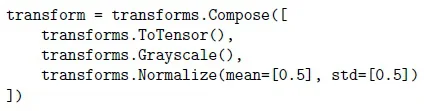
Which of the following code snippets can be used for data augmentation during training in PyTorch?
- A
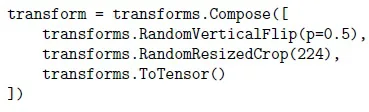
- B
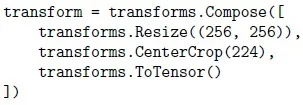
- C

- D
- E

- A
- Q50MSQ5 Marks·Choose all correct options
Which of the following statements are correct regarding the training dynamics and properties of Generative Adversarial Networks (GANs)?
- AThe generator’s objective is to produce data that the discriminator cannot distinguish from real data.
- BThe discriminator is trained to minimize the distance between the generated data and the real data distributions.
- CGAN training is a min-max game where the generator and discriminator have opposing goals.
- DMode collapse refers to the generator producing diverse outputs that cover multiple modes of the data distribution.
- EA balance between generator and discriminator learning rates is important to ensure stable training.
- FConditional GANs extend standard GANs by incorporating label information into both the generator and discriminator.
- Q51MSQ5 Marks·Choose all correct options
SRGAN and ESRGAN are both deep learning architectures designed for single image super- resolution. Which of the following statements about the differences between ESRGAN and SRGAN are NOT correct?
- AESRGAN replaces the standard residual blocks in SRGAN with Residual-in- Residual Dense Blocks (RRDB) for better performance.
- BSRGAN employs Perceptual Loss, while ESRGAN removes it to focus only on pixel-wise MSE loss for training stability.
- CESRGAN produces sharper and more realistic textures than SRGAN due to architectural and loss function improvements.
- DBoth SRGAN and ESRGAN use a VGG-based perceptual loss computed on feature maps extracted from deeper layers of a pretrained classifier.
- ESRGAN is trained using only adversarial and perceptual losses, whereas ESRGAN includes a content loss computed using pixel-wise L1 loss.
- Q52MSQ5 Marks·Choose all correct options
The Multi-stage Progressive Image Restoration Network (MPRNet) is designed to progressively restore degraded images across multiple stages. It integrates several architectural innovations to enhance image restoration performance. How many of the above components are explicitly part of the original MPRNet architecture?
- AUNet-style encoder-decoder at each stage
- BResidual Channel Attention Network (RCAN)
- CSupervised Attention Module (SAM)
- DSkip connections across stages
- ENon-local Attention Module
- Q53NAT5 Marks·Write the number
 Your answer:
 - Q54NAT5 Marks·Write the number
 Your answer:
 - Q55NAT5 Marks·Write the number
 Your answer:
 - Q56NAT5 Marks·Write the number
 Your answer:
 Read the passage below, then answer Q57–Q59
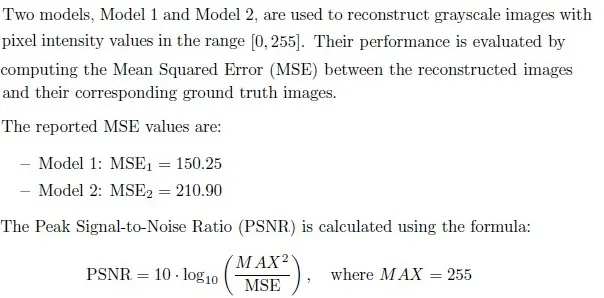
Based on the above data, answer the given subquestions.
Q57NAT1.5 Marks·Write the numberCompute the PSNR for Model 1 (in dB) (rounded to 2 decimal places):
Your answer:- Q58NAT1.5 Marks·Write the number
Compute the PSNR for Model 2 (in dB) (rounded to 2 decimal places):
Your answer: - Q59NAT2 Marks·Write the number
Which model produces an image more similar to the ground truth?
Your answer:
Quiz 2 · 3 Aug 2025 (AN)Quiz 2
- Q60MCQ3 Marks·Choose one option
In a speaker diarization pipeline that uses Whisper for transcription and an embedding model for speaker identification,you observe that one speaker's segments are consistently broken into multiple smaller segments, each assigned a different speaker label (e.g., SPEAKER 1, SPEAKER 3, SPEAKER 5). The transcribed text for this speaker is perfectly accurate. What is the MOST likely cause of this specific issue?
- A

- B

- C

- D

- A
- Q61MCQ3 Marks·Choose one option
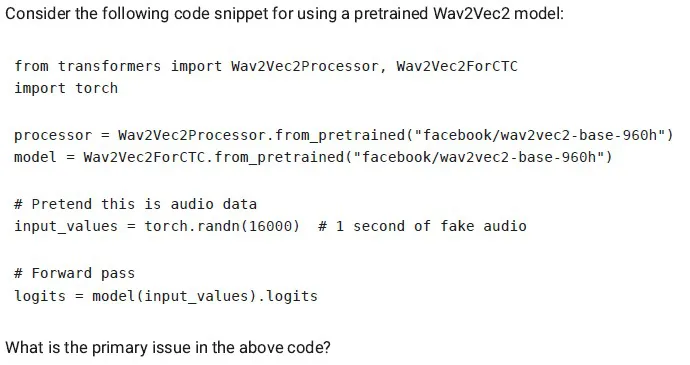
- A

- B

- C

- D

- A
- Q62MSQ5 Marks·Choose all correct options
Which statements accurately describe the roles and differences of the data collators used in the ASR and TTS training scripts?
- A

- B

- C

- D

- E

- A
- Q63MSQ5 Marks·Choose all correct options

- A

- B

- C

- D

- E

- A
- Q64NAT5 Marks·Write the number
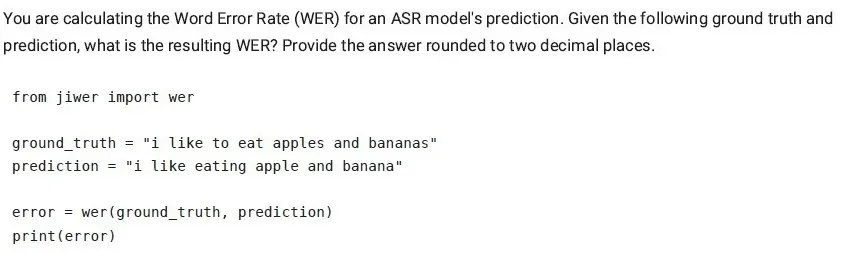 Your answer:
 - Q65NAT5 Marks·Write the number
 Your answer:
 Read the passage below, then answer Q66–Q68
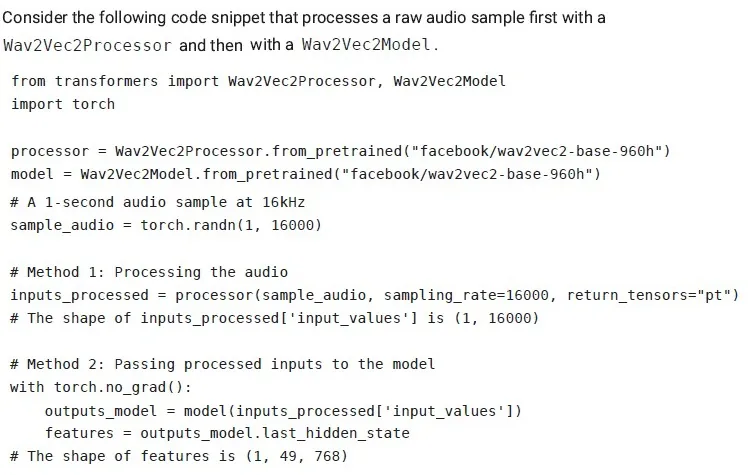
Based on the above data, answer the given subquestions.
Q66MCQ4 Marks·Choose one option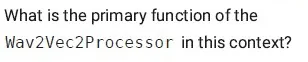
- ATo convert the raw audio waveform into a sequence of contextualized hidden states.
- BTo normalize the raw audio waveform and prepare it in the correct tensor format for the model.
- CTo downsample the audio from its native sampling rate to 16000 Hz.
- DTo tokenize the audio into a sequence of discrete units, similar to a text tokenizer.
- Q67NAT5 Marks·Write the number
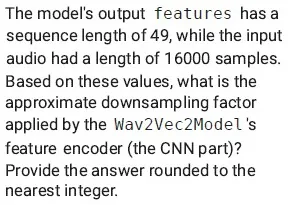 Your answer:
 - Q68MSQ5 Marks·Choose all correct options
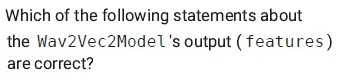
- A
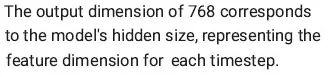
- B

- C
- D
- E

- A
Read the passage below, then answer Q69–Q70
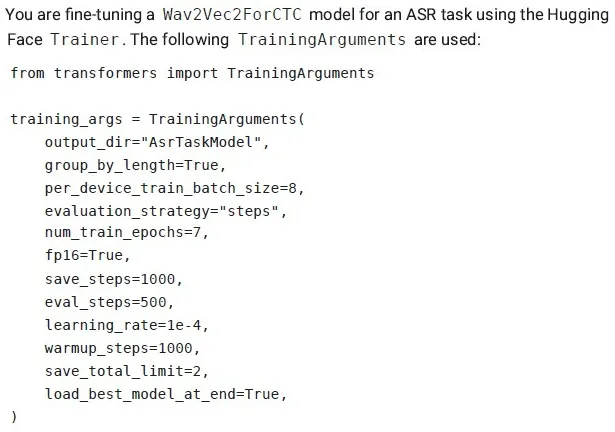
Based on the above data, answer the given subquestions.
Q69MCQ5 Marks·Choose one option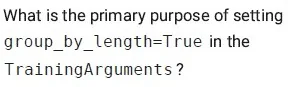
- ATo sort the entire dataset by audio duration before training begins.
- BTo ensure each batch contains audios of exactly the same length, eliminating the need for padding.
- CTo create batches with samples of similar input length, which minimizes the amount of padding required and improves training efficiency.
- DTo group samples by the length of their text transcription rather than their audio length.
- Q70MSQ5 Marks·Choose all correct options
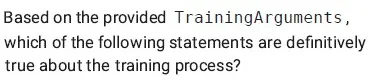
- A

- B
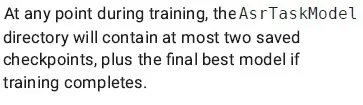
- C
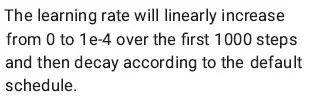
- D

- E
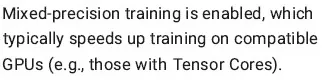
- A
End Term · 13 Apr 2025 (AN)End Term
- Q71MCQ5 Marks·Choose one option
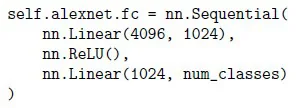
Consider the following code snippet for modifying an AlexNet architecture to adapt it for a custom classification task with 10 output classes. Fill in the blank portion with the most appropriate code snippet.
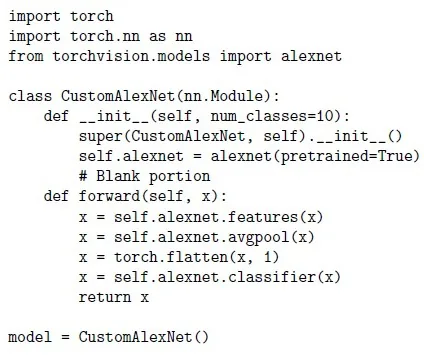 Which of the following code snippets correctly fills the blank portion to modify the AlexNet classifier while preserving the pretrained feature extraction layers?
- A

- B

- C
- D

- A
- Q72MCQ5 Marks·Choose one option
An RGB image of size 227 × 227 × 3 is first converted to grayscale and then passed through a 2D Convolutional Neural Network (CNN) layer with the following parameters: – Kernel size: 3 × 3 – Stride: 1 – Padding: 1 – Number of filters: 16 What will be the shape of the output feature map?
- A(227, 227, 3)
- B(227, 227, 16)
- C(225, 225, 16)
- D(114, 114, 16)
- Q73MCQ5 Marks·Choose one option

- A0.25
- B0.29
- C0.45
- D0.21
- Q74MCQ5 Marks·Choose one option
Consider a Convolutional Neural Network (CNN) where the feature map after the convolutional and pooling layers has a shape of (8, 8, 64). This feature map is flattened and connected to a fully connected layer with 256 output neurons. How many parameters (weights and biases) are in this fully connected layer?
- A524, 544
- B65, 536
- C258, 048
- D10, 48, 832
- Q75MCQ5 Marks·Choose one option
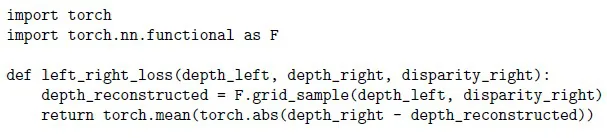
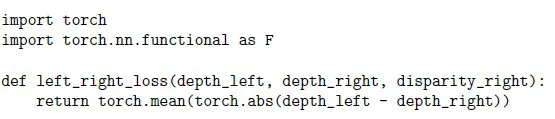
In self-supervised depth estimation, left-right consistency loss is often used to ensure that the depth maps from stereo images agree with each other. Which of the following code snippets correctly implements a left-right consistency loss by reconstructing the left depth map from the right depth map using disparity?
- A
- B
- C
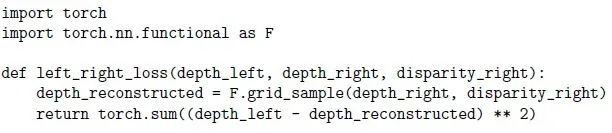
- D
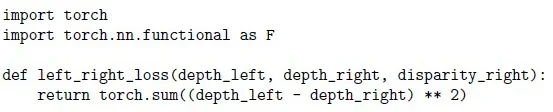
- A
- Q76MCQ5 Marks·Choose one option
In the Fast R-CNN object detection pipeline, which of the following steps is NOT part of the preprocessing process?
- AResize the input image to a fixed size.
- BExtract region proposals using Selective Search.
- CApply a Region Proposal Network (RPN) to generate region proposals.
- DExtract features from the entire image using a CNN backbone before classifying region proposals.
- Q77MCQ5 Marks·Choose one option
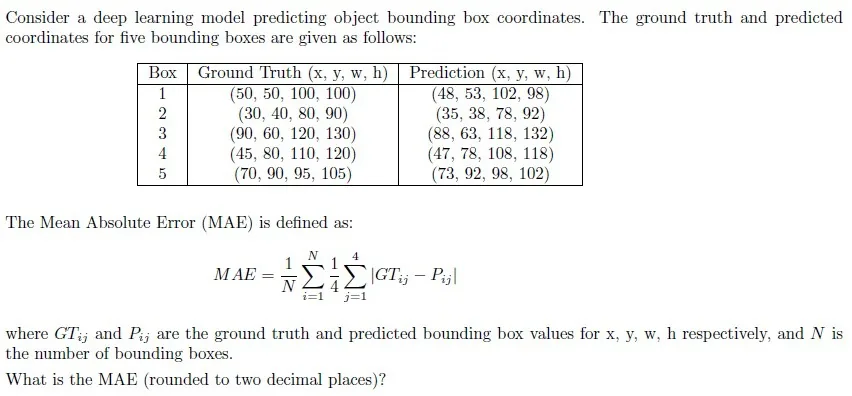
- A2.00
- B2.25
- C2.40
- D2.75
- Q78MCQ5 Marks·Choose one option
The following code snippets attempt to implement an Inception module in PyTorch. Identify the correct snippet(s):
- A
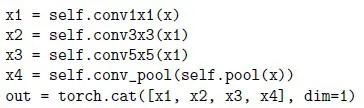
- B
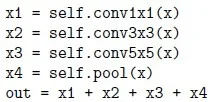
- C
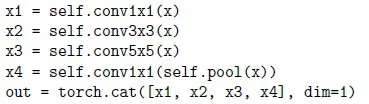
- D
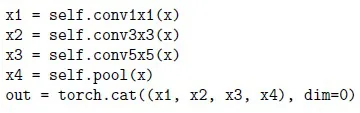
- A
- Q79MCQ5 Marks·Choose one option
LAKDNet is designed to enhance feature extraction and knowledge distillation in deep neural networks. Which of the following best describes its core architectural improvement?
- AIt employs a Dual Attention Mechanism (Spatial and Channel Attention) to improve feature aggregation.
- BIt uses Graph Convolutional Networks (GCNs) to capture hierarchical dependencies in spatial features.
- CIt integrates Recurrent Neural Networks (RNNs) to enhance temporal feature extraction.
- DIt relies on Transformer-based self-attention to capture global contextual dependencies.
- Q80MCQ5 Marks·Choose one option
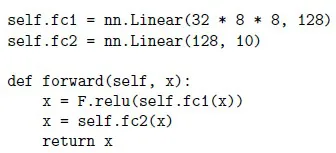
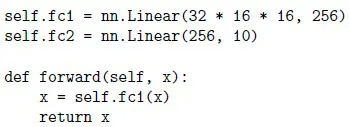
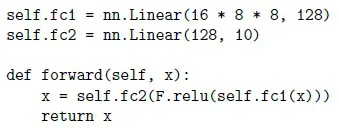
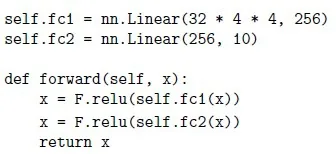
The following PyTorch code implements a simple Convolutional Neural Network (CNN). However, some of the layers are incomplete. Select the correct option to complete the layers.
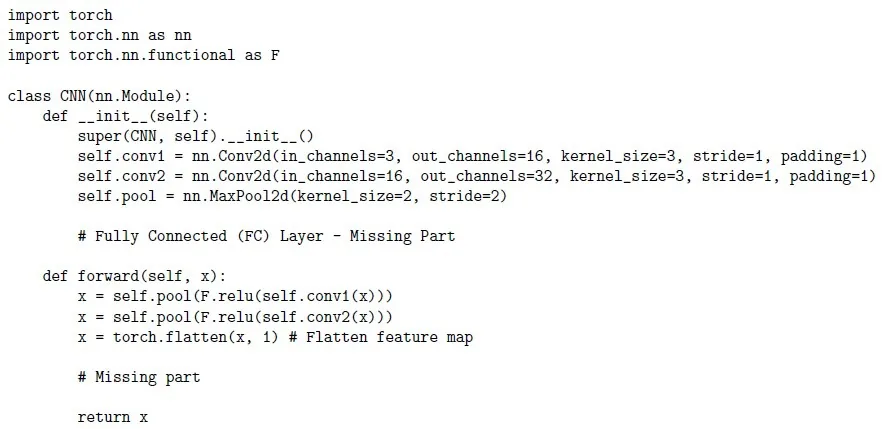
- A
- B
- C
- D
- A
- Q81MCQ5 Marks·Choose one option
SRGAN is a deep learning-based approach for image super-resolution that improves the perceptual quality of upscaled images. Which of the following best describes the role of the adversarial loss in SRGAN?
- AIt minimizes the pixel-wise difference between the super-resolved and high- resolution images to ensure pixel accuracy.
- BIt encourages the generator to produce high-resolution images that are perceptually similar to real images by fooling the discriminator.
- CIt directly optimizes the Structural Similarity Index (SSIM) to improve texture and detail preservation.
- DIt ensures that the generated high-resolution images have better Peak Signal- to-Noise Ratio (PSNR) compared to traditional interpolation methods.
- Q82MCQ5 Marks·Choose one option
In the U-Net architecture, downsampling is performed using pooling layers to reduce spatial dimensions while preserving important features. Which of the following code snippets correctly implement the pooling layer in U-Net?
- A
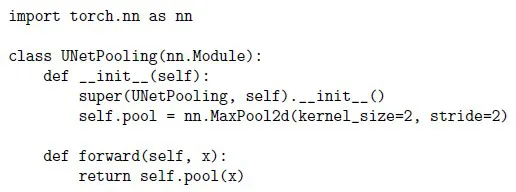
- B
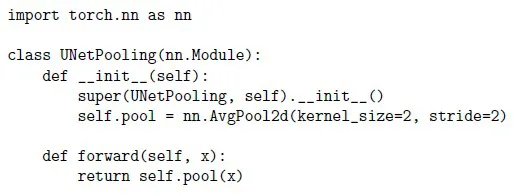
- C
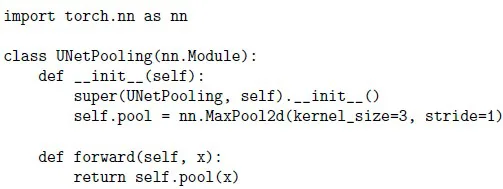
- D
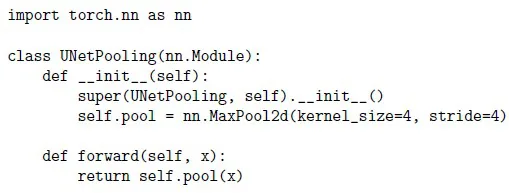
- A
- Q83MCQ5 Marks·Choose one option
Consider the following code snippet, which generates predictions and ground truth for an object detection task:
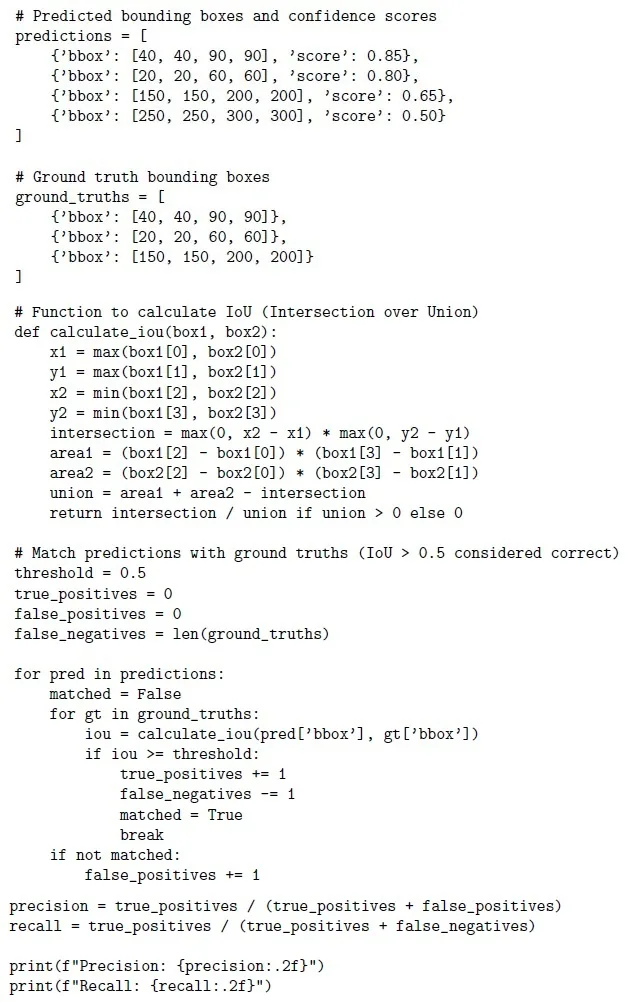 Given the predictions and ground truths, what are the precision and recall values?
- APrecision: 0.75, Recall: 1.00
- BPrecision: 0.75, Recall: 0.75
- CPrecision: 1.00, Recall: 0.75
- DPrecision: 0.60, Recall: 1.00
- Q84MCQ5 Marks·Choose one option
Consider the following code snippet, which calculates the F1-score for an object detection task:
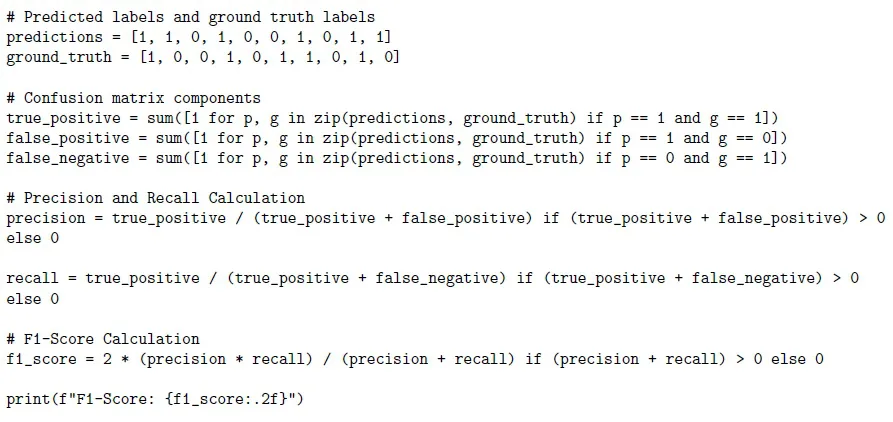 Given the predictions and ground truth, what is the calculated F1-score?
- A0.67
- B0.71
- C0.73
- D0.75
- Q85MCQ5 Marks·Choose one option
In VGGNet, which part of the architecture contributes the most to memory utilization during training, and which part contains the **highest number of parameters?
- AThe early convolutional layers have the highest memory utilization, while the fully connected layers** have the highest number of parameters.
- BThe fully connected layers have the highest memory utilization, while the convolutional layers have the highest number of parameters.
- CThe deeper convolutional layers have the highest memory utilization, while the **pooling layers** have the highest number of parameters.
- DThe batch normalization layers have the highest memory utilization, while the skip connections have the highest number of parameters.
- Q86MSQ5 Marks·Choose all correct options
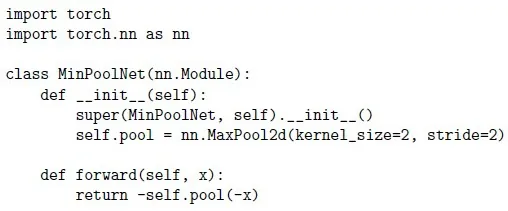
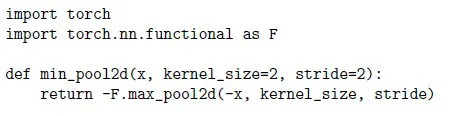
Which of the following code snippets correctly implement Min Pooling in PyTorch?
- A
- B
- C
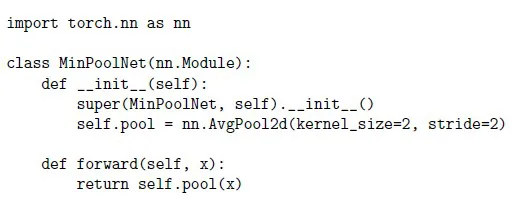
- D
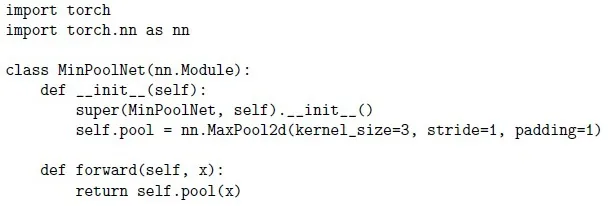
- A
- Q87MSQ5 Marks·Choose all correct options
In deep convolutional neural networks, 1 x 1 convolutions play a significant role in optimizing computation and feature extraction. Which of the following statements correctly describe their role in modern CNN architectures?
- A1 x 1 convolutions can be used to perform dimensionality reduction by reducing the number of channels before applying computationally expensive convolutions.
- BThey introduce non-linearity into the network, even when used without activation functions.
- C1 x 1 convolutions enable cross-channel interactions by linearly combining feature maps from different channels.
- DIn ResNet architectures, 1 x 1 convolutions are used in bottleneck blocks to match the dimensions when applying skip connections.
- EWhen applied after a max pooling layer, 1 x 1 convolutions help recover lost spatial information by increasing the resolution of the feature maps.
- Q88MSQ5 Marks·Choose all correct options
Consider the following PyTorch code snippet for a custom ResNet block.
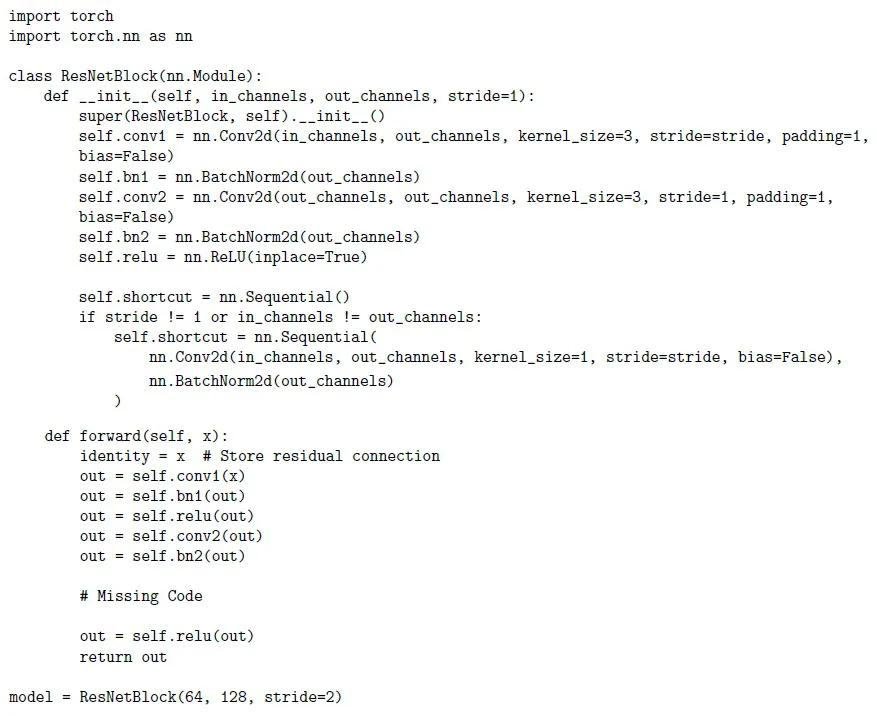 Which of the following options correctly fill in the missing code snippet?
- A
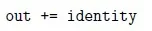
- B

- C

- D

- E

- A
- Q89MSQ5 Marks·Choose all correct options
Estimating depth from a single image using a multiscale deep neural network presents several challenges. Which of the following correctly describe these challenges?
- AUnderstanding global context and handling variations in scene geometry and textureless regions.
- BDealing with scale ambiguity and the lack of absolute depth reference in monocular images.
- CReducing computational complexity while matching points across two images.
- DHandling occlusions and depth discontinuities, especially at object boundaries.
- EAccurately aligning stereo image pairs and computing disparity for depth estimation.
- Q90MSQ5 Marks·Choose all correct options
Monocular depth estimation using a multiscale deep neural network presents several challenges due to the lack of direct depth cues. Which of the following is a primary challenge specific to monocular depth estimation?
- AHandling scale ambiguity and the absence of absolute depth reference in single images.
- BAccurately computing depth by triangulating matching keypoints between two images.
- CEstimating depth consistently in textureless regions and under varying lighting conditions.
- DUsing LiDAR or structured light to obtain precise depth values instead of predicting them.
Official KeyMaster Answer Key & Explanations
Official answer keys from IIT Madras BS past papers. Click any question to review.
Reveal KeyCollapse Key
Master Answer Key & Explanations
Official answer keys from IIT Madras BS past papers. Click any question to review.