Indian Institute of Technology Madras
BS Degree Programme · Examination & Study Paper
Deep Learning Practice
Convolution & pooling arithmetic
Examination Instructions & Guidelines
- Solve on notebook/paper first before checking solutions.
- MCQ: Exactly 1 option is correct. Negative marking applies.
- MSQ: One or more options correct. Select all to score.
- NAT: Numerical response. No negative marking.
- Scientific calculator allowed for all calculations.
- Official answer key is sealed at the end of this sheet.
End Term · 31 Aug 2025 (FN)End Term
- Q1MCQ5 Marks·Choose one option
Consider the task of applying a convolutional layer with a stride of 1 to an image of size 227 × 227 (Grayscale), while ensuring that the output feature map retains the same spatial dimensions. Which of the following code snippets correctly implements this using PyTorch?
- A

- B

- C

- D

- A
- Q2MCQ5 Marks·Choose one option

- AOutput size: 8 × 8; Effective receptive field: 5 × 5
- BOutput size: 10 × 10; Effective receptive field: 5 × 5
- COutput size: 10 × 10; Effective receptive field: 3 × 3
- DOutput size: 12 × 12; Effective receptive field: 7 × 7
- Q3MSQ5 Marks·Choose all correct options
Which of the following are valid advantages of using Convolutional Neural Networks (CNNs) instead of fully connected Multilayer Perceptrons (MLPs) for image-based tasks?
- ACNNs require significantly fewer parameters than MLPs for high-dimensional image inputs.
- BCNNs are better at capturing spatial hierarchies due to weight sharing and local connectivity.
- CCNNs can approximate any function with fewer layers than MLPs due to the universal approximation theorem.
- DCNNs are translation invariant by design, making them robust to object position shifts in images.
- ECNNs do not require any activation functions since convolutions are linear operators.
- FCNNs are computationally faster than MLPs on image data due to sparse connections and weight sharing.
- Q4NAT5 Marks·Write the number
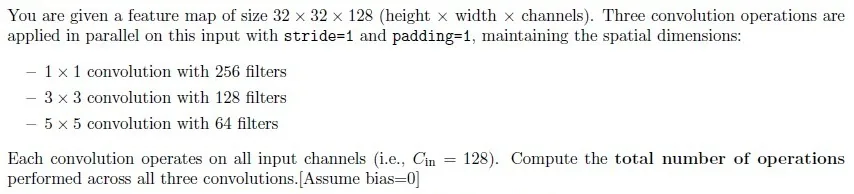 Your answer:
 - Q5NAT5 Marks·Write the number
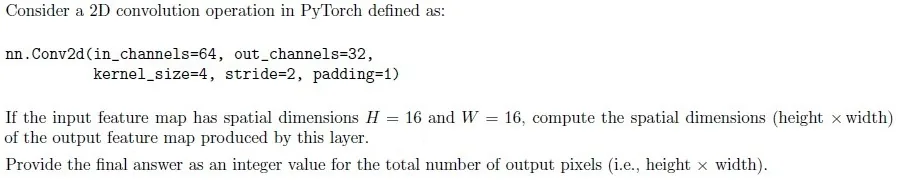 Your answer:
End Term · 31 Aug 2025 (AN)End Term
- Q6MCQ5 Marks·Choose one option
Consider the task of applying a convolutional layer with a stride of 1 to an image of size 111 × 111 (Grayscale), while ensuring that the output feature map retains the same spatial dimensions. Which of the following code snippets correctly implements this using PyTorch?
- A

- B

- C

- D

- A
- Q7MCQ5 Marks·Choose one option

- AOutput size: 15 × 15; Effective receptive field: 5 × 5
- BOutput size: 17 × 17; Effective receptive field: 5 × 5
- COutput size: 13 × 13; Effective receptive field: 5 × 5
- DOutput size: 15 × 15; Effective receptive field: 3 × 3
- Q8MSQ5 Marks·Choose all correct options
Which of the following are valid reasons why Convolutional Neural Networks (CNNs) are preferred over fully connected Multilayer Perceptrons (MLPs) for image processing tasks?
- ACNNs reduce the number of parameters by using local connections and weight sharing.
- BCNNs can process images of arbitrary size without any architectural changes.
- CCNNs exploit the spatial structure of images, making them more efficient at recognizing patterns.
- DCNNs perform better than MLPs because they always use deeper networks.
- ECNNs maintain spatial hierarchies by stacking convolution and pooling layers.
- FCNNs can generalize better to unseen data due to their built-in translational invariance.
- Q9NAT5 Marks·Write the number
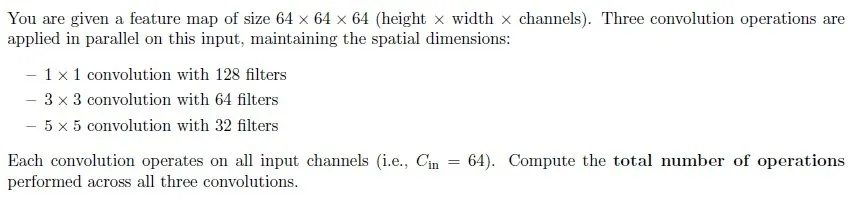 Your answer:
 - Q10NAT5 Marks·Write the number
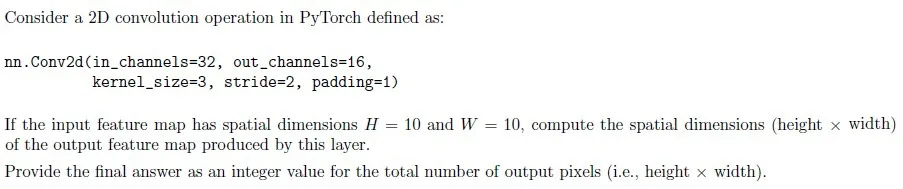 Your answer:
End Term · 13 Apr 2025 (AN)End Term
- Q11MCQ5 Marks·Choose one option
An RGB image of size 227 × 227 × 3 is first converted to grayscale and then passed through a 2D Convolutional Neural Network (CNN) layer with the following parameters: – Kernel size: 3 × 3 – Stride: 1 – Padding: 1 – Number of filters: 16 What will be the shape of the output feature map?
- A(227, 227, 3)
- B(227, 227, 16)
- C(225, 225, 16)
- D(114, 114, 16)
- Q12MCQ5 Marks·Choose one option
Consider a Convolutional Neural Network (CNN) where the feature map after the convolutional and pooling layers has a shape of (8, 8, 64). This feature map is flattened and connected to a fully connected layer with 256 output neurons. How many parameters (weights and biases) are in this fully connected layer?
- A524, 544
- B65, 536
- C258, 048
- D10, 48, 832
- Q13MCQ5 Marks·Choose one option
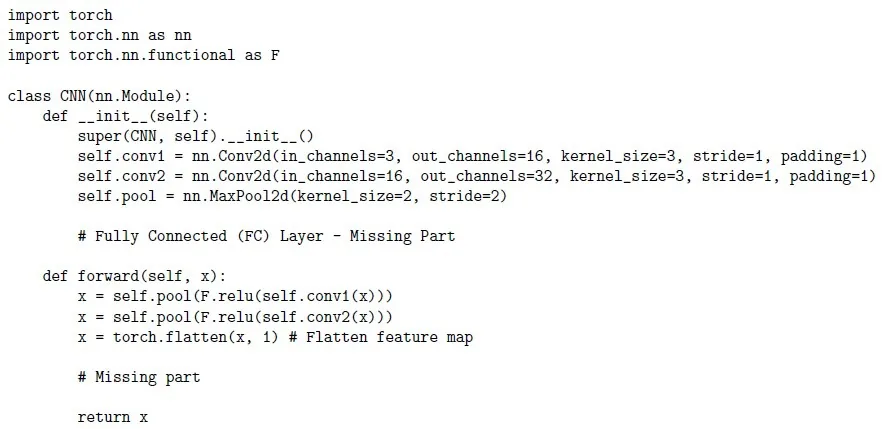
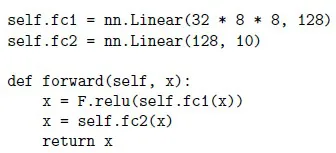
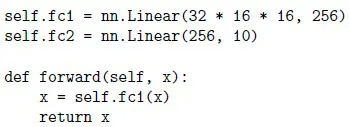
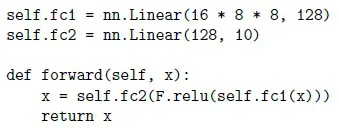
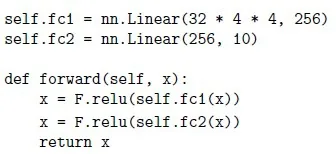
The following PyTorch code implements a simple Convolutional Neural Network (CNN). However, some of the layers are incomplete. Select the correct option to complete the layers.
- A
- B
- C
- D
- A
- Q14MSQ5 Marks·Choose all correct options
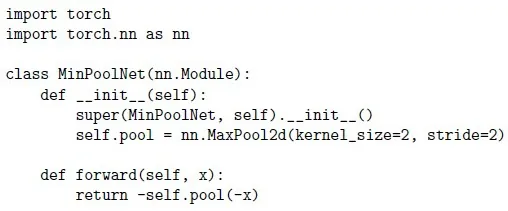
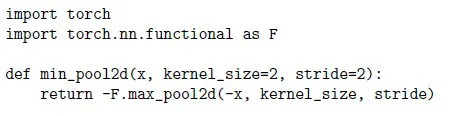
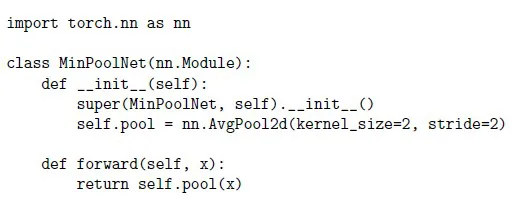
Which of the following code snippets correctly implement Min Pooling in PyTorch?
- A
- B
- C
- D
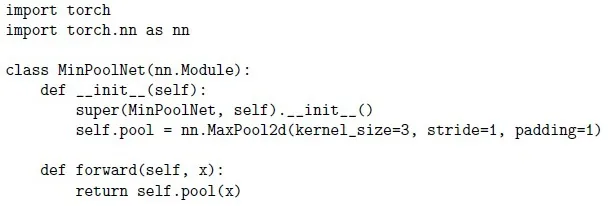
- A
- Q15MSQ5 Marks·Choose all correct options
In deep convolutional neural networks, 1 x 1 convolutions play a significant role in optimizing computation and feature extraction. Which of the following statements correctly describe their role in modern CNN architectures?
- A1 x 1 convolutions can be used to perform dimensionality reduction by reducing the number of channels before applying computationally expensive convolutions.
- BThey introduce non-linearity into the network, even when used without activation functions.
- C1 x 1 convolutions enable cross-channel interactions by linearly combining feature maps from different channels.
- DIn ResNet architectures, 1 x 1 convolutions are used in bottleneck blocks to match the dimensions when applying skip connections.
- EWhen applied after a max pooling layer, 1 x 1 convolutions help recover lost spatial information by increasing the resolution of the feature maps.