Indian Institute of Technology Madras
BS Degree Programme · Examination & Study Paper
Deep Learning Practice
End Term · 31 Aug 2025 (Forenoon)
Examination Instructions & Guidelines
- Solve on notebook/paper first before checking solutions.
- MCQ: Exactly 1 option is correct. Negative marking applies.
- MSQ: One or more options correct. Select all to score.
- NAT: Numerical response. No negative marking.
- Scientific calculator allowed for all calculations.
- Official answer key is sealed at the end of this sheet.
- Q1MCQ5 Marks·Choose one option
Consider the task of applying a convolutional layer with a stride of 1 to an image of size 227 × 227 (Grayscale), while ensuring that the output feature map retains the same spatial dimensions. Which of the following code snippets correctly implements this using PyTorch?
- A

- B

- C

- D

- A
- Q2MCQ5 Marks·Choose one option

- AOutput size: 8 × 8; Effective receptive field: 5 × 5
- BOutput size: 10 × 10; Effective receptive field: 5 × 5
- COutput size: 10 × 10; Effective receptive field: 3 × 3
- DOutput size: 12 × 12; Effective receptive field: 7 × 7
- Q3MCQ5 Marks·Choose one option
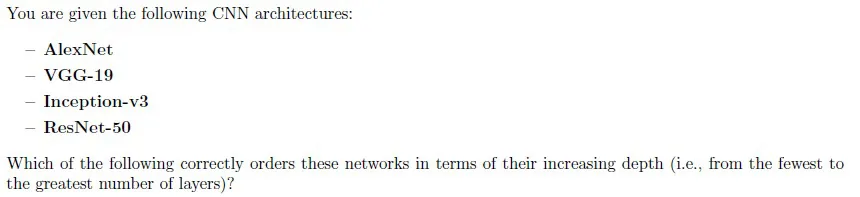
- AAlexNet < InceptionNet-v3 < VGG-19 < ResNet-50
- BAlexNet < VGG-19 < Inception-v3 < ResNet-50
- CInception-v3 < AlexNet < VGG-19 < ResNet-50
- DAlexNet < Inception-v3 < ResNet-50 < VGG-19
- Q4MCQ5 Marks·Choose one option
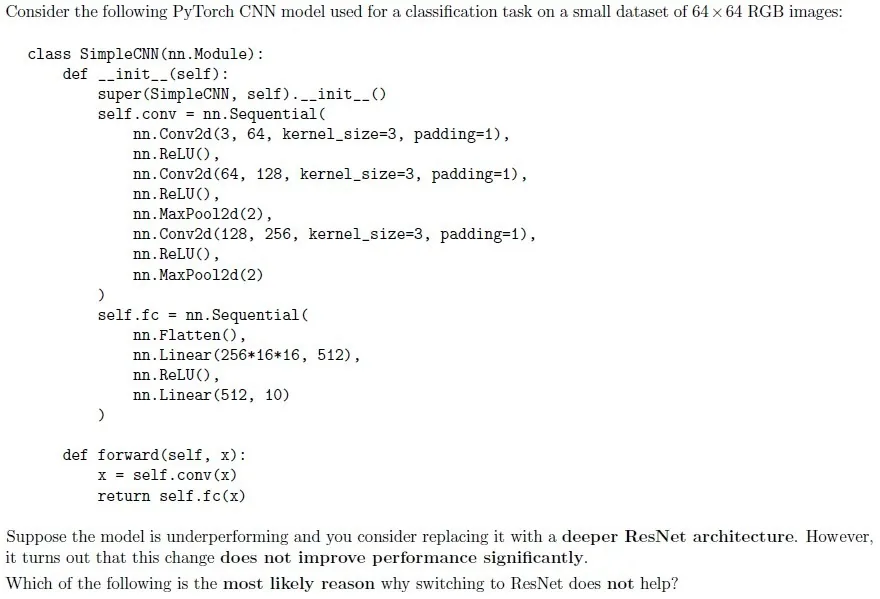
- AResNet has too many parameters for this simple task.
- BResidual connections are only useful when training very deep networks, and this task does not require such depth.
- CResNet architectures perform poorly on low-resolution inputs due to their reliance on fixed feature scales.
- DInceptionNet would have been better because it uses multiple receptive fields in parallel.
- Q5MCQ5 Marks·Choose one option
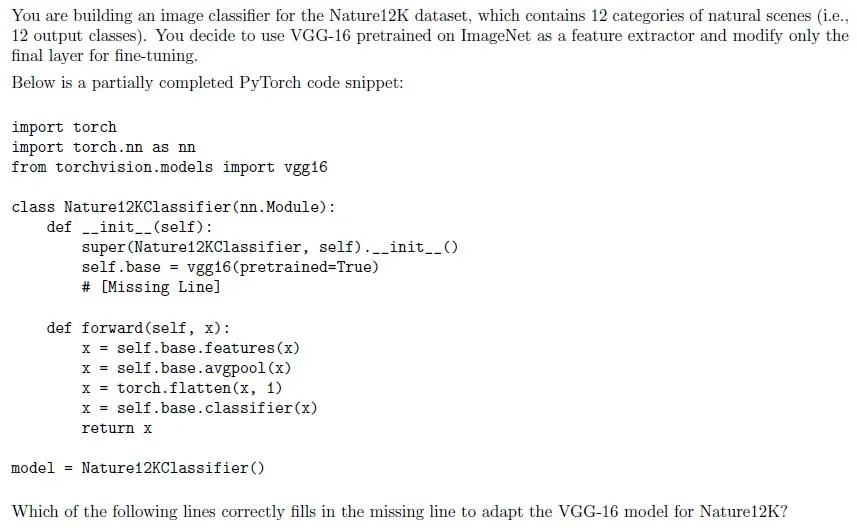
- A

- B

- C

- D

- A
- Q6MCQ5 Marks·Choose one option
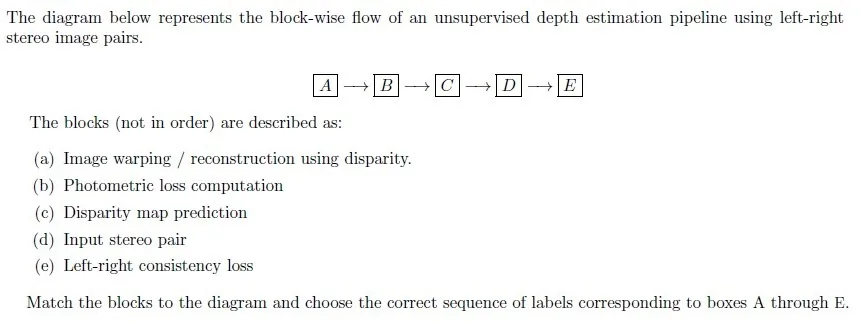
- AA–(e), B–(c), C–(a), D–(d), E–(b)
- BA–(e), B–(b), C–(c), D–(a), E–(d)
- CA–(e), B–(a), C–(c), D–(d), E–(b)
- DA–(c), B–(e), C–(a), D–(b), E–(d)
- Q7MCQ5 Marks·Choose one option
Consider the original U-Net architecture. Which of the following statements about the convolutional and pooling operations is correct?
- AU-Net uses 5 × 5 convolutional filters and 2 × 2 max pooling filters with stride 2 in the encoder path.
- BU-Net uses 3 × 3 convolutional filters and 2 × 2 average pooling filters with stride 1 in both encoder and decoder.
- CU-Net uses 3 × 3 convolutional filters (with padding) and 2 × 2 max pooling filters with stride 2 to halve the spatial resolution in the encoder.
- DU-Net uses 3 × 3 filters and 1 × 1 pooling to preserve spatial dimensions between contracting and expanding paths.
- Q8MSQ5 Marks·Choose all correct options
Which of the following are valid advantages of using Convolutional Neural Networks (CNNs) instead of fully connected Multilayer Perceptrons (MLPs) for image-based tasks?
- ACNNs require significantly fewer parameters than MLPs for high-dimensional image inputs.
- BCNNs are better at capturing spatial hierarchies due to weight sharing and local connectivity.
- CCNNs can approximate any function with fewer layers than MLPs due to the universal approximation theorem.
- DCNNs are translation invariant by design, making them robust to object position shifts in images.
- ECNNs do not require any activation functions since convolutions are linear operators.
- FCNNs are computationally faster than MLPs on image data due to sparse connections and weight sharing.
- Q9MSQ5 Marks·Choose all correct options
In the Faster R-CNN architecture, the Region Proposal Network (RPN) plays a critical role in object detection. Which of the following statements correctly describe the role of the RPN?
- AThe RPN generates a set of class-agnostic region proposals likely to contain objects.
- BThe RPN performs classification and bounding box regression to output object classes and their exact locations.
- CThe RPN uses anchor boxes of different scales and aspect ratios to slide over convolutional feature maps.
- DThe RPN replaces traditional region proposal methods like selective search, making the pipeline faster and end-to-end trainable.
- EThe RPN outputs fixed-size feature maps that are directly used for object classification.
- FThe RPN filters out background regions by assigning objectness scores to anchors.
- Q10MSQ5 Marks·Choose all correct options
Which of the following are valid advantages of YOLO compared to Fast R-CNN or Faster R-CNN?
- AYOLO performs object classification and localization in a single forward pass, making it faster than two-stage detectors like Fast R-CNN and Faster R-CNN.
- BYOLO does not require region proposal generation, making the entire pipeline fully end-to-end trainable.
- CYOLO achieves higher localization accuracy than Faster R-CNN on small objects due to its coarse grid-based prediction.
- DYOLO treats bounding box coordinates and objectness score as regression outputs, while computing class probabilities through classification.
- EYOLO achieves higher precision by using a large number of anchor boxes per region.
- FYOLO treats object detection as a regression problem, which simplifies the detection pipeline and reduces computational overhead.
- Q11MSQ5 Marks·Choose all correct options
Which of the following are advantages of ResNet over VGG-19?
- AResNet requires fewer parameters than VGG-19 while achieving higher accuracy.
- BResNet’s residual connections help mitigate vanishing gradients in very deep networks.
- COn the CIFAR-10 dataset, ResNet achieves higher training and validation accuracy using significantly fewer convolutional layers than VGG-19.
- DResNet models can be trained with depths exceeding 100 layers without suffering from degradation problems.
- EResNet blocks require more memory and training time due to the skip connections compared to VGG-19.
- FVGG-19 is easier to deploy on edge devices because of its lightweight residual architecture.
- Q12MSQ5 Marks·Choose all correct options
Which of the following code snippets can be used for data augmentation during training in PyTorch?
- A
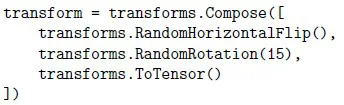
- B
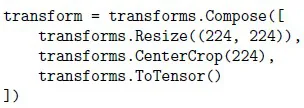
- C
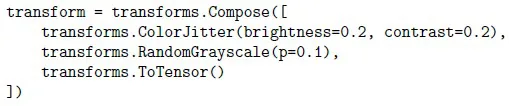
- D

- E
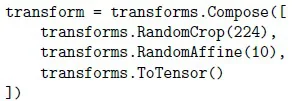
- A
- Q13MSQ5 Marks·Choose all correct options
Which of the following statements are correct regarding Generative Adversarial Networks (GANs)?
- AThe generator tries to minimize the probability that the discriminator correctly classifies fake samples.
- BThe discriminator is trained to maximize the probability of correctly classifying real and generated (fake) data.
- CThe generator directly receives labeled training data to learn the target distribution.
- DDuring training, the generator is updated based on the discriminator’s feedback to improve sample quality.
- EGAN training can suffer from instability due to the adversarial objective, leading to issues like mode collapse.
- FA perfectly trained discriminator ensures faster convergence of the generator.
- Q14MSQ5 Marks·Choose all correct options
SRGAN and ESRGAN are both deep learning architectures designed for single image super- resolution. Which of the following statements correctly describe the key differences between ESRGAN and SRGAN?
- AESRGAN replaces the standard residual blocks in SRGAN with Residual-in- Residual Dense Blocks (RRDB) for better performance.
- BSRGAN employs Perceptual Loss, while ESRGAN removes it to focus only on pixel-wise MSE loss for training stability.
- CESRGAN produces sharper and more realistic textures than SRGAN due to architectural and loss function improvements.
- DBoth SRGAN and ESRGAN use a VGG-based perceptual loss computed on feature maps extracted from deeper and shallower layers, respectively, of a pretrained classifier.
- ESRGAN is trained using only adversarial and perceptual losses, whereas ESRGAN includes a content loss computed using pixel-wise L1 loss.
- Q15MSQ5 Marks·Choose all correct options
The Multi-stage Progressive Image Restoration Network (MPRNet) is a state-of-the-art architecture for tasks like image deblurring and deraining. It follows a multi-stage design where features are progressively refined across stages. how many of the above components are explicitly part of the original MPRNet architecture?
- Aa single layer neural network.
- BUNet
- CSupervised Attention Module
- DChannel Attention Block
- EFast RCNN block
- Q16NAT5 Marks·Write the number
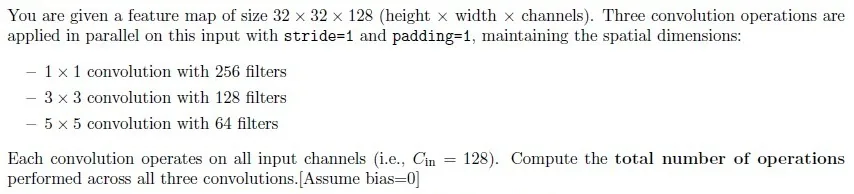 Your answer:
 - Q17NAT5 Marks·Write the number
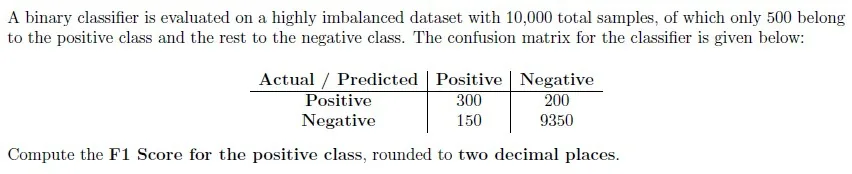 Your answer:
 - Q18NAT5 Marks·Write the number
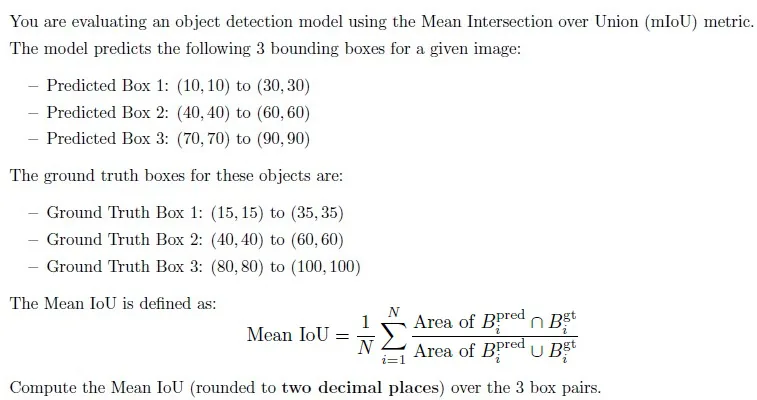 Your answer:
 - Q19NAT5 Marks·Write the number
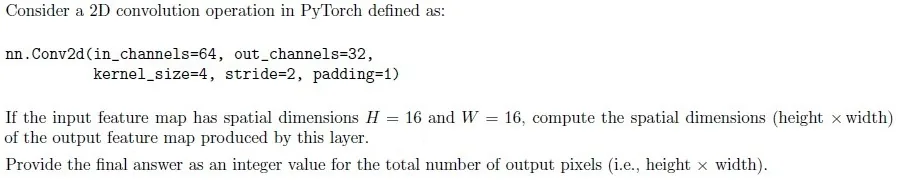 Your answer:
 Read the passage below, then answer Q20–Q22
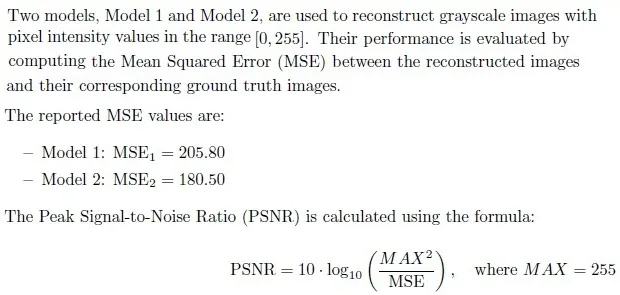
Based on the above data, answer the given subquestions.
Q20NAT1.5 Marks·Write the numberCompute the PSNR for Model 1 (in dB) (rounded to 2 decimal places) :
Your answer:- Q21NAT1.5 Marks·Write the number
Compute the PSNR for Model 2 (in dB) (rounded to 2 decimal places):
Your answer: - Q22NAT2 Marks·Write the number
Which model produces an image more similar to the ground truth?
Your answer:
Official KeyMaster Answer Key & Explanations
Official answer keys from IIT Madras BS past papers. Click any question to review.
Reveal KeyCollapse Key
Master Answer Key & Explanations
Official answer keys from IIT Madras BS past papers. Click any question to review.