Indian Institute of Technology Madras
BS Degree Programme · Examination & Study Paper
Deep Learning for Computer Vision
Object detection & segmentation
Examination Instructions & Guidelines
- Solve on notebook/paper first before checking solutions.
- MCQ: Exactly 1 option is correct. Negative marking applies.
- NAT: Numerical response. No negative marking.
- Scientific calculator allowed for all calculations.
- Official answer key is sealed at the end of this sheet.
End Term · 31 Aug 2025 (FN)End Term
- Q1MCQ2 Marks·Choose one option
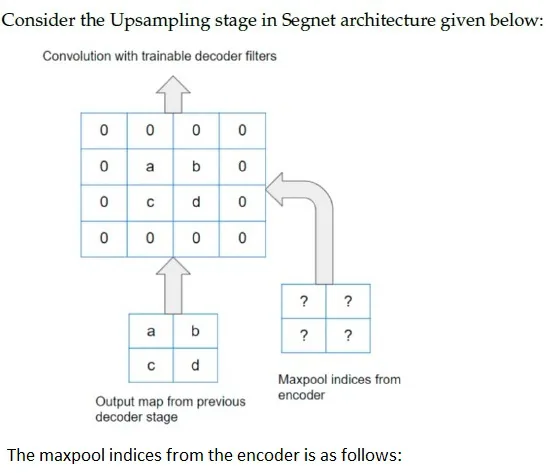
- A

- B

- C

- D

- A
- Q2MCQ2 Marks·Choose one option
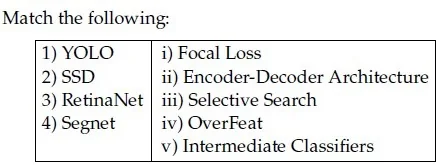
- A1→ iv, 2→ v, 3→ i, 4 → ii
- B1→ iii, 2→ i, 3 → v, 4→ ii
- C1→ iv, 2→ iii, 3→ ii, 4 → i
- D1→ iii, 2→ i, 3 → ii, 4→ v
- Q3MCQ2 Marks·Choose one option
What makes the Segment Anything Model (SAM) particularly advantageous for image annotation tasks compared to conventional segmentation approaches?
- AIt has perfect segmentation accuracy
- BIt has minimal hardware requirements for operation
- CIt can generalize to segment objects it wasn’t specifically trained on
- DIt automatically identifies and labels all objects in an image without user prompts
- Q4MCQ2 Marks·Choose one option
Statement 1: The Segment Anything Model (SAM) demonstrates zero-shot generalization capabilities across various downstream tasks. Statement 2: SAM’s training involves a largescale, diverse mask dataset using a prompt-based segmentation approach. Which one of the following options is most appropriate?
- ABoth statements are correct, and Statement 2 correctly explains Statement 1.
- BBoth statements are correct, but Statement 2 does not correctly explain Statement 1.
- CStatement 1 is correct, but Statement 2 is incorrect.
- DStatement 1 is incorrect, but Statement 2 is correct.
- EBoth statements are incorrect.
- Q5MCQ2 Marks·Choose one option
Why does DETR typically exhibit poor performance in detecting small objects compared to larger ones?
- AThe CNN backbone used in DETR has a fixed receptive field that’s too large for small objects
- BThe global self-attention mechanism in DETR tends to dilute the signal from small objects across all image locations
- CDETR’s loss function actively discards all detections smaller than 50x50 pixels
- DThe object queries in DETR are programmed to ignore any object smaller than 10
- EDETR’s encoder-decoder architecture was specifically designed to only detect large objects
End Term · 31 Aug 2025 (AN)End Term
- Q6MCQ2 Marks·Choose one option
Why does DETR typically exhibit poor performance in detecting small objects compared to larger ones? Choose the best answer in your opinion.
- AThe CNN backbone used in DETR has a fixed receptive field that’s too large for small objects.
- BThe global self-attention mechanism in DETR tends to dilute the signal from small objects across all image locations.
- CDETR’s loss function actively discards all detections smaller than 50 × 50 pixels.
- DThe object queries in DETR are programmed to ignore any object smaller than 10% of the image size.
- EDETR’s encoder-decoder architecture was specifically designed to only detect objects larger than a cat.
- Q7MCQ2 Marks·Choose one option
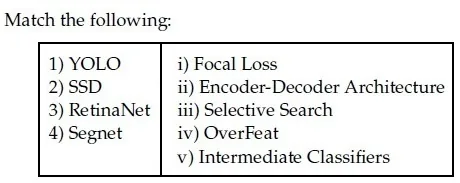
- A1→ iv, 2→ v, 3→ i, 4 → ii
- B1→ iii, 2→ i, 3 → v, 4→ ii
- C1→ iv, 2→ iii, 3→ ii, 4 → i
- D1→ iii, 2→ i, 3 → ii, 4→ v
- Q8MCQ2 Marks·Choose one option
Why might Segment Anything (SAM) be particularly useful in data annotation tasks compared to traditional segmentation models?
- AIt produces perfect segmentation masks.
- BIt can adapt to segment any object, even those not seen during training
- CIt requires less computational resources
- DIt automatically labels all objects in an image without user input
Quiz 2 · 3 Aug 2025 (AN)Quiz 2
- Q9MCQ2 Marks·Choose one option
Which of the following architectures introduced the ROI pooling layer for extracting fixed-size feature maps from variable-size region proposals?
- AR-CNN
- BFast R-CNN
- CFaster R-CNN
- DYOLO
- Q10MCQ2 Marks·Choose one option
Which object detection method first integrated a Region Proposal Network (RPN) to generate region proposals within the detection model?
- AR-CNN
- BFast R-CNN
- CFaster R-CNN
- DYOLO
- Q11MCQ2 Marks·Choose one option
Which architecture performs object detection as a single regression problem from image pixels to bounding boxes and class probabilities?
- AR-CNN
- BFast R-CNN
- CFaster R-CNN
- DYOLO
- Q12NAT2 Marks·Write the number
Consider two bounding boxes in an image: - Box A: top-left at (0, 0), bottom-right at (12, 12) - Box B: top-left at (4, 4), bottom-right at (16, 16) What is the Intersection over Union (IoU) between these two boxes ____________(in %)
Your answer: - Q13MCQ2 Marks·Choose one option
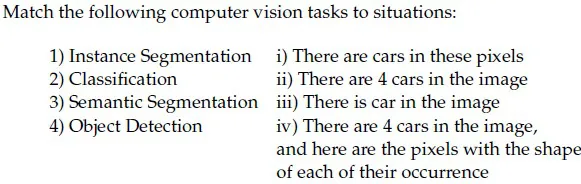
- A

- B

- C

- D

- A
- Q14NAT2 Marks·Write the number
Consider a Faster R-CNN object detection framework, which is being trained with a mini-batch size of 2. The RPN produces 512 proposals, out of which 256 and 128 of them are foreground proposals, corresponding to each image in the mini-batch. For a single mini-batch update, the bounding box regression loss will be computed_____________ times.
Your answer: