Indian Institute of Technology Madras
BS Degree Programme · Examination & Study Paper
English II
Reading comprehension
Examination Instructions & Guidelines
- Solve on notebook/paper first before checking solutions.
- MCQ: Exactly 1 option is correct. Negative marking applies.
- Scientific calculator allowed for all calculations.
- Official answer key is sealed at the end of this sheet.
Quiz 1 · 26 Oct 2025 (AN)Quiz 1
Read the passage below, then answer Q1–Q5
Given below is an excerpt from the essay “Gifts”, written by Ralph Waldo Emerson. Study the essay and answer the given subquestions.
He is a good man, who can receive a gift well. We are either glad or sorry at a gift, and both emotions are unbecoming. Some violence, I think, is done, some degradation borne, when I rejoice or grieve at a gift. I am sorry when my independence is invaded, or when a gift comes from such as do not know my spirit, and so the act is not supported; and if the gift pleases me overmuch, then I should be ashamed that the donor should read my heart, and see that I love his commodity, and not him. The gift, to be true, must be the flowing of the giver unto me, correspondent to my flowing unto him. When the waters are at level, then my goods pass to him, and his to me. All his are mine, all mine his. I say to him, How can you give me this pot of oil, or this flagon of wine, when all your oil and wine is mine, which belief of mine this gift seems to deny? Hence the fitness of beautiful, not useful things for gifts. This giving is flat usurpation, and therefore when the beneficiary is ungrateful, as all beneficiaries hate all Timons, not at all considering the value of the gift, but looking back to the greater store it was taken from, I rather sympathize with the beneficiary, than with the anger of my lord Timon. For, the expectation of gratitude is mean, and is continually punished by the total insensibility of the obliged person. It is a great happiness to get off without injury and heart-burning, from one who has had the ill luck to be served by you. It is a very onerous business, this of being served, and the debtor naturally wishes to give you a slap. A golden text for these gentlemen is that which I so admire in the Buddhist, who never thanks, and who says, "Do not flatter your benefactors."
The reason of these discords I conceive to be that there is no commensurability between a man and any gift. You cannot give anything to a magnanimous person. After you have served him, he at once puts you in debt by his magnanimity. The service a man renders his friend is trivial and selfish, compared with the service he knows his friend stood in readiness to yield him, alike before he had begun to serve his friend, and now also. Compared with that good-will I bear my friend, the benefit it is in my power to render him seems small. When I have attempted to join myself to others by services, it proved an intellectual trick-- no more. They eat your service like apples, and leave you out. But love them, and they feel you, and delight in you all the time.
Q1MCQ2 Marks·Choose one optionArrange the given hints in the correct order to form a synopsis of the essay. i. The unpleasantness of being obligated ii. Love as the most delightful gift iii. The reason why beautiful things make the best gifts iv. The conflict between the beneficiary and the benefactor with an allusion to Timon of Athens v. The thoughts we have upon receiving a gift vi. Comparison between goodwill and gifts vii. The true meaning of a gift
- Av-vii-iii-iv-i-vi-ii
- Bvi-v-iii-ii-iv-i-vii
- Ciii-i-vii-iv-vi-ii-v
- Dii-vi-i-iii-v-iv-vii
- Q2MCQ2 Marks·Choose one option
Why does the essayist refer to lord Timon?
- ALord Timon once gave the essayist a gift which he disliked
- BLord Timon is used here as an example, denoting gift-givers in general; it is implied that he was famous for giving gifts
- CLord Timon commissioned this essay, so this essay is Emerson’s gift to Timon
- Q3MCQ2 Marks·Choose one option
Which of the following is NOT true?
- AThe excerpt argues that man’s goodwill is greater than any gift
- BThe excerpt states that it is not noble to expect gratitude
- CThe excerpt states that only useful things are acceptable as gifts
- DThe excerpt states that you cannot give anything to a magnanimous person
- Q4MCQ2 Marks·Choose one option
Study the nouns given below. On the basis of your reading of the passage, choose the option that correctly matches the noun to its fitting adjective. i. Usurpation ii. Person iii. Business iv. Trick
- Ai-Unbecoming, ii-Trivial, iii-Flat, iv-Obliged
- Bi-Complete, ii-Magnanimous, iii-Heart-burning, iv-Ungrateful
- Ci-Onerous, ii-Intellectual, iii-Flat, iv-Complete
- Di-Flat, ii-Obliged, iii-Onerous, iv-Intellectual
- Q5MCQ2 Marks·Choose one option
He is a good man, who can receive a gift well. Which of the following options can replace the word in italics without greatly altering the sense of the statement?
- ABegrudgingly
- BGraciously
- CCautiously
- DWhimsically
End Term · 31 Aug 2025 (FN)End Term
Read the passage below, then answer Q6–Q15
Read the following passage and answer the given subquestions.
I asked the policemen to come in. The cry, I said, was my own, in a dream. The old man, I said, was away; he had gone to visit a friend in the country. I took them through the whole house, telling them to search it all, to search well. I led them finally into the old man’s bedroom. As if playing a game with them I asked them to sit down and talk for a while. My easy, quiet manner made the policemen believe my story. So they sat talking with me in a friendly way. But although I answered them in the same way, I soon wished that they would go. My head hurt and there was a strange sound in my ears. I talked more, and faster. The sound became clearer. And still they sat and talked. Suddenly I knew that the sound was not in my ears, it was not just inside my head. At that moment I must have become quite white. I talked still faster and louder. And the sound, too, became louder. It was a quick, low, soft sound, like the sound of a clock heard through a wall, a sound I knew well. Louder it became, and louder. Why did the men not go? Louder, louder. I stood up and walked quickly around the room. I pushed my chair across the floor to make more noise, to cover that terrible sound. I talked even louder. And still the men sat and talked, and smiled. Was it possible that they could not hear? No! They heard! I was certain of it. They knew! Now it was they who were playing a game with me. I was suffering more than I could bear, from their smiles, and from that sound. Louder, louder, louder! Suddenly I could bear it no longer. I pointed at the boards and cried, “Yes! Yes, I killed him. Pull up the boards and you shall see! I killed him. But why does his heart not stop beating?! Why does it not stop!?”
(The Tell Tale Heart ~ Edgar Allen Poe)
Q6MCQ2 Marks·Choose one optionWhat does the narrator tell the policemen about the cry?
- AThat it was the cry of the friend whom the old man had gone to visit in the country
- BThat it was he himself who had cried in a dream
- CThat it was the cry of an old man who had gone to visit a friend in the country
- DNone of these
- Q7MCQ2 Marks·Choose one option
How did the narrator try to reassure the policemen?
- ABy offering them money
- BBy acting easy and quiet
- CBy showing them a letter
- DBy calling a friend
- Q8MCQ2 Marks·Choose one option
To which room did the narrator finally lead the policemen after taking them through the whole house and telling them to search it all?
- AThe basement
- BThe kitchen
- CThe old man's bedroom
- DThe attic
- Q9MCQ2 Marks·Choose one option
What physical sensation did the narrator experience as he spoke with the policemen?
- AHis eyes hurt
- BHis stomach ached
- CHis head hurt
- DHis legs felt weak
- Q10MCQ2 Marks·Choose one option
What realization did the narrator have about the source of the sound?
- AIt was coming from outside the house
- BIt was in his ears
- CIt was not just inside his head
- DIt was the noise made by a machine
- Q11MCQ2 Marks·Choose one option
“Now it was they who were playing a game with me.” According to this sentence, who was playing a game with whom?
- AThe narrator was playing a game with the policeman
- BThe policemen were playing a game with the narrator
- CThe narrator was playing a game with the old man
- DThe policemen were playing a game with the old man
- Q12MCQ2 Marks·Choose one option
What did the narrator do to “cover that terrible sound”?
- AHe took the policemen through the whole house
- BHe made the policemen believe his story
- CHe pushed his chair across the floor to make more noise and talked loudly
- DHe became quite white
- Q13MCQ2 Marks·Choose one option
Which of the following words from the passage is similar in meaning to the word clamorous? Choose your answer on the basis of how these words are used in the passage.
- ALouder
- BFaster
- CFriendly
- DClearer
- Q14MCQ2 Marks·Choose one option
What ultimately caused the narrator to confess to the crime?
- AFear of being caught
- BThe loudness of the sound
- CThe policemen's questioning
- DThe old man’s visit to the country
- Q15MCQ2 Marks·Choose one option
Read the concluding lines of the passage. In the narrator’s perception, what is the source of the sound that is tormenting him?
- AThe smiles of the policemen
- BA dream that the narrator had of an old man
- CThe stopless beating of the heart of the man whom the narrator claims to have killed
- DThe sound of a clock heard through a wall
Read the passage below, then answer Q16–Q25
Jean-Michel Basquiat and the Work Ethic of Creative Flow: A Radio Report
Reporter:
Jean-Michel Basquiat had endless inspiration. He was the embodiment of artistic flow, and while most artists will never approach anything close to his once in a generation talent, there are a few things that you could learn from his work methods that will help you tap into your own creative genius. For example, at the beginning of his career, Basquiat went out and bought two books– two books that would inform all of his works right up until his death. The first of these was a book called Henry Dreyfuss Symbol Sourcebook. This rare book would end up providing source material for almost all of the fifteen hundred drawings and six hundred paintings that he left behind. His art was filled with symbols–ladders, crowns, crosses, copyrights, and all of them came from this rare book. Many of them are gathered on one page– page ninety– a page that almost looks like a dictionary of his whole artistic language. There is, for instance, the symbol that denotes the death of man, which, sadly, he used to symbolise and prophesy his own death.One of the secrets of staying in flow is thus source material. Basquiat used source material like he was J Dilla sampling records, but source material alone will not automatically give you creativity. You have to learn to use it the artist’s way, and it is thus a question of taste– you choose source material that can expose you to the best things that humans have done, and try to bring those things into what you are doing. Picasso had a saying; he said “Good artists copy; great artists steal.” Stealing like an artist means stealing with no judgement. Let your taste make the decisions, not your brain. In an interview at the Fun Gallery in the early 1980s, Marc H. Miller asked Basquiat where the words in his paintings came from. He was interviewing the artist at an exhibition of his paintings at the Fun Gallery in the East Village of New York, and had the rare privilege of being able to refer back from the art to the artist, as both were present there at the gallery.
[Original audio of the interview]
Interviewer: Where do the words come from?
Basquiat: Real life, books, television…
Interviewer: Yeah, and you just skim them and start including…
Basquiat: No man, when I’m working, I hear them, you know, and I just throw them down. Interviewer: Oh yeah? Well, I mean, things like “punic wars” I remember that was in one of your… Basquiat: Uh, yeah, that was from a guidebook on Roman history. “History of Rome in 5 Pages,” you know?
Interviewer: So you snatched a few words from it?
Basquiat (smiling): I didn’t snatch them, you know?
Interviewer: They, they caught your…
Basquiat: They caught my eye and then I took them.
Interviewer points to a painting– what’s this?
Basquiat: That’s Pluto. Based on a drawing of the moon…the first drawing of the moon by Galileo. Interviewer: This looks like an eye
Basquiat: Yeah yeah, that’s the evil eye of the Malocchio
Reporter:
The moment you stop judging “Should I use this? What would people say?”, you open yourself to flow. Stealing like an artist is not to end up as just the sum of your influences. The choices of the artist are choices that serve his message and it is this informed choice that renders an artwork meaningful. The second book that gave Basquiat his unparalleled momentum was Flash of the Spirit- a book about African art. This book was key in helping him zero in on his message. The reason most artists lose flow when they are working is that when they get stuck, they have no guiding ideology to get them out of their tough spot, and because they don’t know what they are trying to communicate to the world, any roadblock could stop them in their tracks for days and open up a vortex of overthinking, staring at a blank canvas, and artist’s paralysis. That’s what happens when you don’t have an overarching message in your works. Basquiat did.
[Original audio]
Basquiat: I think there’s a lot of people that are neglected in art. I don’t know if it’s because of who made the paintings or what. Black people are never portrayed realistically, or not even portrayed in modern art enough.
Reporter:
And because he had a message, art came out of him that much more effortlessly. It’s not just that he had source material; it’s that he had a place to channel it. His work became a commentary on the underrepresentation of black art in the established art world. When you have a message, art comes out of you easily, but a message, tons of source material, and your newfound audacity to steal like an artist is still not enough. You will never have that Basquiat-like limitless inspiration and flow if you don’t master speed. The day Basquiat met Andy Warhol, he ran back home and painted a self-portrait of both of them from a polaroid his idol had just taken. And then he ran back to the restaurant to give it to him as a gift. The paint was still fresh. Warhol couldn’t believe it. All he kept repeating was “Oh, I’m jealous. I’m jealous. He’s faster than me, and these are so great.” That was the beginning of the collaborations between Andy and Jean-Michel. When one of the most prolific artists of all time is jealous of your speed, you know you are doing something right. Work quickly, like a demon. You should work so fast that you don’t have time to think. The brain is your enemy in art. Like they say in the music industry, keep the tape rolling.
If you really want to become the legendary artist that you have the potential to be, if you really want that endless inspiration, you have to understand that most of the flow that you have for making art will come from all the things that you are doing while you’re not making art. In between your creative sessions, while everyone else is busy consuming regurgitated content on social media, you should go offline and you should go deep. Most people need to rev up when they sit down to work. They need hours before they can finally get into the groove. That is because they haven’t been feeding their minds during their downtime.
[Original audio]
Basquiat: I never went to an art school. I failed the art courses that I did take in school. I just looked at a lot of things. And that’s how I think I learned about art, by looking at it. That’s a Roman belt buckle. It’s from a drawing that I did at the Metropolitan. Went all the way to the Metropolitan museum, and I did the drawing of the buckle and I came back with it and I put it right there. Interviewer: Well, that’s kind of a slow process.
Basquiat: I’m a slow person.
Reporter:
The process may seem slow to an outsider, but that slow process is what makes you outrageously fast when you get back into the studio. Make it your mantra to study, memorise and internalise, and those ideas you consume will marinate inside of you, and will eventually become part of your artistic DNA. Suddenly, the oddest things will come out of you at the most unexpected times. It’s all because you made yourself this well of inspiration. You became a student of life– ready at any time to express your genius.
Based on the above data, answer the given subquestions.
Q16MCQ2 Marks·Choose one optionEach argument in this radio report is built progressively on the one preceding it. Identify the sequence in which this radio report constructs its arguments. i. Work fast ii. Have a message to communicate iii. Study, memorise, internalise iv. Use source material according to taste v. Feed your mind
- Aii→ iii→ v→ iv→ i
- Biv→ ii→ i→ v→ iii
- Ciii→ i→ v→ iv→ ii
- Di→ v→ iii→ ii→ iv
- Q17MCQ2 Marks·Choose one option
This radio report illustrates how one can use the phraseology of a different domain in order to make a point about art. The word marinate is typically associated with:
- ADeep sea fishing
- BMarine ecosystems
- CCooking
- DRitual and sacrifice
- Q18MCQ2 Marks·Choose one option
What is the relevance of Jean-Michel Basquiat in this radio report?
- AThe report is a biography of the artist and catalogues his works
- BThe report presents his work methods as a model to learn from
- CThe report eulogises his passing
- Q19MCQ2 Marks·Choose one option
Why does this audio report incorporate into it elements from an original interview with the artist? i. A radio report relies solely on the auditory medium and an original interview brings in a variety of voices into the report, making it more engaging. ii. This radio report draws on the artistic process of Jean-Michel Basquiat and incorporating elements from an original interview with the artist helps the report to be structured and more convincing.
- AOnly i
- BOnly ii
- CBoth i and ii
- DNeither i nor ii
- Q20MCQ2 Marks·Choose one option
Who do you suppose is the intended addressee of this radio report?
- AJean-Michel Basquiat
- BUpcoming artists
- CAndy Warhol
- DDNA researchers
- Q21MCQ2 Marks·Choose one option
This radio report is an interesting instance of how personal names and the names of objects and places are used to build an argument in the report. How do the items in List A add to the report? Match them to suitable items in List B.
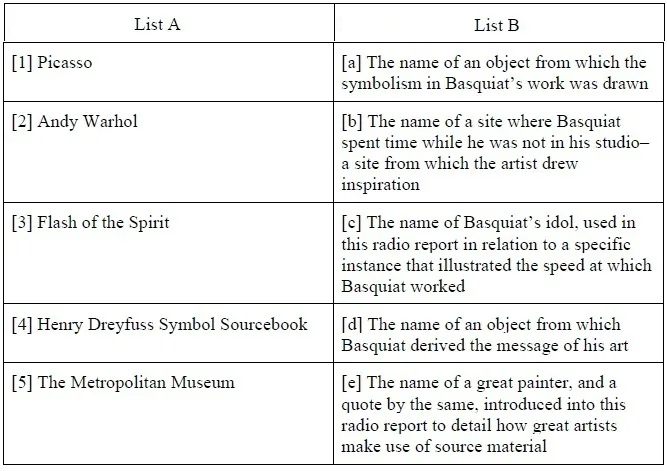 Picasso
- AThe name of an object from which the symbolism in Basquiat’s work was drawn
- BThe name of a site where Basquiat spent time while he was not in his studio– a site from which the artist drew inspiration
- CThe name of Basquiat’s idol, used in this radio report in relation to a specific instance that illustrated the speed at which Basquiat worked
- DThe name of an object from which Basquiat derived the message of his art
- EThe name of a great painter, and a quote by the same, introduced into this radio report to detail how great artists make use of source material
- Q22MCQ2 Marks·Choose one option
This radio report is an interesting instance of how personal names and the names of objects and places are used to build an argument in the report. How do the items in List A add to the report? Match them to suitable items in List B.
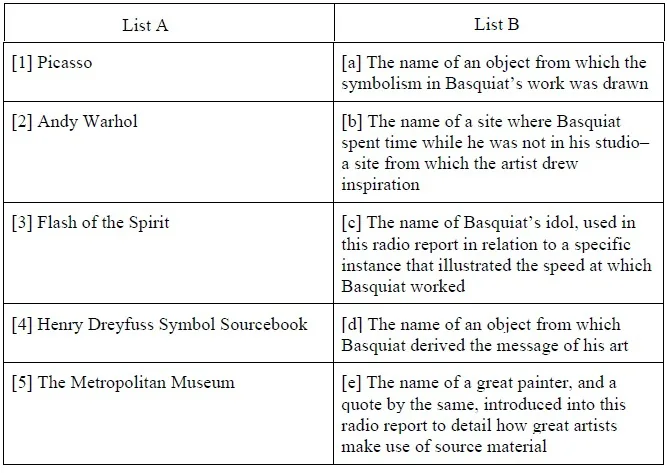 Andy Warhol
- AThe name of an object from which the symbolism in Basquiat’s work was drawn
- BThe name of a site where Basquiat spent time while he was not in his studio– a site from which the artist drew inspiration
- CThe name of Basquiat’s idol, used in this radio report in relation to a specific instance that illustrated the speed at which Basquiat worked
- DThe name of an object from which Basquiat derived the message of his art
- EThe name of a great painter, and a quote by the same, introduced into this radio report to detail how great artists make use of source material
- Q23MCQ2 Marks·Choose one option
This radio report is an interesting instance of how personal names and the names of objects and places are used to build an argument in the report. How do the items in List A add to the report? Match them to suitable items in List B.
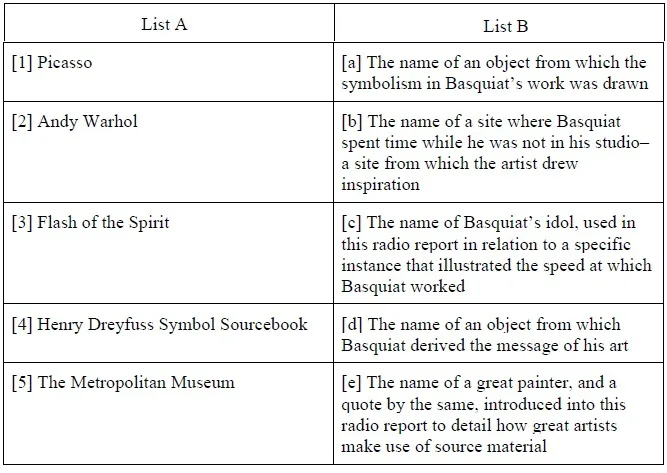 Flash of the Spirit
- AThe name of an object from which the symbolism in Basquiat’s work was drawn
- BThe name of a site where Basquiat spent time while he was not in his studio– a site from which the artist drew inspiration
- CThe name of Basquiat’s idol, used in this radio report in relation to a specific instance that illustrated the speed at which Basquiat worked
- DThe name of an object from which Basquiat derived the message of his art
- EThe name of a great painter, and a quote by the same, introduced into this radio report to detail how great artists make use of source material
- Q24MCQ2 Marks·Choose one option
This radio report is an interesting instance of how personal names and the names of objects and places are used to build an argument in the report. How do the items in List A add to the report? Match them to suitable items in List B.
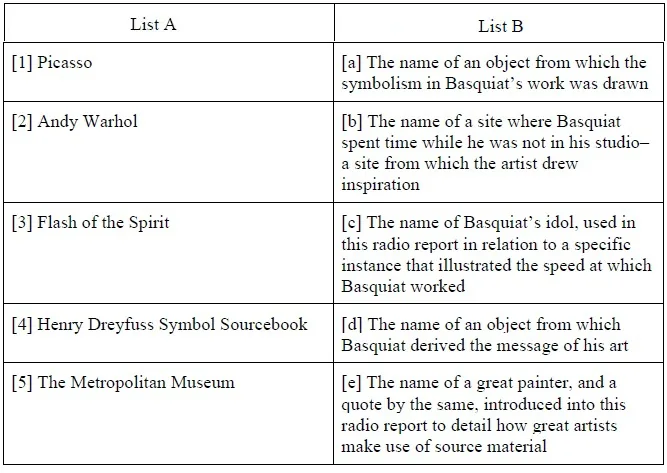 Henry Dreyfuss Symbol Sourcebook
- AThe name of an object from which the symbolism in Basquiat’s work was drawn
- BThe name of a site where Basquiat spent time while he was not in his studio– a site from which the artist drew inspiration
- CThe name of Basquiat’s idol, used in this radio report in relation to a specific instance that illustrated the speed at which Basquiat worked
- DThe name of an object from which Basquiat derived the message of his art
- EThe name of a great painter, and a quote by the same, introduced into this radio report to detail how great artists make use of source material
- Q25MCQ2 Marks·Choose one option
This radio report is an interesting instance of how personal names and the names of objects and places are used to build an argument in the report. How do the items in List A add to the report? Match them to suitable items in List B.
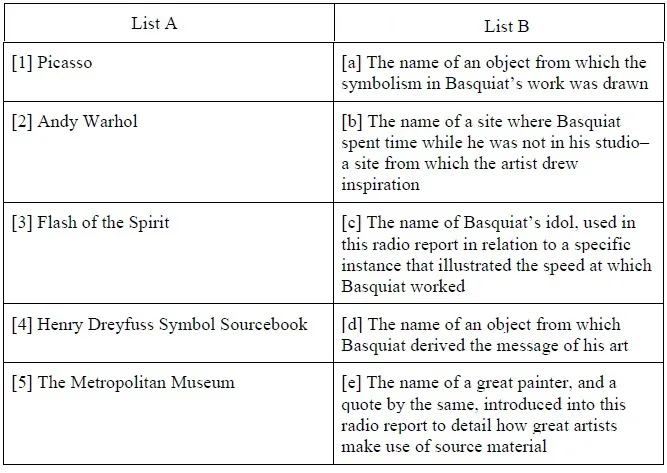 The Metropolitan Museum
- AThe name of an object from which the symbolism in Basquiat’s work was drawn
- BThe name of a site where Basquiat spent time while he was not in his studio– a site from which the artist drew inspiration
- CThe name of Basquiat’s idol, used in this radio report in relation to a specific instance that illustrated the speed at which Basquiat worked
- DThe name of an object from which Basquiat derived the message of his art
- EThe name of a great painter, and a quote by the same, introduced into this radio report to detail how great artists make use of source material
End Term · 31 Aug 2025 (AN)End Term
Read the passage below, then answer Q26–Q35
Read the following passage and answer the given subquestions.
Gregor summoned all his courage to try to bring him back; the manager must have suspected something of the sort, for he leaped several steps at a single bound and disappeared with a cry of, “Huh!” which resounded in the hollow of the stairwell. This flight had the unfortunate effect of causing Gregor’s father—who till now had remained master of himself—to lose his head completely; instead of running after the manager, or at least not interfering with Gregor in his pursuit, he seized in his right hand the manager’s walking stick, which had been left behind on a chair with his overcoat and hat, took up in his left a newspaper from the table, and began stamping his feet and brandishing the newspaper and the cane to drive Gregor back into his room. Gregor’s prayers were unavailing, were not even understood; he had turned to his father a supplicating head, but, meek though he showed himself, his father merely stamped all the louder. In the dining room, despite the cold, the mother had opened the window wide and was leaning out as far as possible, pressing her face in her hands. A great rush of air swept the space between the room and the stairway; the curtains billowed, the papers rustled, and a few sheets flew over the carpet. But the father pursued Gregor pitilessly, whistling and whooping like a savage, and Gregor, who was not used to walking backward, progressed but slowly.
Had he been able to turn around he could have reached his room quickly, but he feared to make his father impatient by the slowness of his turning and feared also that at any moment he might receive a mortal blow on his head or on his back from this menacing stick. Soon Gregor had no choice; for he realized with terror that when he was going backward he was not master of his direction and, still fearfully watching the attitude of his father out of the corner of his eye, he began his turning movement as quickly as possible, which was really only very slowly. Perhaps his father realized his good intention for, instead of hindering this move, he guided him from a little distance away, helping Gregor with the tip of the stick. If only he had left off that insupportable whistling! Gregor was completely losing his head.
(Metamorphosis ~ Franz Kafka)
Q26MCQ2 Marks·Choose one optionWhat is the synonym for unfortunate?
- ALucky
- BUnlucky
- CFortunate
- DHappy
- Q27MCQ2 Marks·Choose one option
How did Gregor's father treat him while driving him back?
- AWith pity and care
- BPitilessly, whistling and whooping
- CWith understanding and patience
- DWith indifference
- Q28MCQ2 Marks·Choose one option
Why did Gregor start turning around?
- AHe wanted to face his father
- BHe realized he was not master of his direction while going backward
- CHe heard someone calling him
- DHe wanted to reach the window
- Q29MCQ2 Marks·Choose one option
Had he been able to turn around he could have reached his room quickly. What fears/fears stop him from turning around? i. He feared to make his father impatient by the slowness of his turning ii. He feared that at any moment he might receive a mortal blow on his head or on his back from this menacing stick iii. He feared that his mother would fall out of the window
- AAll i, ii and iii
- BOnly ii and iii
- COnly i and ii
- DOnly i and iii
- Q30MCQ2 Marks·Choose one option
How did Gregor’s father use the walking stick?
- AAs a tool to close the open window
- BFirst as a weapon to strike Gregor, and then to guide Gregor back into his room
- CTo block Gregor’s path
- DTo lean on while walking
- Q31MCQ2 Marks·Choose one option
What did the manager do when Gregor tried to bring him back?
- AHe called for help
- BHe leaped several steps at a single bound and disappeared
- CHe talked to Gregor's father
- DHe tried to calm Gregor
- Q32MCQ2 Marks·Choose one option
What is the opposite of supplicating?
- ADemanding
- BRequesting
- CBegging
- DPleading
- Q33MCQ2 Marks·Choose one option
How did Gregor's father express his anger?
- ABy shouting loudly
- BBy stamping his feet and brandishing the cane
- CBy breaking furniture
- DBy calling the police
- Q34MCQ2 Marks·Choose one option
What effect did the open window have on the room?
- AIt made the room darker
- BIt caused a great rush of air to sweep through
- CIt had no noticeable effect
- DIt cooled the room down
- Q35MCQ2 Marks·Choose one option
What did Gregor feel as he walked backwards?
- ARelief
- BConfidence
- CFear and helplessness
- DAnger
End Term · 13 Apr 2025 (AN)End Term
Read the passage below, then answer Q36–Q45
Read the following passage and answer the given subquestions.
The dog was sleeping nearby. He was stirred by the smell of food. He got up, came out of his shelter and stood before the blind man, wagging his tail and gazing expectantly at the bowl, as he was eating his sparse meal. The blind man swept his arms about and asked, 'Who is there?' at which the dog went up and licked his hand. The blind man stroked its coat gently tail to ear and said, 'What a beauty you are. Come with me—' He threw a handful of food, which the dog ate gratefully. It was perhaps an auspicious moment for starting a friendship. They met every day there, and the dog cut off much of its rambling to sit up beside the blind man and watch him receive alms morning to evening. In course of time, observing him, the dog understood that the passers-by must give a coin, and whoever went away without dropping a coin was chased by the dog; he tugged the edge of their clothes by his teeth and pulled them back to the old man at the gate and let go only after something was dropped in his bowl. Among those who frequented this place was a village urchin, who had the mischief of a devil in him. He liked to tease the blind man by calling him names and by trying to pick up the coins in his bowl. The blind man helplessly shouted and cried and whirled his staff. On Thursdays this boy appeared at the gate, carrying on his head a basket loaded with cucumber or plantain. Every Thursday afternoon it was a crisis in the blind man's life. A seller of bright-coloured but doubtful perfumes with his wares mounted on a wheeled platform, a man who spread out cheap storybooks on a gunny sack, another man who carried coloured ribbons on an elaborate frame—these were the people who usually gathered under the same arch. On a Thursday when the young man appeared at the eastern gate one of them remarked, 'Blind fellow! Here comes your scourge—'
Extract from: The Malgudi Days by R.K. Narayan
Q36MCQ2 Marks·Choose one optionWhat initially stirred the dog from sleep?
- ASound of footsteps
- BSmell of food
- CA loud noise
- DThe blind man's voice
- Q37MCQ2 Marks·Choose one option
How did the dog first interact with the blind man?
- ABarking
- BSitting quietly
- CLicking his hand
- DBringing him food
- Q38MCQ2 Marks·Choose one option
What did the dog learn to do over time?
- AHunt for food
- BChase after people who didn't give coins
- CSing for the blind man
- DProtect the blind man's shelter
- Q39MCQ2 Marks·Choose one option
Who is described as having "the mischief of a devil"?
- APerfume seller
- BStorybook seller
- CVillage urchin
- DBlind man
- Q40MCQ2 Marks·Choose one option
What did 'the boy' carry on his head?
- AStorybooks
- BA basket with cucumber or plantain
- CColored ribbons
- DPerfume bottles
- Q41MCQ2 Marks·Choose one option
How did the blind man react when teased?
- AIgnored the taunts
- BFought back physically
- CHelplessly shouted and cried
- DLaughed it off
- Q42MCQ2 Marks·Choose one option
“he tugged the edge of their clothes” What is the antonym to the word 'tugged' ?
- ADragged
- BLugged
- CPushed
- DCarried
- Q43MCQ2 Marks·Choose one option
A man sold storybooks on a gunny sack.
- ATRUE
- BFALSE
- Q44MCQ2 Marks·Choose one option
How did the blind man initially greet the dog's presence?
- AStanding up
- BBy asking "Who is there?"
- CThrowing food
- DBy waving his staff
- Q45MCQ2 Marks·Choose one option
What did the blind man do after the dog licked his hand?
- APushed the dog away
- BStroked its coat gently
- CTook it to the vet
- DIgnored the dog
End Term · 22 Dec 2024 (AN)End Term
Read the passage below, then answer Q46–Q55
Read the following passage and answer the given subquestions.
I had been puzzled too when I first discovered how much deference Robi commanded in college. It was hard to understand, for he did not excel particularly in any of the spheres which were held to confer distinction in that milieu: he was not unusually good at sports, just about good enough to keep a place in the college cricket eleven; he was good at his studies but not brilliant; he was not clever, not well dressed, not talented, nor in any way unlike a dozen others in our college, and yet, without asking for it, barely seeming to notice, he commanded a respect immeasurably greater than the best sportsmen and the most brilliant students.
It took me time to see that this respect was really a tribute to the superhuman simplicity of his view of the world: to the fact that he had no hesitation in making judgements – because there were whole domains of conduct within which he would not admit the possibility of argument – and no fear of defending them, because of his abundant physical courage. Once, for example, there was a great uproar in our college because a student had been expelled for some minor misdemeanour – for asking a girl up to his room for a cup of tea or some such thing. The students’ union was unanimous in calling for a strike. But Robi, alone in the whole college, refused to go along with everyone else: he didn’t argue or make speeches, he merely refused to attend the union meetings. And when some of the union’s leaders threatened to give him a beating, they found to their surprise that he was relieved at the prospect of settling the issue by a
straightforward physical contest. Such was his standing in the college that eventually the leaders gave in and the strike was called off.
Later, I asked him: Why wouldn’t you join the strike? Tell me, just as a matter of interest. He wouldn’t answer, so I asked him again, and then reluctantly he said: Because a rule’s a rule; if you break one you have to be willing to pay the price.
Extract from: The Shadow Lines by Amitav Ghosh
Q46MCQ2 Marks·Choose one optionWhat sport did Robi play in college?
- AFootball
- BCricket
- CHockey
- DTennis
- Q47MCQ2 Marks·Choose one option
According to the passage, what was Robi's academic performance like?
- APoor but unrecognized
- BBrilliant but immoral
- CGood but not brilliant
- DOutstanding
- Q48MCQ2 Marks·Choose one option
What was the reason for the student's expulsion mentioned in the passage?
- ACheating on an exam
- BFighting with other students
- CAsking a girl to his room for tea
- DStealing from the college
- Q49MCQ2 Marks·Choose one option
How did Robi respond to the strike call?
- AHe organized protests
- BHe made speeches against it
- CHe supported it enthusiastically
- DHe refused to attend union meetings
- Q50MCQ2 Marks·Choose one option
What was the ultimate outcome of the strike situation?
- ARobi was beaten up
- BThe strike continued
- CThe strike was called off
- DThe expelled student was reinstated
- Q51MCQ2 Marks·Choose one option
How did Robi react when threatened with a beating?
- AHe reported it to authorities
- BHe wanted to fight
- CHe ran away
- DHe apologized
- Q52MCQ2 Marks·Choose one option
What did Robi say when asked why he wouldn't join the strike?
- A"what he did was wrong"
- B"rules are there for a reason"
- C"a rule's a rule"
- D"I don't believe in strikes"
- Q53MCQ2 Marks·Choose one option
How did the narrator initially feel about Robi's status in college?
- AAccepting
- BPuzzled
- CAngry
- DIndifferent
- Q54MCQ2 Marks·Choose one option
What was the student union's initial stance on the expulsion?
- AThey were divided on the issue
- BThey were unanimous in calling for a strike
- CThey supported the college's decision
- DThey were indifferent
- Q55MCQ2 Marks·Choose one option
How did Robi typically approach making judgments?
- AWith great hesitation
- BWith no hesitation
- CBy avoiding them
- DBy consulting others
Official KeyMaster Answer Key & Explanations
Official answer keys from IIT Madras BS past papers. Click any question to review.
Reveal KeyCollapse Key
Master Answer Key & Explanations
Official answer keys from IIT Madras BS past papers. Click any question to review.