Indian Institute of Technology Madras
BS Degree Programme · Examination & Study Paper
BSMS3206 · Managerial Economics
All 2025 papers
Examination Instructions & Guidelines
- Solve on notebook/paper first before checking solutions.
- MCQ: Exactly 1 option is correct. Negative marking applies.
- NAT: Numerical response. No negative marking.
- Scientific calculator allowed for all calculations.
- Official answer key is sealed at the end of this sheet.
End Term · 31 Aug 2025 (FN)End Term
Read the passage below, then answer Q1–Q8

Based on the above data, answer the given subquestions.
Q1NAT1 Mark·Write the number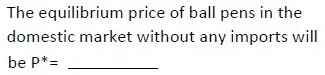 Your answer:
- Q2NAT1 Mark·Write the number
Consumer surplus in this case will be CS = _____________
Your answer: - Q3NAT1 Mark·Write the number
Producer surplus in this case will be PS = ______________
Your answer: - Q4NAT1 Mark·Write the number
In case of import without tariff, how many total units of ball pens will be imported _____________
Your answer: - Q5NAT1 Mark·Write the number
In case of import without tariff, how many units of ball pens are being supplied by domestic firms ___________
Your answer: - Q6NAT1 Mark·Write the number
With the tariff, how many units would be imported? _____________
Your answer: - Q7NAT1.5 Marks·Write the number
How much would domestic producer surplus change compared to the case with imports without tariffs if the government introduces a ₹10 import duty per ball pen? ___________
Your answer: - Q8NAT1.5 Marks·Write the number
How much revenue would the domestic government collect from the imports of ball pens due to this import duty of ₹10? _________________
Your answer: Read the passage below, then answer Q9–Q10
A beekeeper lives adjacent to an apple orchard. The orchard owner benefits from the bees because each hive pollinates about one acre of apple trees. The orchard owner pays nothing for this service, however, because the bees come to the orchard without his having to do anything. Because there are not enough bees to pollinate the entire orchard, the orchard owner must complete the pollination by artificial means, at a cost of $10 per acre of trees.
Beekeeping has a marginal cost MC=10+5Q, where Q is the number of beehives. Each hive yields $50 worth of honey.
Based on the above data, answer the given subquestions.
Q9NAT2 Marks·Write the numberWhat should be the socially efficient number of hives that the beekeeper should maintain ____________
Your answer:- Q10NAT1 Mark·Write the number
How many beehives will the beekeeper maintain if we ignore the apple orchard ____________
Your answer: Read the passage below, then answer Q11–Q12
Imagine that you have been working after college and now face the decision of whether or not to get an MBA at a prestigious institution. The cost of getting the MBA is 10. (Again, you can decide on the denomination, but rest assured that this sum includes the income lost over the course of the two years you will be studying!) Your future value is your stream of income, which depends on the strength of the labor market for the next decade. If the labor market is strong then your income value from having an MBA is 32, while your income value from your current status is 12. If the labor market is average then your income value from having an MBA is 16, while your income value from your current status is 8. If the labor market is weak then your income value from having an MBA is 12, while your income value from your current status is 4. Further assume that the probability of a strong labor market is p, of an average labor market is 0.5 and of a weak labor market is 0.5− p.
Based on the above data, answer the given subquestions.
Q11MCQ2 Marks·Choose one optionFor which values of p will you decide to get an MBA?
- A

- B

- C

- D

- A
- Q12NAT2 Marks·Write the number
If p = 0.4, what is the highest price the university can charge for you to be willing to go ahead and get an MBA? ___________
Your answer: Read the passage below, then answer Q13–Q16
Recall the example of apartments’ market discussed in the week 1. Suppose the demand curve faced by a monopolist apartment owner who has 60 apartments is D(p) = 100−2p.
Based on the above data, answer the given subquestions.
Q13NAT1 Mark·Write the numberWhat price would this monopolist will set? ____________
Your answer:- Q14NAT1 Mark·Write the number
How many apartments will he offer for rent? _____________
Your answer: - Q15NAT1 Mark·Write the number
What price would he set if he had 40 apartments? _____________
Your answer: - Q16NAT1 Mark·Write the number
How many would he rent if he had 40 apartments? ______________
Your answer: Read the passage below, then answer Q17–Q25
A monopolist can produce at a constant average (and marginal) cost of AC = MC = $5. It faces a market demand curve given by Q = 53 – P.
Based on the above data, answer the given subquestions.
Q17NAT1 Mark·Write the number Your answer:
- Q18NAT1 Mark·Write the number
 Your answer:
 - Q19NAT1 Mark·Write the number
What will be the profit of this monopolist? Profit = _____________
Your answer: - Q20NAT1 Mark·Write the number
Suppose a second firm enters the market. Let Q_1 be the output of the first firm and Q_2 be the output of the second. Market demand is now given by Q_1 + Q_2 = 53 – P. Assuming that this second firm has the same costs as the first and the firms are competing as per the Cournot competition, find out the equilibrium quantity for both firms, equilibrium price and difference in profit of a firm compared to monopolist case.
 Your answer:
 - Q21NAT1 Mark·Write the number
Suppose a second firm enters the market. Let Q_1 be the output of the first firm and Q_2 be the output of the second. Market demand is now given by Q_1 + Q_2 = 53 – P. Assuming that this second firm has the same costs as the first and the firms are competing as per the Cournot competition, find out the equilibrium quantity for both firms, equilibrium price and difference in profit of a firm compared to monopolist case.
 Your answer:
 - Q22NAT1 Mark·Write the number
Suppose a second firm enters the market. Let Q_1 be the output of the first firm and Q_2 be the output of the second. Market demand is now given by Q_1 + Q_2 = 53 – P. Assuming that this second firm has the same costs as the first and the firms are competing as per the Cournot competition, find out the equilibrium quantity for both firms, equilibrium price and difference in profit of a firm compared to monopolist case.
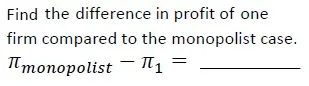 Your answer:
 - Q23NAT2 Marks·Write the number
Suppose a second firm enters the market. Let Q_1 be the output of the first firm and Q_2 be the output of the second. Market demand is now given by Q_1 + Q_2 = 53 – P. Assuming that this second firm has the same costs as the first and the firms are competing as per the Cournot competition, find out the equilibrium quantity for both firms, equilibrium price and difference in profit of a firm compared to monopolist case. Now suppose that the two firms are competing in the Stackelberg manner where one of the firms makes its output decision before the other. Suppose Firm 1 is the Stackelberg leader (i.e., makes its output decisions before Firm 2). Calculate the equilibrium quantity for both the firms, equilibrium market price and difference in profit of both firms compared to Cournot case.
 Your answer:
 - Q24NAT1 Mark·Write the number
Suppose a second firm enters the market. Let Q_1 be the output of the first firm and Q_2 be the output of the second. Market demand is now given by Q_1 + Q_2 = 53 – P. Assuming that this second firm has the same costs as the first and the firms are competing as per the Cournot competition, find out the equilibrium quantity for both firms, equilibrium price and difference in profit of a firm compared to monopolist case. Now suppose that the two firms are competing in the Stackelberg manner where one of the firms makes its output decision before the other. Suppose Firm 1 is the Stackelberg leader (i.e., makes its output decisions before Firm 2). Calculate the equilibrium quantity for both the firms, equilibrium market price and difference in profit of both firms compared to Cournot case.
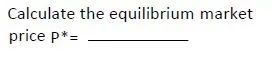 Your answer:
 - Q25NAT1 Mark·Write the number
Suppose a second firm enters the market. Let Q_1 be the output of the first firm and Q_2 be the output of the second. Market demand is now given by Q_1 + Q_2 = 53 – P. Assuming that this second firm has the same costs as the first and the firms are competing as per the Cournot competition, find out the equilibrium quantity for both firms, equilibrium price and difference in profit of a firm compared to monopolist case. Now suppose that the two firms are competing in the Stackelberg manner where one of the firms makes its output decision before the other. Suppose Firm 1 is the Stackelberg leader (i.e., makes its output decisions before Firm 2). Calculate the equilibrium quantity for both the firms, equilibrium market price and difference in profit of both firms compared to Cournot case.
 Your answer:
 Read the passage below, then answer Q26–Q28
In a market for old cars, there are 200 used cars for sale; half of these cars are good and half of them are lemons (the bad ones). Owners of lemons are willing to sell them for $500. Owners of good used cars are willing to sell them for prices above $1,100 but will keep them if the price is lower than $1,100. There are many potential buyers who are willing to pay $600 for a lemon and $1,700 for a good car. Buyers can’t tell good cars from bad, but original owners know. Based on the above data, answer the given subquestions.
Q26NAT1 Mark·Write the numberThe expected valuation of a car for a potential buyer will be (in $) ______________
Your answer:- Q27MCQ2 Marks·Choose one option
In equilibrium, what kind of cars will be sold
- AAll the good quality cars
- BAll the bad quality cars (Lemons)
- CAll 200 cars
- DCannot answer
- Q28NAT2 Marks·Write the number
What will be the equilibrium price at which the buyers will buy the cars (in $)? _____________
Your answer: Read the passage below, then answer Q29–Q30
There are 50 low-risk people in a town and 50 high-risk people. A low-risk person has an average of $500 in medical expenses each year and is willing to pay $800 for medical insurance (this person is risk averse). A high-risk person has an average of $1,200 in medical expenses each year and is willing to pay $1,500 for medical insurance. Insurance companies are unable to differentiate who is high-risk and who is low risk.
Based on the above data, answer the given subquestions.
Q29MCQ1.5 Marks·Choose one optionIf the insurance provider offered medical insurance at a price of $1,000
- AEveryone will enroll for the insurance irrespective of the type
- BThe provider will lose money
- CBoth Everyone will enroll for the insurance irrespective of the type & The provider will lose money
- DNone of these
- Q30MCQ1.5 Marks·Choose one option
If the insurance company offered medical insurance at a price of $1,300
- Alow-risk people would not be insured
- BTotal surplus will be $10000 if the price is $1300
- CBoth low-risk people would not be insured & Total surplus will be $10000 if the price is $1300
- DNone of these
- Q31MCQ1 Mark·Choose one option
If the income of the consumer increases and the one of the prices decreases at the same time, the consumer will necessarily be at least as well-off.
- ATrue
- BFalse
- Q32MCQ1 Mark·Choose one option
Which of the following is true about monopolistic competition?
- AFirms compete by selling differentiated products that are highly, but not perfectly substitutable
- BThere is free entry and exit from the market
- CBoth Firms compete by selling differentiated products that are highly, but not perfectly substitutable & There is free entry and exit from the market
- DNone of these
- Q33MCQ1 Mark·Choose one option
A monopolist always produces in
- AThe inelastic region of market demand curve
- BThe elastic region of market demand curve
- CThe whole demand curve
- DNone of these
- Q34MCQ1 Mark·Choose one option
Public goods are provided by the government because
- APrivate firms do not take into account the impact of external costs.
- BGovernments are more efficient than private firms at producing public goods.
- CPeople value national defence very highly.
- DPrivate firms will make an economic profit.
- Efree-rider problems result in underproduction by private markets.
- Q35MCQ1 Mark·Choose one option
Which goods represent network goods?
- APepsi, toilet paper, headphones
- Bcalculator, oven, couch
- CTwitter, Microsoft Excel, Facebook
- Dfireworks, lighthouse, swimming pool
- Q36MCQ1 Mark·Choose one option
Moral hazard occurs when contracts are written in such a way that
- Athe interests of agent and principal converge
- Bthe interests of agent and principal diverge
- Cagents will wish to maximize the principal's utility
- Dproduction and risk-bearing efficiency are achieved
- Q37MCQ1 Mark·Choose one option
Suppose the supply curve for pencils is vertical and government imposes a tax in this market.
- ADeadweight loss of tax in this market will be finite
- BSuppliers are paying full amount of tax
- CBoth Deadweight loss of tax in this market will be finite & Suppliers are paying full amount of tax
- DNone of these
End Term · 31 Aug 2025 (AN)End Term
Read the passage below, then answer Q38–Q40
Suppose a profit-maximizing monopolist is producing 800 units of output and is charging a price of ₹40 per unit.
Based on the above data, answer the given subquestions.
Q38NAT2 Marks·Write the numberIf the price elasticity of demand for the product is –2, find the marginal cost (in ₹) of the last unit produced ____________
Your answer:- Q39NAT2 Marks·Write the number
What is the firm’s percentage markup of price over marginal cost (as a % of the price)? ___________
Your answer: - Q40NAT2 Marks·Write the number
Suppose that the average cost of the last unit produced is ₹15 and the firm’s fixed cost is ₹2000. Find the firm’s profit (in ₹)___________
Your answer: Read the passage below, then answer Q41–Q47
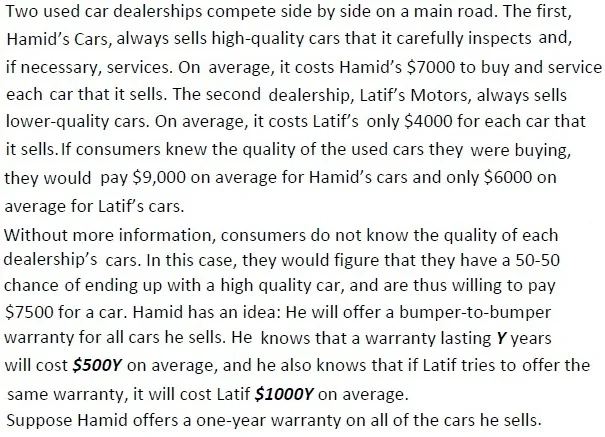
Based on the above data, answer the given subquestions.
Q41NAT1 Mark·Write the numberWhat is Latif’s profit (per car in $) if he does not offer a one-year warranty?______________
Your answer:- Q42NAT1 Mark·Write the number
What is Latif’s profit (per car in $) if he offers a one-year warranty?______________
Your answer: - Q43NAT1 Mark·Write the number
What is Hamid’s profit (per car in $) if Latif’s does not offer a one-year warranty? ___________
Your answer: - Q44NAT1 Mark·Write the number
What is Hamid’s profit (per car in $) if Latif’s offers a one-year warranty? _____________
Your answer: - Q45MCQ1 Mark·Choose one option
Will Latif’s match Hamid’s one-year warranty?
- AYes
- BNo
- Q46MCQ1 Mark·Choose one option
Is it a good idea for Hamid’s to offer a one-year warranty?
- AYes
- BNo
- Q47MCQ1 Mark·Choose one option
What if Hamid offers a two-year warranty? Will this generate a credible signal of quality?
- AYes
- BNo
Read the passage below, then answer Q48–Q55
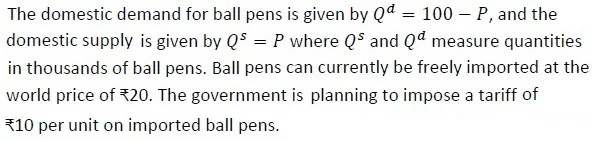
Based on the above data, answer the given subquestions.
Q48NAT1 Mark·Write the numberThe equilibrium price of ball pens in the domestic market without any imports will be P*= _______
Your answer:- Q49NAT1 Mark·Write the number
Consumer surplus in this case will be CS = ____________
Your answer: - Q50NAT1 Mark·Write the number
Producer surplus in this case will be PS = ____________
Your answer: - Q51NAT1 Mark·Write the number
In case of import without tariff, how many total units of ball pens will be imported _______________
Your answer: - Q52NAT1 Mark·Write the number
In case of import without tariff, how many units of ball pens are being supplied by domestic firms ____________
Your answer: - Q53NAT1 Mark·Write the number
With the tariff, how many units would be imported? ____________
Your answer: - Q54NAT1.5 Marks·Write the number
How much would domestic producer surplus change compared to the case with imports without tariffs if the government introduces a ₹10 import duty per ball pen?____________
Your answer: - Q55NAT1.5 Marks·Write the number
How much revenue would the domestic government collect from the imports of ball pens due to this import duty of ₹10? ____________
Your answer: Read the passage below, then answer Q56–Q65
The market demand curve for pizzas is P=300-Q and the market supply curve is P=60+2Q. A tax of t=15 INR is imposed on one unit of pizza sold. Answer the given subquestions.
Q56MCQ0.5 Marks·Choose one optionThe equilibrium quantity and price before incidence of tax are
- A

- B

- C

- D

- A
- Q57MCQ0.5 Marks·Choose one option
Consumer surplus before incidence of tax is
- AINR 4500
- BINR 2700
- CINR 3200
- DINR 4200
- Q58MCQ0.5 Marks·Choose one option
Producer surplus before incidence of tax is
- AINR 6400
- BINR 4600
- CINR 3700
- DINR 2700
- Q59MCQ0.5 Marks·Choose one option
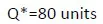
The equilibrium quantity after the incidence of tax is
- A

- B
- C

- D

- A
- Q60MCQ0.5 Marks·Choose one option
The new price that buyer pays after incidence of tax is
- AP=220 INR
- BP=190 INR
- CP=180 INR
- DP=225 INR
- Q61MCQ0.5 Marks·Choose one option
The net price received by the seller after incidence of tax
- AP=220 INR
- BP=225 INR
- CP=190 INR
- DP=210 INR
- Q62MCQ0.5 Marks·Choose one option
The loss in consumer surplus due to incidence of tax is
- A527.5 INR
- B387.5 INR
- C478.5 INR
- D268.5 INR
- Q63MCQ0.5 Marks·Choose one option
The loss in producer surplus due to incidence of tax is
- AINR 565
- BINR 845
- CINR 775
- DINR 695
- Q64MCQ0.5 Marks·Choose one option
The total tax revenue is
- AINR 1255
- BINR 1075
- CINR 1535
- DINR 1125
- Q65MCQ0.5 Marks·Choose one option
Deadweight loss of tax is
- AINR 48.5
- BINR 37.5
- CINR 89.5
- DINR 68.5
Read the passage below, then answer Q66–Q67
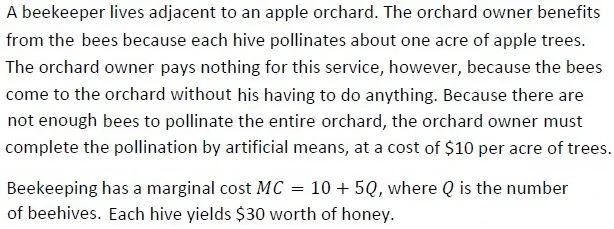
Based on the above data, answer the given subquestions.
Q66NAT2 Marks·Write the numberWhat should be the socially efficient number of hives that the beekeeper should maintain ____________
Your answer:- Q67NAT1 Mark·Write the number
How many beehives will the beekeeper maintain if we ignore the apple orchard ____________
Your answer: Read the passage below, then answer Q68–Q69
Imagine that you have been working after college and now face the decision of whether or not to get an MBA at a prestigious institution. The cost of getting the MBA is 10. (Again, you can decide on the denomination, but rest assured that this sum includes the income lost over the course of the two years you will be studying!) Your future value is your stream of income, which depends on the strength of the labor market for the next decade. If the labor market is strong then your income value from having an MBA is 32, while your income value from your current status is 12. If the labor market is average then your income value from having an MBA is 16, while your income value from your current status is 8. If the labor market is weak then your income value from having an MBA is 12, while your income value from your current status is 4. Further assume that the probability of a strong labor market is p, of an average labor market is 0.5 and of a weak labor market is 0.5− p.
Based on the above data, answer the given subquestions.
Q68MCQ2 Marks·Choose one optionFor which values of p will you decide not to get an MBA?
- A

- B

- C

- D

- A
- Q69NAT2 Marks·Write the number
If P=0.4, what is the highest price the university can charge for you to be willing to go ahead and get an MBA? ____________
Your answer: Read the passage below, then answer Q70–Q73

Based on the above data, answer the given subquestions.
Q70NAT1 Mark·Write the numberWhat price would this monopolist will set? ____________
Your answer:- Q71NAT1 Mark·Write the number
How many apartments will he offer for rent?____________
Your answer: - Q72NAT1 Mark·Write the number
What price would he set if he had 40 apartments? ____________
Your answer: - Q73NAT1 Mark·Write the number
How many would he rent if he had 40 apartments?____________
Your answer: - Q74MCQ1 Mark·Choose one option
What is true about monopolistic competition
- AFirms compete by selling differentiated products that are highly, but not perfectly, substitutable
- BEntry and exit are free in the market
- CNone
- DBoth the firms compete by selling differentiated products that are highly, but not perfectly, substitutable and entry and exit are free in the market
- Q75MCQ1 Mark·Choose one option
Choose the correct statement
- AQuasi linear preferences are linear in one good
- BU = min{ax, by} represents complements
- CU = ax+by represents substitutes
- DAll of these
- Q76MCQ1 Mark·Choose one option
Choose the correct alternative
- AFirst-degree price discrimination is the practice of attempting to price each unit at the consumer’s reservation price
- BOutcome in First-degree price discrimination is not Pareto efficient
- CBoth the first-degree price discrimination is the practice of attempting to price each unit at the consumer’s reservation price and outcome in First-degree price discrimination is not Pareto efficient
- DNone
- Q77MCQ1 Mark·Choose one option
Adverse selection occurs when
- Aa person takes more risks that are not known to the life insurance company because he has life insurance
- Ba person buys life insurance because he has a risky lifestyle that is not known to the life insurance company
- Ca person is a risk lover
- Dpregnant women with health insurance make more doctor visits than uninsured pregnant women
- Q78MCQ1 Mark·Choose one option
Moral hazard occurs when contracts are written in such a way that
- Athe interests of agent and principal converge
- Bthe interests of agent and principal diverge
- Cagents will wish to maximize the principal's utility
- Dproduction and risk-bearing efficiency are achieved
- Q79MCQ1 Mark·Choose one option
If the income of the consumer increases and the one of the prices decreases at the same time, the consumer will not necessarily be at least as well-off.
- ATRUE
- BFALSE
- Q80MCQ1 Mark·Choose one option
A monopolist never produces in
- AThe inelastic region of market demand curve
- BThe elastic region of market demand curve
- CThe whole demand curve
- DNone of these
Quiz 2 · 3 Aug 2025 (AN)Quiz 2
Read the passage below, then answer Q81–Q82
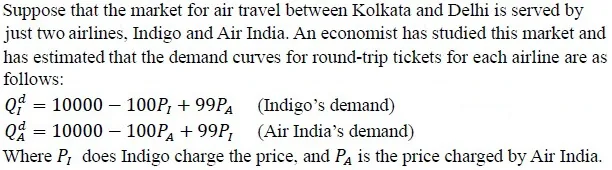
Based on the above data, answer the given subquestions.
Q81NAT1 Mark·Write the numberSuppose that both Air India and Indigo charge a price of $300 each for a round-trip ticket between Kolkata and Delhi. What is the price elasticity of demand for Indigo flights between Kolkata and Delhi? (please ignore the sign)
Your answer:- Q82NAT1 Mark·Write the number
What is the market-level price elasticity of demand for air travel between Kolkata and Delhi when both airlines charge a price of $300? (please ignore the sign)
Your answer: Read the passage below, then answer Q83–Q84

Based on the above data, answer the given subquestions.
Q83MCQ1 Mark·Choose one optionHow many nurses will the hospital hire as a monopsonist
- A100
- B120
- C140
- D160
- Q84MCQ1 Mark·Choose one option
What wage will it pay to a nurse
- A12500
- B13000
- C14000
- D16000
Read the passage below, then answer Q85–Q86
Consider the following game matrix where only the payoff of player 1 is given.
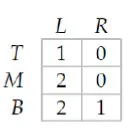
Based on the above data, answer the given subquestions.
Q85MCQ0.5 Marks·Choose one optionM weakly dominates T
- ATrue
- BFalse
- Q86MCQ0.5 Marks·Choose one option
M weakly dominates B
- ATrue
- BFalse
Read the passage below, then answer Q87–Q89
A monopolist can produce at a constant average (and marginal) cost of AC = MC = $5. It faces a market demand curve given by Q = 53 – P.
Based on the above data, answer the given subquestions.
Q87NAT1 Mark·Write the numberCalculate the profit-maximizing price (in $) for this monopolist.
 Your answer:
- Q88NAT1 Mark·Write the number
Calculate the profit-maximizing quantity for this monopolist.
 Your answer:
 - Q89NAT1 Mark·Write the number
What will be the profit of this monopolist? Profit= ___________________
Your answer: Read the passage below, then answer Q90–Q92
Suppose that a competitive firm’s marginal cost of producing output q is given by MC(q)=6+4q. Assume that the market price of the firm’s product is ₹18.
Based on the above data, answer the given subquestions.
Q90MCQ1 Mark·Choose one optionWhat level of output (q) the firm will produce?
- A2
- B3
- C4
- D5
- Q91MCQ1 Mark·Choose one option
Producer surplus of the firm is
- A17
- B18
- C19
- D20
- Q92MCQ1 Mark·Choose one option
Suppose the average variable cost of the firm is given by AVC(q)=3+q and firm’s fixed costs are known to be ₹3, the firm be earning
- APositive economic profit
- BNegative economic profit
- CZero economic profit
- DCannot say
Read the passage below, then answer Q93–Q101
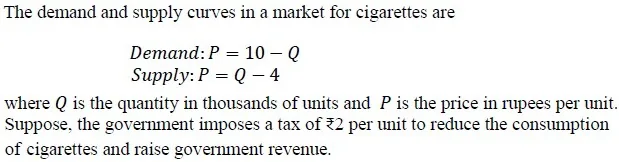
Based on the above data, answer the given subquestions.
Q93NAT1 Mark·Write the number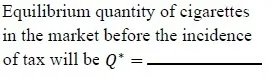 Your answer:
- Q94NAT1 Mark·Write the number
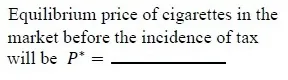 Your answer:
 - Q95NAT1 Mark·Write the number
New equilibrium quantity after the incidence of tax Q^t = __________________
Your answer: - Q96NAT1 Mark·Write the number
Price that buyers pay now will be P^B= ________________
Your answer: - Q97NAT1 Mark·Write the number
Price that seller receives per unit will be P^S= _______________
Your answer: - Q98NAT1 Mark·Write the number
Suppose, the government acts weird and removes the tax to provide a subsidy of ₹2 per unit to cigarette producers. New equilibrium quantity after the subsidy, Q^S = __________
Your answer: - Q99NAT1 Mark·Write the number
Suppose, the government acts weird and removes the tax to provide a subsidy of ₹2 per unit to cigarette producers. Price that buyers pay now will be P^B= ______________
Your answer: - Q100NAT1 Mark·Write the number
Suppose, the government acts weird and removes the tax to provide a subsidy of ₹2 per unit to cigarette producers. Price that seller receives per unit (including subsidy) will be P^S= _____________
Your answer: - Q101NAT1 Mark·Write the number
Suppose, the government acts weird and removes the tax to provide a subsidy of ₹2 per unit to cigarette producers. Total cost to the government will be (in rupees) ______________
Your answer: - Q102MCQ0.5 Marks·Choose one option
In quasi-linear utility functions, the marginal utility of income remains constant
- ATrue
- BFalse
- Q103MCQ0.5 Marks·Choose one option
A monotonic transformation can alter the shape of indifference curves
- ATrue
- BFalse
- Q104MCQ0.5 Marks·Choose one option
Marginal utility is unaffected by monotonic transformations
- ATrue
- BFalse
- Q105MCQ0.5 Marks·Choose one option
The entire burden of a quantity tax falls on buyers when the price elasticity of supply is zero.
- ATrue
- BFalse
- Q106MCQ0.5 Marks·Choose one option
If demand is perfectly inelastic, consumers bear the full incidence of a per-unit tax.
- ATrue
- BFalse
- Q107MCQ0.5 Marks·Choose one option
For a profit-maximizing monopolist, price exceeds marginal revenue at the equilibrium quantity.
- ATrue
- BFalse
- Q108MCQ0.5 Marks·Choose one option
When a monopolist practices perfect price discrimination, it eliminates only some portion of the deadweight loss.
- ATrue
- BFalse
- Q109MCQ0.5 Marks·Choose one option
A natural monopoly has a long-run marginal cost that exceeds long-run average cost.
- ATrue
- BFalse
- Q110MCQ0.5 Marks·Choose one option
Peak load pricing is a form of price discrimination.
- ATrue
- BFalse
- Q111MCQ0.5 Marks·Choose one option
A monopolist will never operate in the elastic portion of the demand curve.
- ATrue
- BFalse
Official KeyMaster Answer Key & Explanations
Official answer keys from IIT Madras BS past papers. Click any question to review.
Reveal KeyCollapse Key
Master Answer Key & Explanations
Official answer keys from IIT Madras BS past papers. Click any question to review.
Detailed Answer Notes & Working
- Q2Answer: 1250 or 1250000
- Official answer key accepts 1250 or 1250000.
- Q3Answer: 1250 or 1250000
- Official answer key accepts 1250 or 1250000.
- Q4Answer: 60 or 60000
- Official answer key accepts 60 or 60000.
- Q5Answer: 20 or 20000
- Official answer key accepts 20 or 20000.
- Q6Answer: 40 or 40000
- Official answer key accepts 40 or 40000.
- Q7Answer: 250000 or 250
- Official answer key accepts 250000 or 250.
- Q8Answer: 400 or 400000
- Official answer key accepts 400 or 400000.
- Q49Answer: 1250 or 1250000
- Official answer key accepts 1250 or 1250000.
- Q50Answer: 1250 or 1250000
- Official answer key accepts 1250 or 1250000.
- Q51Answer: 60 or 60000
- Official answer key accepts 60 or 60000.
- Q52Answer: 20 or 20000
- Official answer key accepts 20 or 20000.
- Q53Answer: 40 or 40000
- Official answer key accepts 40 or 40000.
- Q54Answer: 250000 or 250
- Official answer key accepts 250000 or 250.
- Q55Answer: 400 or 400000
- Official answer key accepts 400 or 400000.
- Q93Answer: 7 or 7000
- Official answer key accepts 7 or 7000.
- Q95Answer: 6 or 6000
- Official answer key accepts 6 or 6000.
- Q98Answer: 8 or 8000
- Official answer key accepts 8 or 8000.