Indian Institute of Technology Madras
BS Degree Programme · Examination & Study Paper
Machine Learning Practice
All 2024 papers
Examination Instructions & Guidelines
- Solve on notebook/paper first before checking solutions.
- MCQ: Exactly 1 option is correct. Negative marking applies.
- MSQ: One or more options correct. Select all to score.
- NAT: Numerical response. No negative marking.
- Scientific calculator allowed for all calculations.
- Official answer key is sealed at the end of this sheet.
- Q1MCQ2 Marks·Choose one option
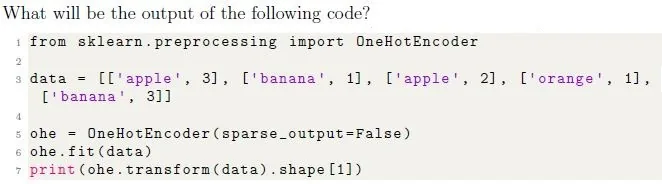
- A4
- B5
- C3
- D6
- Q2MCQ2 Marks·Choose one option
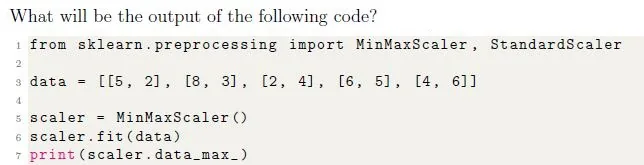
- A[5, 6]
- B[4, 5]
- C[8, 6]
- D[2, 3]
- Q3MCQ2 Marks·Choose one option
You have loaded a dataset with 1000 samples and 20 features into a Pandas DataFrame. Some samples have missing values for a few features. If you want to remove rows with fewer than 15 non-null values, what method would you use?
- A

- B

- C

- D

- E

- A
- Q4MCQ2 Marks·Choose one option
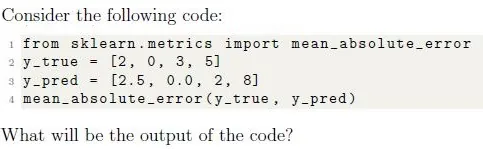
- A1.25
- B2.56
- C4.25
- D1.12
- EGiven code will return an error.
- Q5MCQ2 Marks·Choose one option
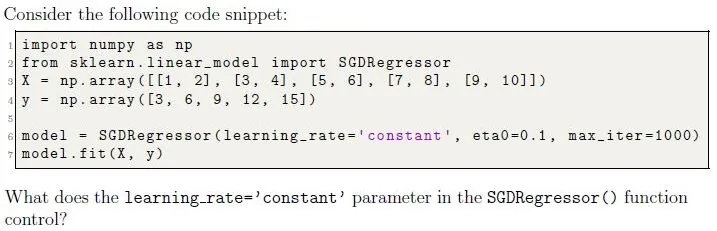
- AIt adjusts the learning rate based on the number of iterations.
- BIt defines the initial value for the learning rate and keeps it constant throughout training.
- CIt determines the maximum step size allowed during training.
- DIt specifies the fraction of the dataset used for each step in the stochastic gradient descent.
- Q6MCQ2 Marks·Choose one option

- AIt determines the number of features to select for each base model.
- BIt controls the number of base learners (models) to train in the ensemble.
- CIt decides the maximum number of samples to use in each base model.
- DIt ensures randomness in the sample selection for each base model.
- Q7MCQ2 Marks·Choose one option
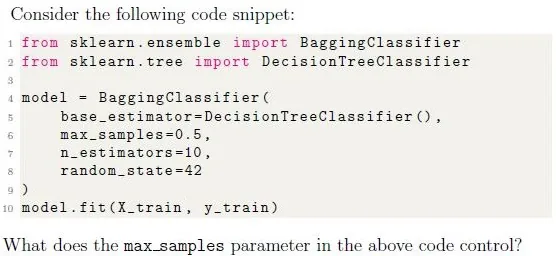
- AThe percentage of training samples used to train each base estimator.
- BThe number of base estimators trained on subsets of the training data.
- CThe maximum number of features used by each base estimator during training.
- DThe total number of samples used to train all base estimators combined.
- Q8MCQ2 Marks·Choose one option

- AIt increases the variance among individual trees.
- BIt decreases the variance among individual trees.
- CIt reduces the number of samples used for training each tree.
- DIt reduces overfitting by restricting tree depth.
- Q9MCQ2 Marks·Choose one option
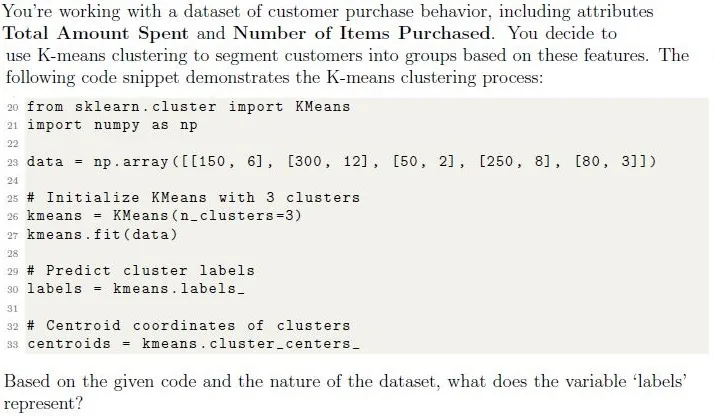
- AThe total amount spent by each customer.
- BThe cluster assignments indicating which group each customer belongs to.
- CThe number of items purchased by each customer.
- DThe centroid coordinates of the clusters formed.
- Q10MCQ2 Marks·Choose one option
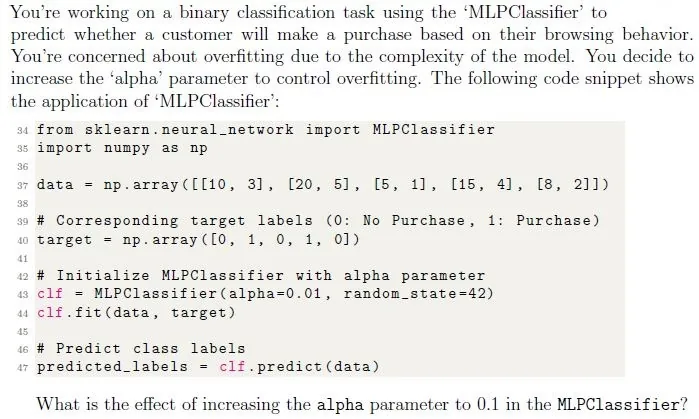
- AIt increases the model’s capacity to fit the training data closely, potentially causing overfitting.
- BIt adds a stronger regularization term to the loss function, reducing the model’s complexity and helping prevent overfitting.
- CIt makes the model more prone to overfitting by increasing its sensitivity to noise in the training data.
- DIt directly affects the learning rate, controlling how fast the model converges during training.
- Q11MCQ2 Marks·Choose one option
Consider the following two statements and select the correct answer: 1. Statement 1: The multinomial Naive Bayes classifier is suitable for classification with discrete features 2. Statement 2: Two dependent features do not impact GaussianNB performance because internally it calculates the conditional probability independently for each feature.
- ABoth statements are True
- BOnly statement 1 is True
- COnly statement 2 is True
- DBoth statements are False
- Q12MCQ3 Marks·Choose one option
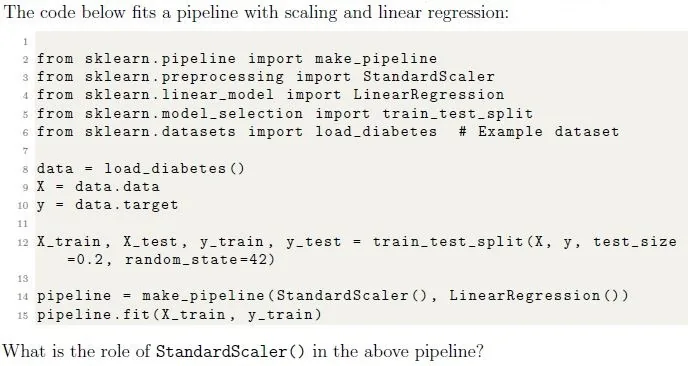
- A

- B

- C

- D

- A
- Q13MCQ3 Marks·Choose one option

- A

- B

- C

- D

- A
- Q14MCQ3 Marks·Choose one option
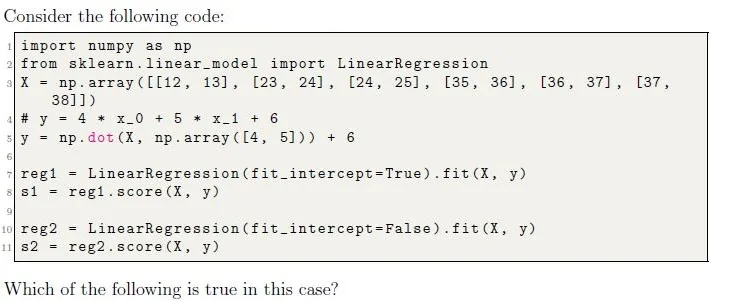
- As1 = s2
- Bs1 < s2
- Cs1 > s2
- Q15MCQ3 Marks·Choose one option
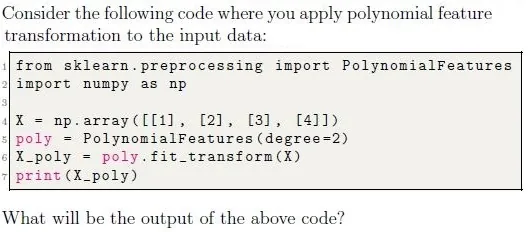
- A

- B
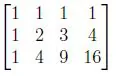
- C

- D
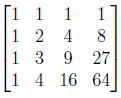
- E

- A
- Q16MCQ3 Marks·Choose one option
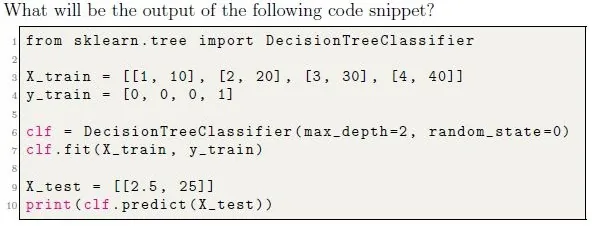
- A[0]
- B[1]
- C[0.5]
- D[2]
- Q17MCQ3 Marks·Choose one option
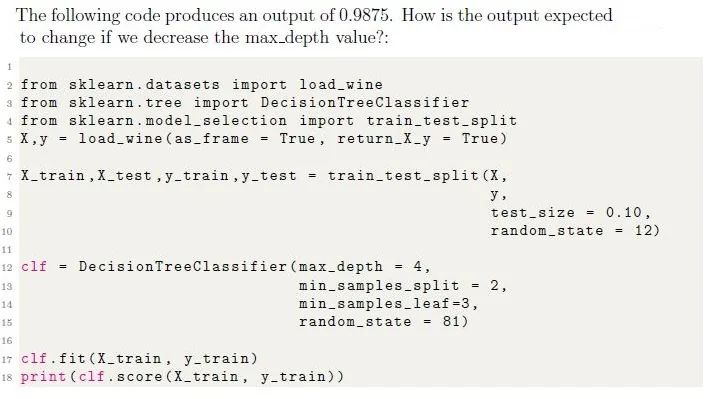
- AOutput score is likely to increase.
- BOutput score is likely to decrease.
- COutput score may increase or decrease depending on other factors.
- DOutput score will remain the same.
- Q18MCQ3 Marks·Choose one option
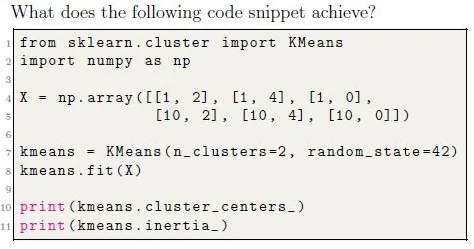
- AOutputs the number of iterations and the final silhouette score of the clusters.
- BOutputs the cluster labels for each data point and the maximum distance between clusters.
- COutputs the coordinates of the cluster centroids and the number of points in each cluster.
- DOutputs the coordinates of the cluster centroids and the sum of squared distances of samples to their closest cluster center.
- Q19MCQ3 Marks·Choose one option
- A

- B

- C

- D

- A
- Q20MCQ3 Marks·Choose one option
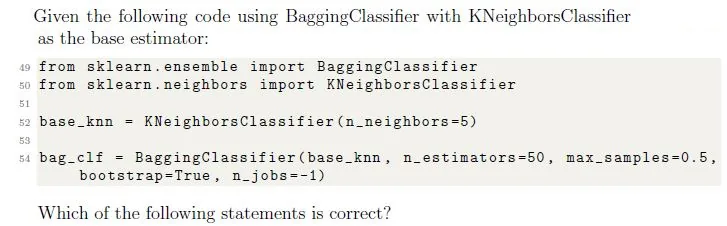
- A

- B

- C

- D

- A
- Q21MCQ3 Marks·Choose one option
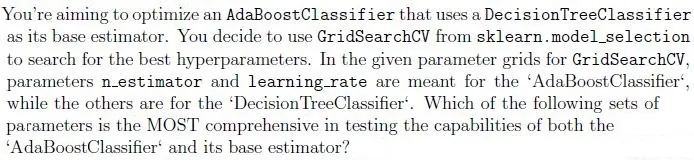
- A

- B
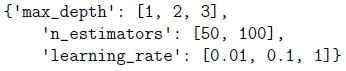
- C

- D

- A
- Q22MCQ4 Marks·Choose one option
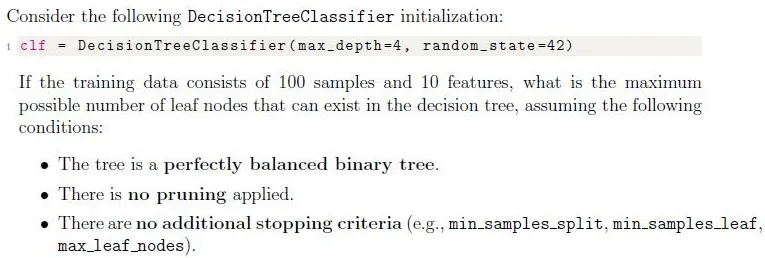
- A8
- B16
- C32
- D64
- Q23MSQ2 Marks·Choose all correct options
Which of the following are techniques for dimensionality reduction?
- APCA (Principal Component Analysis)
- BStandardScaler
- CLasso Regression
- Dt-SNE (t-distributed Stochastic Neighbor Embedding)
- Q24MSQ2 Marks·Choose all correct options

- AWhen data is streaming or generated incrementally.
- BWhen the dataset is small.
- CWhen the dataset cannot fit in memory.
- DWhen the training labels are noisy.
- Q25MSQ3 Marks·Choose all correct options
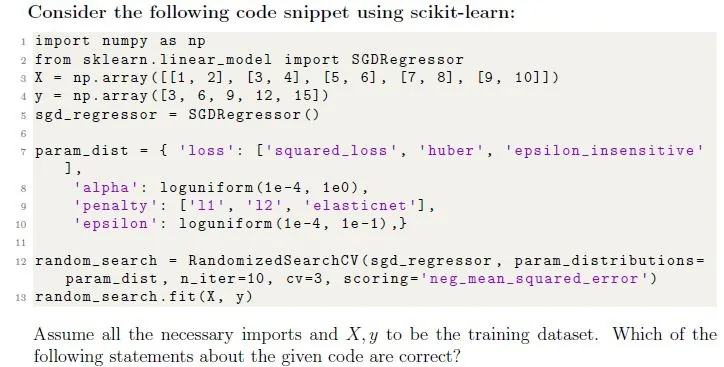
- A

- B

- C

- D

- A
- Q26MSQ3 Marks·Choose all correct options
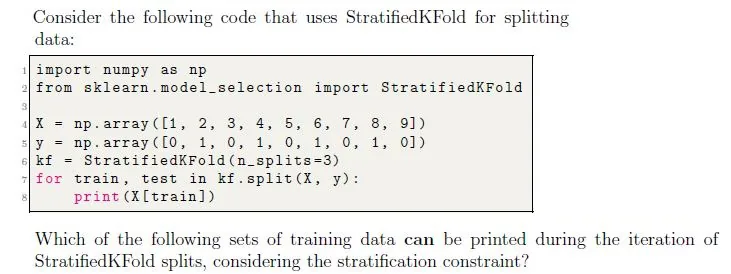
- A[1, 2, 3, 6, 7]
- B[1, 2, 3, 4, 5, 7]
- C[2, 4, 6, 8]
- D[1, 2, 3, 6, 8, 9]
- E[2, 5, 8]
- F[4, 5, 6, 7, 8, 9]
- Q27MSQ3 Marks·Choose all correct options

- A

- B

- C

- D

- A
- Q28MSQ3 Marks·Choose all correct options

- A

- B

- C

- D

- A
- Q29MSQ3 Marks·Choose all correct options

- A

- B

- C

- D

- A
- Q30MSQ3 Marks·Choose all correct options

- AThe neural network contains 3 hidden layers with 5 neurons in each hidden layer
- BThe neural network contains 5 hidden layers with 3 neurons in each hidden layer
- CThe neural network contains 2 hidden layers with 3 neurons in the second hidden layer
- DThe neural network contains 2 hidden layers with 5 neurons in the first hidden layer
- ENone of the given options are correct
- Q31MSQ4 Marks·Choose all correct options
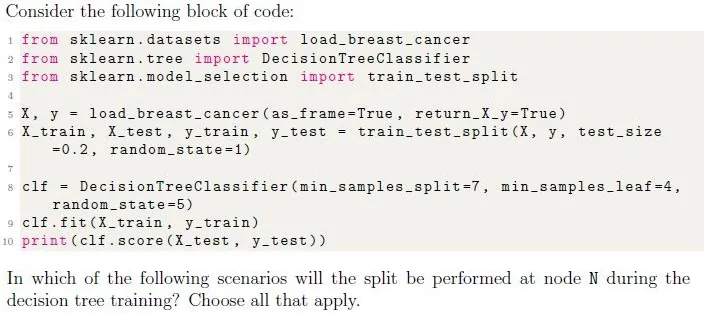
- AThe number of samples at node N is 15. If split, the left child will have 10 samples, and the right child will have 5 samples.
- BThe number of samples at node N is 8. If split, the left child will have 4 samples, and the right child will have 4 samples.
- CThe number of samples at node N is 9. If split, the left child will have 2 samples, and the right child will have 7 samples.
- DThe number of samples at node N is 14. If split, the left child will have 4 samples, and the right child will have 10 samples.
- EThe number of samples at node N is 6. If split, the left child will have 3 samples, and the right child will have 3 samples.
- Q32NAT3 Marks·Write the number
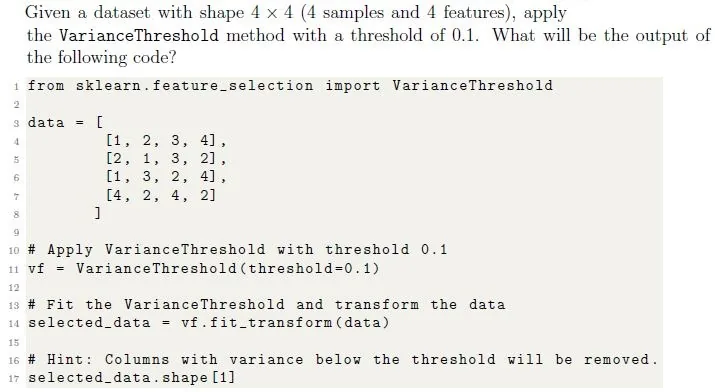 Your answer:
 - Q33NAT3 Marks·Write the number
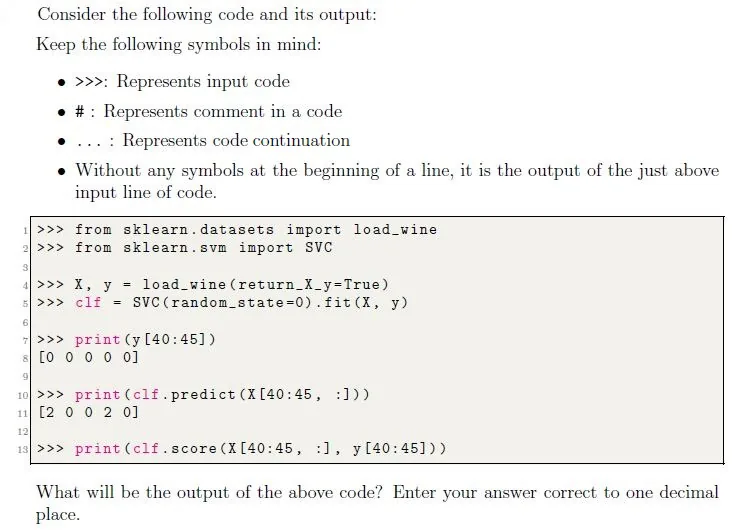 Your answer:
 - Q34NAT3 Marks·Write the number
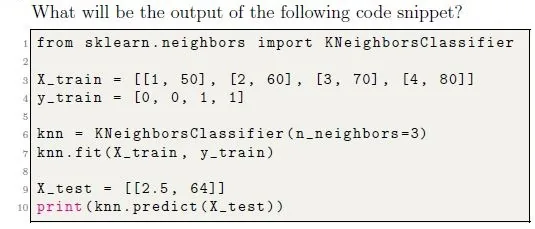 Your answer:
 Read the passage below, then answer Q35–Q38
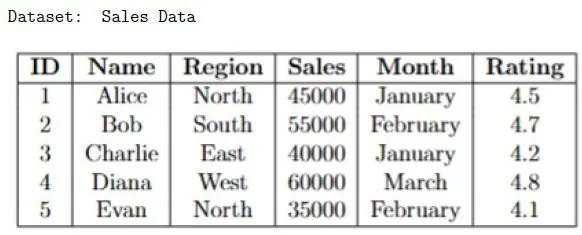
Based on the above data, answer the given subquestions
Q35MCQ2 Marks·Choose one optionWhich of the following commands will return the total sales across all regions?
- A

- B

- C

- D

- A
- Q36MSQ2 Marks·Choose all correct options
Which of the following commands will return the names of employees in the ”North” region?
- A

- B

- C

- D

- A
- Q37MSQ3 Marks·Choose all correct options
Which of the following methods can be used to find the employee(s) with the highest sales?
- A

- B

- C

- D

- A
- Q38MCQ2 Marks·Choose one option

- AThe total sales for each region.
- BThe average sales for each month.
- CThe average sales for each region.
- DNone of these.
Official KeyMaster Answer Key & Explanations
Official answer keys from IIT Madras BS past papers. Click any question to review.
Reveal KeyCollapse Key
Master Answer Key & Explanations
Official answer keys from IIT Madras BS past papers. Click any question to review.