Indian Institute of Technology Madras
BS Degree Programme · Examination & Study Paper
Machine Learning Practice
Decision trees & ensembles
Official Paper
Examination Instructions & Guidelines
- Solve on notebook/paper first before checking solutions.
- MCQ: Exactly 1 option is correct. Negative marking applies.
- MSQ: One or more options correct. Select all to score.
- Scientific calculator allowed for all calculations.
- Official answer key is sealed at the end of this sheet.
- Q1MCQ2 Marks·Choose one option

- AIt determines the number of features to select for each base model.
- BIt controls the number of base learners (models) to train in the ensemble.
- CIt decides the maximum number of samples to use in each base model.
- DIt ensures randomness in the sample selection for each base model.
- Q2MCQ2 Marks·Choose one option
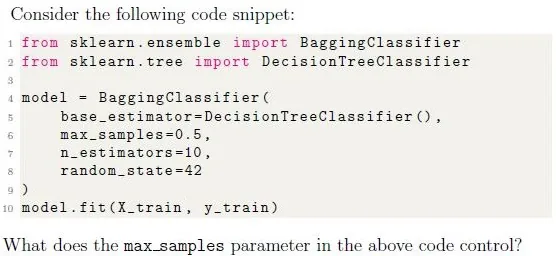
- AThe percentage of training samples used to train each base estimator.
- BThe number of base estimators trained on subsets of the training data.
- CThe maximum number of features used by each base estimator during training.
- DThe total number of samples used to train all base estimators combined.
- Q3MCQ2 Marks·Choose one option

- AIt increases the variance among individual trees.
- BIt decreases the variance among individual trees.
- CIt reduces the number of samples used for training each tree.
- DIt reduces overfitting by restricting tree depth.
- Q4MCQ3 Marks·Choose one option
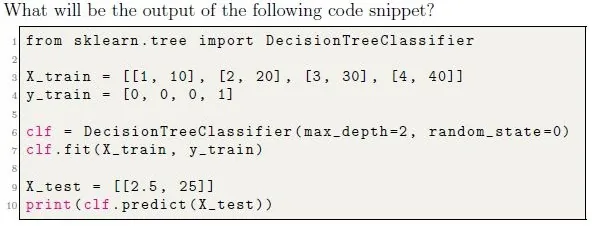
- A[0]
- B[1]
- C[0.5]
- D[2]
- Q5MCQ3 Marks·Choose one option
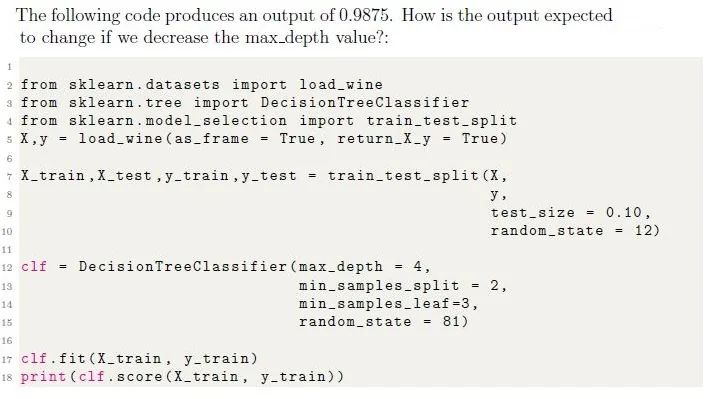
- AOutput score is likely to increase.
- BOutput score is likely to decrease.
- COutput score may increase or decrease depending on other factors.
- DOutput score will remain the same.
- Q6MCQ3 Marks·Choose one option
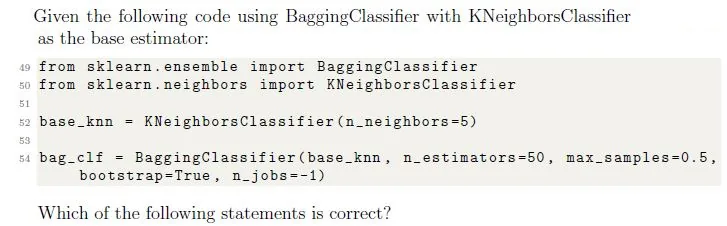
- A

- B

- C

- D

- A
- Q7MCQ4 Marks·Choose one option
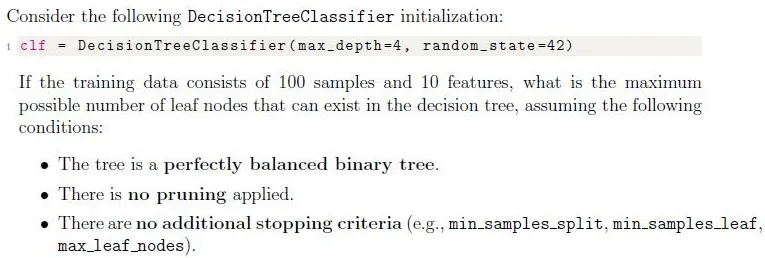
- A8
- B16
- C32
- D64
- Q8MSQ4 Marks·Choose all correct options
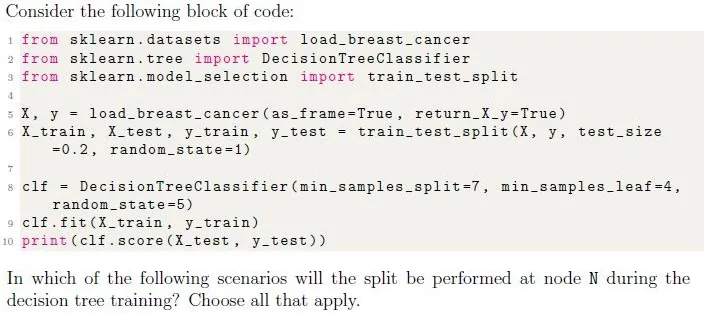
- AThe number of samples at node N is 15. If split, the left child will have 10 samples, and the right child will have 5 samples.
- BThe number of samples at node N is 8. If split, the left child will have 4 samples, and the right child will have 4 samples.
- CThe number of samples at node N is 9. If split, the left child will have 2 samples, and the right child will have 7 samples.
- DThe number of samples at node N is 14. If split, the left child will have 4 samples, and the right child will have 10 samples.
- EThe number of samples at node N is 6. If split, the left child will have 3 samples, and the right child will have 3 samples.