Indian Institute of Technology Madras
BS Degree Programme · Examination & Study Paper
Business Analytics
Demand response curves & pricing
Examination Instructions & Guidelines
- Solve on notebook/paper first before checking solutions.
- MCQ: Exactly 1 option is correct. Negative marking applies.
- NAT: Numerical response. No negative marking.
- Scientific calculator allowed for all calculations.
- Official answer key is sealed at the end of this sheet.
Quiz 1 · 26 Oct 2025 (AN)Quiz 1
- Q1MCQ1 Mark·Choose one option
Latent demand in a demand-response curve is the area obtained when?
- APrice is reduced below the identified optimal price
- BPrice is increased beyond the identified optimal price
- CThe optimal price is increased beyond the maximum available price
- DQuantity is reduced below the identified optimal quantity
Read the passage below, then answer Q2–Q4
(The following is a purely imaginary scenario)
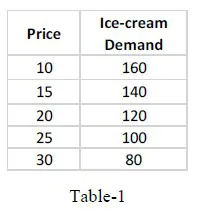
The demand for ice creams at different prices in the supermarket at IITM is specified in Table-1. Given this data, answer the subquestions (Note: For all the sub-questions, round your answer to two decimal places. Eg: If your answer is 10.256, then round it to 10.26)
 Q2NAT1 Mark·Write the number
If a linear demand-response curve is fit for the data in Table-1, what is the satiating price for ice creams? (Note: Enter the answer rounded to two decimal places. For example, if the answer is “1.235”, then enter it as “1.24”)
Your answer:- Q3NAT1 Mark·Write the number
If a linear demand-response curve is fit for the data in Table-1, what is the market size for ice creams? (Note: Enter the answer rounded to two decimal places. For example, if the answer is “1.235”, then enter it as “1.24”)
Your answer: - Q4NAT1 Mark·Write the number
What is the elasticity of the linear demand-response curve, when the price is Rs. 35? (Note: Enter the answer rounded to two decimal places. For example, if the answer is “1.235”, then enter it as “1.24”)
Your answer:
Quiz 2 · 3 Aug 2025 (AN)Quiz 2
Read the passage below, then answer Q5–Q6
A demand response curve has a constant price elasticity of +0.6. If the price of the product is 100 and the corresponding demand is 200, then answer the given subquestions.
Q5NAT0.5 Marks·Write the numberWhat is the value of “Constant” (“C”) for the constant elasticity model? (Note: Enter the answer rounded to two decimal places. For example, if the answer is “1.234”, then enter it as “1.23”)
Your answer:- Q6NAT1 Mark·Write the number
What should be the price to achieve a demand of 300? (Note: Enter the answer rounded to two decimal places. For example, if the answer is “1.234”, then enter it as “1.23”)
Your answer:
End Term · 13 Apr 2025 (FN)End Term
Read the passage below, then answer Q7–Q11
(The following is a purely imaginary scenario)
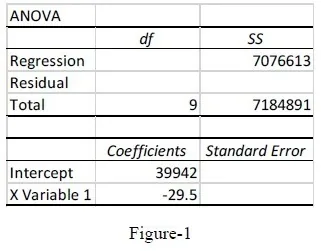
A demand response curve is modelled using linear regression. The partial regression output is given in Figure-1 below. Given this information, answer the subquestions.
 Q7NAT1.5 Marks·Write the number
What is the elasticity of the demand response curve at a price of Rs. 50? (Note: Enter the answer rounded to two decimal places. For example, if the answer is “1.234”, then enter it as “1.23”)
Your answer:- Q8NAT0.5 Marks·Write the number
What is the market size? (Note: Enter the answer rounded to two decimal places. For example, if the answer is “1.234”, then enter it as “1.23”)
Your answer: - Q9NAT0.5 Marks·Write the number
What is the satiating price? (Note: Enter the answer rounded to two decimal places. For example, if the answer is “1.234”, then enter it as “1.23”)
Your answer: - Q10MCQ0.5 Marks·Choose one option
Based on the elasticity, which of the following statements are TRUE
- AThe demand is elastic
- BThe demand is inelastic
- CThe price is elastic
- DThe price is inelastic
- Q11NAT1 Mark·Write the number
What percentage of the total linear variability in demand is captured by this model (given in figure-1)? (Note: Enter the answer in “percentage rounded to two decimal places without the percentage sign. For example, if the answer is “1.234%”, then enter it as “1.23”)
Your answer: Read the passage below, then answer Q12–Q13
(The following is a purely imaginary scenario)
The relationship between Demand “D” and Selling Price “P” is given by the equation D(p) = 780 – 9*P. Then answer the given sub-questions.
Q12NAT2 Marks·Write the numberIf the intention is to maximize the profit, then what is the optimal selling price if the item is going to be made at Rs. 30 per unit? (Note: Enter the answer rounded to two decimal places. For example, if the answer is “1.234”, then enter it as “1.23”)
Your answer:- Q13NAT1 Mark·Write the number
What is the maximum profit that can be generated? (Note: Enter the answer rounded to two decimal places. For example, if the answer is “1.234”, then enter it as “1.23”)
Your answer: