Indian Institute of Technology Madras
BS Degree Programme · Examination & Study Paper
BSGN3001 · Strategies for Professional Growth
All 2025 papers
Examination Instructions & Guidelines
- Solve on notebook/paper first before checking solutions.
- MCQ: Exactly 1 option is correct. Negative marking applies.
- Scientific calculator allowed for all calculations.
- Official answer key is sealed at the end of this sheet.
End Term · 31 Aug 2025 (FN)End Term
Read the passage below, then answer Q1–Q5

Cross-cultural Management:
Identify the most appropriate cross-cultural management strategies demonstrated in the scenario from the options provided below.
a. Cultural Dominance
b. Cultural Avoidance
c. Cultural Compromise
d. Cultural Accommodation
e. Cultural Synergy
Based on the above data, answer the given subquestions.
Q1MCQ1 Mark·Choose one option[Cross-cultural Management] Kumkum, an Indian manager, is in a global meeting where a minor disagreement arises about the layout of an employee satisfaction survey. She believes her approach is better, but insisting would distract from the larger agenda and risk straining relationships with European colleagues. She chooses to set the issue aside and continue.
- ACultural Dominance
- BCultural Avoidance
- CCultural Compromise
- DCultural Accommodation
- ECultural Synergy
- Q2MCQ1 Mark·Choose one option
[Cross-cultural Management] Gulshan, leading a joint US–Japan project, faces a conflict over reporting standards. Both sides hold firm views, and time is short. She proposes that both sides make slight concessions in order to work together.
- ACultural Dominance
- BCultural Avoidance
- CCultural Compromise
- DCultural Accommodation
- ECultural Synergy
- Q3MCQ1 Mark·Choose one option
[Cross-cultural Management] Bhavya, a junior analyst, proposes a new reporting style in collaboration with a Japanese partner company. However, her Japanese manager insists on maintaining the traditional approach, so she fully adopts the local company's system.
- ACultural Dominance
- BCultural Avoidance
- CCultural Compromise
- DCultural Accommodation
- ECultural Synergy
- Q4MCQ1 Mark·Choose one option
[Cross-cultural Management] During a high-stakes product launch, Piyush, representing a US multinational, encounters resistance from a local supplier in India about delivery methods. With deadlines looming, Piyush imposes the parent company’s system, prioritizing efficiency over negotiation.
- ACultural Dominance
- BCultural Avoidance
- CCultural Compromise
- DCultural Accommodation
- ECultural Synergy
- Q5MCQ1 Mark·Choose one option
[Cross-cultural Management] Abdul, an Indian student newly arrived in Germany for university, joins a group project with both German and Indian classmates. He prefers a project style he's used to, but a German teammate insists on a different approach. Since the difference is small, Abdul agrees. Later, the group sees the value in both styles and combines them, leading to a stronger and more balanced presentation for future projects.
- ACultural Dominance
- BCultural Avoidance
- CCultural Compromise
- DCultural Accommodation
- ECultural Synergy
- Q6MCQ1 Mark·Choose one option
The TKI model explains conflict-handling styles based on two key dimensions. Which of the following correctly identifies them?
- ATrust and Cooperation
- BAssertiveness and Cooperativeness
- CAuthority and Win-Lose
- DCooperation and Negotiation
- Q7MCQ1 Mark·Choose one option
Which of the following best illustrates self-regulation in Emotional Intelligence?
- AThe ability to know one's emotions, strengths, weaknesses, and recognize their impact on others while using gut feelings to guide decisions
- BBeing aware of what motivates them.
- CThe ability to control or redirect one's disruptive emotions and impulses and adapt to changing circumstances.
- DConsidering other people's feelings especially when making decisions.
- Q8MCQ1 Mark·Choose one option
What happens to bond prices when interest rates rise, and why?
- ABond prices rise because older bonds become more attractive.
- BBond prices fall because newer bonds offer higher interest than existing ones.
- CBond prices stay the same because interest rate changes don’t affect them.
- DBond prices rise because demand for bonds increases with interest rates.
Read the passage below, then answer Q9–Q12
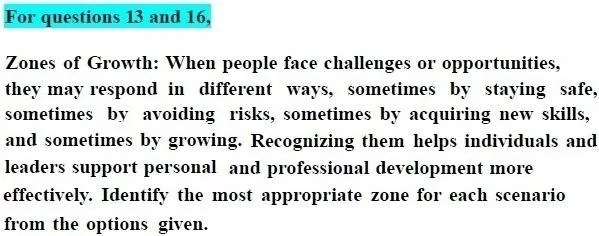
Based on the above data, answer the given subquestions.
Q9MCQ1 Mark·Choose one option[Zones of Growth] Drashti has been working in her current role for five years. She knows her tasks inside out and rarely feels stressed. Her performance reviews are - consistently “meets expectations,” but she hasn’t taken on any stretch assignments. Recently, her manager suggested she try leading a cross-functional project, but she hesitated, preferring to stay with what she knows well. Which zone is Drashti operating in?
- AFear Zone
- BComfort Zone
- CLearning Zone
- DGrowth Zone
- EFixed Zone
- Q10MCQ1 Mark·Choose one option
[Zones of Growth] Rajat is suddenly asked by the CEO to represent his department in a board meeting. He has never presented to senior leaders before and feels overwhelmed. His stress rises, and he begins to doubt himself, fearing failure. Rather than preparing, he tries to avoid the situation. Which zone does Rajat’s experience reflect?
- AComfort Zone
- BStress Zone
- CFear Zone
- DGrowth Zone
- EFixed Zone
- Q11MCQ1 Mark·Choose one option
[Zones of Growth] Rajamanickam believes that intelligence and ability can be developed. When he fails at pitching a new startup idea, instead of feeling discouraged, he reflects on the feedback and tries again with improvements. He enjoys challenges, sees failure as temporary, and feels motivated by the learning process. Which zone best describes Rajamanickam ’s mindset?
- AComfort Zone
- BLearning Zone
- CFear Zone
- DGrowth Zone
- EFixed Zone
- Q12MCQ1 Mark·Choose one option
Tannu volunteers to join a new product development team even though she has little prior experience with innovation projects. She feels nervous but sees it as a chance to seek new skills. With some effort, she picks up, asks questions, and slowly becomes more confident. Which zone is Tannu in?
- AFear Zone
- BLearning Zone
- CComfort Zone
- DGrowth Zone
- EFixed Zone
- Q13MCQ1 Mark·Choose one option
According to Maslow’s hierarchy of needs, which of the following statements is true?
- AOnce higher-level needs are fulfilled, lower-level needs stop influencing behavior.
- BNeeds operate in a strict sequence, and individuals cannot pursue higher needs without fully satisfying lower ones.
- CIn practice, multiple needs may influence behavior simultaneously, though lower needs generally take priority.
- DOnly individuals in high-level roles, like leaders or entrepreneurs, experience all levels of needs.
- Q14MCQ1 Mark·Choose one option
Read the following statements and determine whether each reflects a fixed or growth mindset: 1. “Taking just one course on personal and professional development can't really improve someone's managerial skills or self-awarness.” 2. “Leadership is a skill I can strengthen over time through practice and learning.” 3. “I’m just not good at leadership, so there’s no point in trying too hard.” 4. “Improving how I think and make decisions is possible if I actively apply what I learn.” Which option below correctly classifies the statements?
- A(1) Growth, (2) Growth, (3) Fixed, (4) Fixed
- B(1) Growth, (2) Fixed, (3) Fixed, (4) Growth
- C(1) Fixed, (2) Fixed, (3) Growth, (4) Growth
- D(1) Fixed, (2) Growth, (3) Fixed, (4) Growth
- Q15MCQ1 Mark·Choose one option
In a retail company to analyze its supply chain, the team monitors the following key variables: 1. Inventory of products in warehouse 2. Rate of sales per day 3. Number of shipments dispatched 4. Production rate from the factory Using a systems thinking lens, identify which of the above are stocks and which are flows. Select the correct option using the codes given below:
- A1 and 3 are stocks; 2 and 4 are flows
- B1 is stock; 2, 3, and 4 are flows
- C1 and 4 are stocks; 2 and 3 are flows
- DAll four are flows
- Q16MCQ1 Mark·Choose one option
Consider the following: 1. Fluctuation in petrol prices 2. The stress you are currently experiencing during this exam 3. Number of startups pre-incubated at Nirmaan, IIT Madras at a given point In terms of systems thinking, which of the following correctly classifies them as stock or flow? Select the correct option using the codes given below:
- A1 – Flow, 2 – Flow, 3 – Stock
- B1 – Stock, 2 – Flow, 3 – Flow
- C1 – Flow, 2 – Stock, 3 – Flow
- D1 – Stock, 2 – Stock, 3 – Stock
- Q17MCQ1 Mark·Choose one option
Consider the following: 1. A warehouse filled with boxes of unsorted, returned merchandise. 2. An integrated hospital management process involving patient admission, diagnosis, treatment, and discharge planning. 3. A digital archive of thousands of research papers stored on a personal drive. 4. A supply chain where procurement, logistics, and sales align to deliver products to customers. In terms of systems thinking, which of these are examples of a heap and which of a system? Select the correct option using the codes given below:
- A1 and 3 are heaps; 2 and 4 are systems
- B1 and 2 are heaps; 3 and 4 are systems
- C1 and 4 are heaps; 2 and 3 are systems
- DAll four are heaps
- Q18MCQ1 Mark·Choose one option
Consider the following: 1. Using imagination to visualize new possibilities. 2. Applying curiosity to ask questions and explore unfamiliar areas. 3. Intersections of different disciplines. 4. Routine procedures without exploring alternatives. Which of these are examples of tools that foster creativity? Select the correct option using the codes given below:
- A1, 2, and 3 are tools for creativity; 4 is not
- B1 and 2 are tools for creativity; 3 and 4 are not
- COnly 1 is a tool for creativity
- DAll four are tools for creativity
- Q19MCQ1 Mark·Choose one option
As part of a new product initiative, Lakshita has been assigned to lead the project. Before assigning tasks to her team, she spends time clarifying the goals, identifying the tools, technologies, and materials required, and creating a comprehensive timeline that outlines key stages and target completion dates. Which core principle of engineering sense is most clearly demonstrated in this scenario?
- AOrganizing
- BControlling
- CPlanning
- DLeading
- Q20MCQ1 Mark·Choose one option
State whether the following statement is True or False: A SMART goal is one that is Simple, Measurable, Attainable, Realistic, and Timeless.
- ATrue
- BFalse
End Term · 31 Aug 2025 (AN)End Term
Read the passage below, then answer Q21–Q25

Conflict Management Style: Conflict naturally arises in workplaces and, when handled effectively, can lead to better understanding and stronger teamwork. The Thomas–Kilmann Conflict Mode Instrument (TKI) provides a useful framework to identify different conflict management styles and choose the most effective approach for each situation, helping managers maintain a healthy and productive work environment.
Identify the most appropriate conflict management style demonstrated in the scenario from the options provided below.
a. avoiding
b. accommodating
c. forcing
d. negotiating
e. collaborating
Based on the above data, answer the given subquestions.
Q21MCQ1 Mark·Choose one option[Conflict Management Style] Rithika is in a cross-department meeting where a disagreement arises about a low-priority issue. She feels strongly that her opinion is correct, but pressing it further would waste time and distract from the larger agenda. She decides to set it aside and move on, as confrontation will damage an important relationship.
- Aavoiding
- Baccommodating
- Cforcing
- Dnegotiating
- Ecollaborating
- Q22MCQ1 Mark·Choose one option
[Conflict Management Style] Sahana is mediating a dispute between two team members about resource allocation. Both hold equally strong but opposing positions. Sahana realizes that neither side can have everything they want, but if each side gains something, things could work. She encourages both to adjust their expectations to reach a temporary solution as the time is short.
- Aavoiding
- Baccommodating
- Cforcing
- Dnegotiating
- Ecollaborating
- Q23MCQ1 Mark·Choose one option
[Conflict Management Style] Agrima, a newly joined analyst, feels that her idea about redesigning an internal report could be useful. However, her manager disagrees strongly and insists on continuing the old method. Since the issue is minor and Agrima does not want to risk her relationship with the manager early on, she chooses to let go.
- Aavoiding
- Baccommodating
- Cforcing
- Dnegotiating
- Ecollaborating
- Q24MCQ1 Mark·Choose one option
[Conflict Management Style] During a high-pressure product launch, Jatin, the project head, encounters a conflict with a vendor who insists on a particular delivery method. Since deadlines are critical and there is no time for extended discussion, Jatin decides to impose his own decision, prioritizing speed and results over consensus.
- Aavoiding
- Baccommodating
- Cforcing
- Dnegotiating
- Ecollaborating
- Q25MCQ1 Mark·Choose one option
[Conflict Management Style] Ansari notices that his teammate is very emotionally invested in how a presentation should be formatted. Although Ansari prefers a different approach, the matter is minor, and he doesn’t want to upset his colleague. The time to resolve the conflict is limited. To maintain goodwill and harmony, he allows his teammate to go ahead with their preference.
- Aavoiding
- Baccommodating
- Cforcing
- Dnegotiating
- Ecollaborating
- Q26MCQ1 Mark·Choose one option
Deepan joins an IT company in Country Z. He finds that employees rarely question managers, always follow hierarchy in communication, and important decisions are reserved for senior leaders. Junior staff hesitate to disagree openly with their supervisors. Which cultural dimension does this situation highlight?
- ACollective vs Individual
- BTime is Scarce vs Plentiful
- CEqual vs Unequal
- DCertainty vs Ambiguity
- Q27MCQ1 Mark·Choose one option
At a multinational subsidiary, Raksha notices that employees in Country X insist on detailed policies, risk assessments, and step-by-step guidelines before starting a project. In contrast, employees in Country Y are more comfortable experimenting, taking risks, and adapting plans as the situation changes without much documentation. Which Hofstede dimension is illustrated here?
- APower Distance
- BMasculinity–Femininity
- CUncertainty Avoidance
- DIndividualism–Collectivism
- Q28MCQ1 Mark·Choose one option
Imagine your savings account earns 1% interest per year, while the inflation rate is 2% per year. After one year, compared to today, ceteris paribus, the money in your account will be able to buy:
- AMore than today
- BExactly the same as today
- CLess than today
- DCannot be determined
- Q29MCQ1 Mark·Choose one option
According to Maslow’s hierarchy of needs, which of the following statements is true?
- AOnce higher-level needs are fulfilled, lower-level needs stop influencing behavior.
- BNeeds operate in a strict sequence, and individuals cannot pursue higher needs without fully satisfying lower ones.
- CIn practice, multiple needs may influence behavior simultaneously, though lower needs generally take priority.
- DSelf-actualization needs are only relevant for leaders and entrepreneurs.
- Q30MCQ1 Mark·Choose one option
Read the following statements and determine whether each reflects a fixed or growth mindset: 1. “Taking just one course on personal and professional development can't really improve someone's managerial skills or self-awarness.” 2. “Leadership is a skill I can strengthen over time through practice and learning.” 3. “I’m just not good at leadership, so there’s no point in trying too hard.” 4. “Improving how I think and make decisions is possible if I actively apply what I learn.” Which option below correctly classifies the statements?
- A(1) Growth, (2) Growth, (3) Fixed, (4) Fixed
- B(1) Growth, (2) Fixed, (3) Fixed, (4) Growth
- C(1) Fixed, (2) Fixed, (3) Growth, (4) Growth
- D(1) Fixed, (2) Growth, (3) Fixed, (4) Growth
- Q31MCQ1 Mark·Choose one option
In a consulting firm to improve client management, the team identifies key variables related to customer retention: 1. Number of active clients at a given time 2. New client acquisition rate 3. Client attrition (drop-off) rate 4. Total revenue accumulated till date Using a systems thinking perspective, classify which of the above are stocks and which are flows. Select the correct option using the codes given below:
- A1 and 4 are stocks; 2 and 3 are flows
- B1 and 2 are stocks; 3 and 4 are flows
- C1, 2, and 3 are flows; only 4 is a stock
- D1 and 3 are stocks; 2 and 4 are flows
- Q32MCQ1 Mark·Choose one option
Consider the following: 1. Inflation in the economy 2. Stress that you are experiencing while giving this exam 3. Intellectual Property (IP) held by IIT Madras In terms of systems thinking, which of the following correctly classifies them as stock or flow? Select the correct option using the codes given below:
- A1 – Flow, 2 – Flow, 3 – Stock
- B1 – Stock, 2 – Flow, 3 – Flow
- C1 – Flow, 2 – Stock, 3 – Flow
- D1 – Stock, 2 – Stock, 3 – Stock
- Q33MCQ1 Mark·Choose one option
Consider the following: 1. A warehouse filled with boxes of unsorted, returned merchandise. 2. An integrated hospital management process involving patient admission, diagnosis, treatment, and discharge planning. 3. A digital archive of thousands of research papers stored on a personal drive. 4. A supply chain where procurement, logistics, and sales align to deliver products to customers. In terms of systems thinking, which of these are examples of a heap and which of a system? Select the correct option using the codes given below:
- A1 and 3 are heaps; 2 and 4 are systems
- B1 and 2 are heaps; 3 and 4 are systems
- C1 and 4 are heaps; 2 and 3 are systems
- DAll four are heaps
- Q34MCQ1 Mark·Choose one option
State whether the following statement is True or False: In cross-cultural management, the Iceberg Principle suggests that most cultural aspects such as values, beliefs, and attitudes are visible and can be easily observed.
- ATRUE
- BFALSE
- Q35MCQ1 Mark·Choose one option
Shambhavi, a project manager is tasked with overseeing the development of a new product. Before delegating responsibilities to the team, she carefully defines the project objectives, determines the necessary technical and material resources, and lays out a detailed project schedule with milestones and deadlines. Which concept of engineering sense does this situation best illustrate?
- AOrganizing
- BControlling
- CPlanning
- DLeading
- Q36MCQ1 Mark·Choose one option
State whether the following statement is True or False: According to Goal-Setting Theory, specific goals, when accepted, improve performance more effectively than easy goals and feedback like “do your best.”
- ATRUE
- BFALSE
Read the passage below, then answer Q37–Q40

Maslow’s Hierarchy of Needs is a motivational theory that explains how human behavior is driven by different levels of needs. Recognizing them is important for understanding what drives human motivation and for effectively supporting personal growth and development. Identify the most appropriate level or need in the given scenarios.
Based on the above data, answer the given subquestions.
Q37MCQ1 Mark·Choose one optionAbhishek Kumar, a new employee in a consulting firm, is anxious because his job contract is only for six months. He spends most of her time worrying about whether he will be retained. Which level of Maslow’s hierarchy is most relevant here?
- ASelf-Esteem Needs
- BSafety Needs
- CBelongingness Needs
- DSelf-Actualization
- Q38MCQ1 Mark·Choose one option
Chirag recently got promoted to team leader. He enjoys recognition from peers and appreciates being publicly acknowledged for his contributions. Which level of Maslow’s hierarchy does this represent?
- ASelf-Actualization
- BSafety Needs
- CSelf-Esteem Needs
- DBelongingness Needs
- Q39MCQ1 Mark·Choose one option
Rajyalakshmi, a senior designer, already has financial stability and industry recognition. She now wants to start her own venture to create innovative solutions for rural communities. Which need does Rajyalakshmi’s aspiration reflect?
- ASelf-Actualization
- BSelf-Esteem Needs
- CBelongingness Needs
- DSafety Needs
- Q40MCQ1 Mark·Choose one option
Narendrean, a software engineer, after getting a stable job and good salary, now seeks to be part of cross-functional project teams to feel connected with colleagues. Which need is dominant in this situation?
- APhysiological Needs
- BBelongingness Needs
- CSafety Needs
- DEsteem Needs
Quiz 2 · 3 Aug 2025 (AN)Quiz 2
Useful Reference Data for this Paper
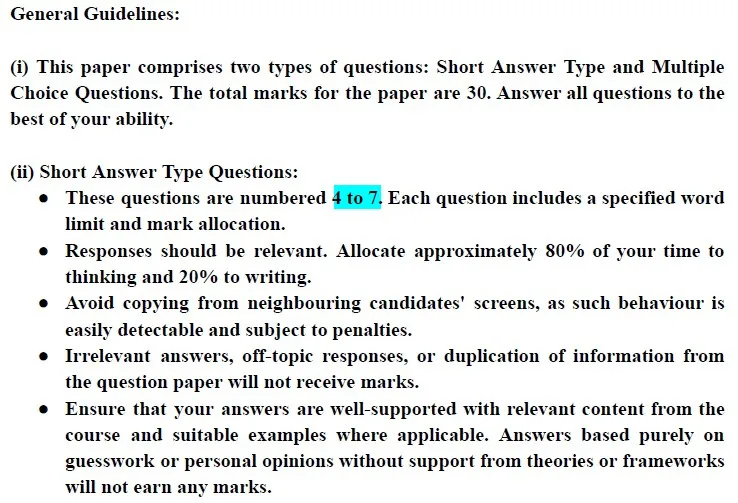
[Content Redacted – Not for Distribution]
*This content is the property of its respective authors, copyright holders and publishers.
Q41MCQ1 Mark·Choose one optionWhich of the following best illustrates an "amygdala hijack" in the context of emotional intelligence?
- AFeeling tired after a long meeting and deciding to take a break
- BReacting with sudden anger during a team discussion and regretting it later
- CCalmly disagreeing with a colleague and explaining your viewpoint
- DIdentifying a teammate’s stress and offering support
- Q42MCQ1 Mark·Choose one option
According to the "Culture as an Iceberg" model, which of the following is an example of a visible, surface-level element of culture?
- AIdeas of right and wrong
- BPrivacy
- CTempo of life
- DTraditions and festivals
- Q43MCQ1 Mark·Choose one option
Which of the following best distinguishes IRR from CAGR?
- AIRR assumes a constant growth rate; CAGR accounts for variable cash flows
- BIRR considers the timing and size of intermediate cash flows; CAGR does not
- CCAGR is used for multiple cash inflows; IRR is only for a single lump-sum
- DCAGR includes taxes and inflation; IRR does not
- Q44MCQ1 Mark·Choose one option
Arun receives the following cash flows from a project: Initial investment of ₹1,00,000, and returns of ₹30,000, ₹40,000, and ₹50,000 over 3 years. Which is the right method, should Arun use to evaluate if the project is financially viable?
- ACAGR
- BPayback Period
- CIRR
- DSimple Interest
- Q45MCQ1 Mark·Choose one option
Arrange the following asset classes in order of increasing potential return and expected risk (from lowest to highest): 1. Cash 2. Fixed Income / Debt 3. Property 4. Equity Choose the correct option:
- A1 - 2 - 3 - 4
- B3 - 2 - 1 - 4
- C4 - 3 - 2 - 1
- D3 - 4 - 2 - 1
- Q46MCQ1 Mark·Choose one option
Which of the following financial instruments are generally permissible investments for mutual fund schemes across global markets? 1. Equity securities (stocks) 2. Gold Exchange Traded Funds (ETFs) 3. Government bonds and treasury bills 4. Corporate bonds and 5. Debentures Select the correct option using the code below:
- A1, 2, 3 and 5 only
- B1, 3 and 4 only
- C2, 4 and 5 only
- D1, 2, 3, 4 and 5
- Q47MCQ1 Mark·Choose one option
In business communication, what does an outline generally refer to in the context of preparing a presentation?
- AA list of tools and technologies used to deliver the presentation
- BA checklist of audience needs and the overall purpose of the presentation
- CA structured list of main topics or key points to be covered in the presentation
- DA compilation of references and citations used in the presentation
- Q48MCQ1 Mark·Choose one option
In business communication, which of the following best helps prevent graphs or charts from presenting misleading information during a presentation?
- AUse stacked graphs or charts to add depth
- BUse 3-D effects to make the visuals more attractive
- CUse vibrant colors to catch audience attention
- DUse complete and consistent scales for graph axes
Read the passage below, then answer Q49–Q51
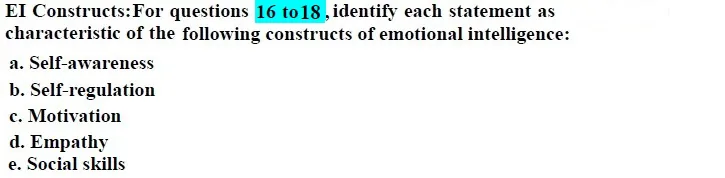
Based on the above data, answer the given subquestions.
Q49MCQ1 Mark·Choose one option[EI Constructs] Vaibhwee, an electronics engineer, leads a team developing a new IoT-enabled home automation device. Despite delays due to component shortages, Vaibhwee remains calm, adapts plans quickly, and helps the team stay focused. She manages stress well and doesn’t let frustration spill over into meetings, encouraging others to stay flexible and professional too. Which construct of emotional intelligence does Vaibhwee demonstrate?
- ASelf-awareness
- BSelf-regulation
- CMotivation
- DEmpathy
- ESocial skills
- Q50MCQ1 Mark·Choose one option
[EI Constructs] Puja, a senior professional with over 15 years of experience, mentors junior employees regularly. She actively listens to their concerns, picks up on unspoken emotional cues, and adjusts her guidance based on their comfort levels. Her team often says they feel “understood” and “supported” in her presence. Which construct of emotional intelligence does Pooja demonstrate?
- ASelf-awareness
- BSelf-regulation
- CMotivation
- DEmpathy
- ESocial skills
- Q51MCQ1 Mark·Choose one option
[EI Constructs] Sreekanth is a data scientist working in a fast-paced product analytics team. Before presenting findings to stakeholders, he always double-checks his biases and acknowledges when his emotional state could affect interpretation. He is quick to recognize moments when he feels defensive in meetings and works on adjusting his tone and body language to remain composed. Which construct of emotional intelligence does Sreekanth demonstrate?
- ASelf-awareness
- BSelf-regulation
- CMotivation
- DEmpathy
- ESocial skills
Read the passage below, then answer Q52–Q54
Based on the above data, answer the given subquestions.
Q52MCQ1 Mark·Choose one option[Leadership Style] A senior data scientist ensures the team follows exact data cleaning protocols, insists on specific documentation formats, and double-checks that model evaluation steps are completed precisely as outlined in the workflow. Which leadership style does this behaviour represent?
- ATask-oriented
- BPeople-oriented
- Q53MCQ1 Mark·Choose one option
[Leadership Style] A lead ML engineer regularly shares sprint progress updates, sets strict model deployment deadlines, and enforces performance benchmarks with clear incentives for goals and accountability for delays. Which leadership style does this behaviour represent?
- ATask-oriented
- BPeople-oriented
- Q54MCQ1 Mark·Choose one option
[Leadership Style] A product manager begins each stand-up by checking inpersonally with teammates, facilitates cross-functional discussions, and ensures psychological safety is maintained during team retrospectives. Which leadershipstyle does this behaviour represent?
- ATask-oriented
- BPeople-oriented
End Term · 13 Apr 2025 (AN)End Term
- Q55MCQ1 Mark·Choose one option
[Teams] A cross-functional team is working on optimizing customer retention for an e-commerce platform. Ravi, the data engineer, focuses on ensuring clean and structured data pipelines, while Meera, the data scientist, develops predictive models to identify at-risk customers. Meanwhile, Kiran from the marketing team interprets insights to craft targeted engagement strategies. By integrating their diverse expertise, the team creates a data-driven retention strategy that improves customer loyalty and business performance—an outcome none of them could have achieved alone. [Teams] What concept best explains the team's success?
- AShared expertise
- BSynergy
- CRole clarity
- DTeam management
- Q56MCQ1 Mark·Choose one option
[Listening] During a high-stakes product strategy meeting, team lead Amogh actively nods, rephrases key points for clarity, and asks thoughtful questions to ensure alignment. He maintains consistent eye contact, allows speakers to finish without interruption, and reflects on feedback before responding. As a result, his team members feel acknowledged and engaged in the decision-making process. [Listening] What type of listening is Amogh demonstrating?
- APassive Listening
- BSuperficial Listening
- CActive Listening
- DCritical Listening
- Q57MCQ1 Mark·Choose one option
[Spheres of Responsibility] Raj focuses his time on building new skills and expanding his professional network rather than stressing over industry-wide layoffs. [Spheres of Responsibility] Which sphere is Raj focusing on?
- ASphere of Concern
- BSphere of Control
- CSphere of Influence
- DNone of these
- Q58MCQ1 Mark·Choose one option
[Leadership] In a fast-growing fintech startup, Raghav ensures the operations team follows structured protocols, meets deadlines, and maintains compliance. His primary goal was to administer tasks effectively and keep the team aligned with existing workflows. On the other hand, Kavya, leading the product innovation team, focuses on inspiring her teammates, encouraging experimentation, and innovation. She regularly mentors individuals to help them reach their potential, even beyond their current roles. [Leadership] What best describes the difference between the two approaches?
- ARaghav shows leadership, Kavya shows management
- BRaghav shows management, Kavya shows leadership
- CBoth show transactional leadership
- DBoth focus on administrative control
- Q59MCQ1 Mark·Choose one option
Emotional intelligence is critical in leadership and teamwork. Which of the following best defines Emotional Intelligence?
- AAbility to stay happy at all times
- BAbility to understand and manage emotions and social interactions
- CSkill of influencing others emotions
- DPersonality trait that determines how naturally empathetic a person is
- Q60MCQ1 Mark·Choose one option
Prashant is conscious of his emotions, while Ananyaa senses how others feel and responds accordingly. Which EI constructs do they reflect respectively?
- AMotivation and empathy
- BSelf-awareness and empathy
- CSelf-regulation and social skills
- DEmpathy and social awareness
Read the passage below, then answer Q61–Q64
[Cross-cultural Strategies] Organizations, teams, and individuals navigate cross-cultural dynamics using distinct strategies to manage differences in values, work styles, and decision-making. These strategies influence collaboration, integration, and overall effectiveness in multicultural environments. In the following scenarios, identify the cultural approach being used from the options below (order may vary):
a. Cultural Dominance
b. Cultural Avoidance
c. Cultural Compromise
d. Cultural Accommodation
e. Cultural Synergy
Analyze each scenario carefully to determine which cultural strategy is best being applied. Based on the above data, answer the given subquestions.
Q61MCQ1 Mark·Choose one option[Cross-cultural Strategies] At a global consulting firm, senior leadership mandates that everyone follow the corporate etiquette of the parent country, ignoring local customs in international offices. Which cross-cultural strategy is the firm following?
- ACultural Accommodation
- BCultural Synergy
- CCultural Compromise
- DCultural Dominance
- ECultural Avoidance
- Q62MCQ1 Mark·Choose one option
[Cross-cultural Strategies] Soumya, an Indian professional, working in South Korea, finds indirect communication confusing but continues being direct, as though there are no differences. What cultural approach is she demonstrating?
- ACultural Avoidance
- BCultural Synergy
- CCultural Dominance
- DCultural Compromise
- ECultural Accommodation
- Q63MCQ1 Mark·Choose one option
[Cross-cultural Strategies] Sayed, an Indian software developer, moves to Germany for work. In India, he was used to flexible work hours, but in Germany, punctuality is strictly observed. Instead of fully adapting to the German work style or expecting flexibility, Sayed and his team agree on a middle ground—he adheres to strict work timings during core hours but is allowed flexibility when working remotely. Which cultural approach is Sayed demonstrating?
- ACultural Avoidance
- BCultural Compromise
- CCultural Synergy
- DCultural Dominance
- ECultural Accommodation
- Q64MCQ1 Mark·Choose one option
[Cross-cultural Strategies] Harshil integrates fully with his team’s preference for precision and punctuality, without bringing in his prior flexible style. Which approach is he using?
- ACultural Compromise
- BCultural Accommodation
- CCultural Dominance
- DCultural Avoidance
- ECultural Synergy
- Q65MCQ1 Mark·Choose one option
Shruti was nervous about leading a client workshop but pushed herself to do it, learned from the experience, and grew confident. Which phase of the Four Zones of Growth model does this represent?
- AComfort to Fear Zone only
- BFear to Learning Zone
- CDirect entry into Growth Zone
- DStaying in Comfort Zone
- Q66MCQ1 Mark·Choose one option
In a fast-paced corporate environment, different employees respond to challenges in unique ways. Which of the following scenarios DOES NOT demonstrate a Growth Mindset?
- ASurya, a UX designer, struggles with a new tool but remains optimistic, saying, “If I keep practicing regularly, I’ll get better at this.”
- BRishabh, a sales lead, faces repeated rejections but reflects, “Every rejection is a lesson. I’ll analyze my mistakes and improve my pitch.”
- CIndranil, a senior developer, actively seeks feedback from colleagues, believing, “The more I learn from others, the better I become.”
- DRashmi, a marketing executive, feels demotivated after a campaign failure and sighs, “I’m just not cut out for this. Some people are naturally good at marketing, and I’m not one of them.”
- Q67MCQ1 Mark·Choose one option
Leela praises her team’s efforts regardless of outcome and avoids giving constructive feedback. What growth mindset type does this reflect?
- AScarcity Mindset
- BFalse Growth Mindset
- CPositive Mindset
- DLearning Culture
Read the passage below, then answer Q68–Q70
[Maslow’s Hierarchy of Needs] Maslow’s Hierarchy of Needs explains how motivation progresses from basic survival to self-actualization. While lacking strong empirical evidence, it remains useful for identifying barriers to career growth and shaping workplace policies that support employees at different stages, driving higher performance and productivity.
Read the given workplace scenarios and identify which level of Maslow’s Hierarchy of Needs best apply to each situation.
Based on the above data, answer the given subquestions.
Q68MCQ1 Mark·Choose one optionMurthy recently moved to a new city to start his first job. While he was eager to begin his career, the excitement quickly gave way to long work hours. With a modest salary and rising living costs, he found himself constantly worried about paying rent, managing bills, and affording basic meals. The financial pressure began to take a toll on his focus and productivity at work. Which level of Maslow’s hierarchy is Murthy striving for?
- ASocial Needs
- BPhysiological Needs
- CEsteem Needs
- DSelf-actualization
- Q69MCQ1 Mark·Choose one option
Salma has everything but still wants to become a motivational speaker and inspire change. Which need is she pursuing?
- ASelf-actualization
- BEsteem
- CSocial
- DSafety
- Q70MCQ1 Mark·Choose one option
Anand feels isolated at work and unappreciated by his team. Which needs are unfulfilled?
- ASocial
- BSelf-actualization
- CPhysiological
- DEsteem
- Q71MCQ1 Mark·Choose one option
What does Systems Thinking emphasize?
- AInterconnectedness of elements
- BIndependent processes
- CIndividual fault finding
- DTask breakdown only
- Q72MCQ1 Mark·Choose one option
What differentiates a heap from a system?
- ASystems have purpose; heaps don’t
- BSystems and heaps are equal
- CHeaps are more organized
- DHeaps are interconnected elements
Read the passage below, then answer Q73–Q74
[Principles & Archetypes] Systems thinking principles and archetypes reveal recurring patterns in complex systems, making their understanding essential for leaders and strategists to effectively navigate and solve dynamic challenges.
Read the given scenarios and identify which principle or archetype best applies to each situation. Based on the above data, answer the given subquestions.
Q73MCQ1 Mark·Choose one optionIn product design, Akriti asks her team to align every decision with customer needs and business strategy, not just fix bugs. Which principle is she using?
- ACause-effect Loops
- BBig Picture Thinking
- CProcess Mapping
- DNarrow Focus
- Q74MCQ1 Mark·Choose one option
Teams in a company blame different issues for a drop in performance, while leaders see only one big cause. Which principle does this illustrate?
- ASystem Boundaries
- BElephant and the Blind Men
- CCausal Loops
- DBig Picture Thinking
Official KeyMaster Answer Key & Explanations
Official answer keys from IIT Madras BS past papers. Click any question to review.
Reveal KeyCollapse Key
Master Answer Key & Explanations
Official answer keys from IIT Madras BS past papers. Click any question to review.