Indian Institute of Technology Madras
BS Degree Programme · Examination & Study Paper
Game Theory and Strategy
All 2025 papers
Examination Instructions & Guidelines
- Solve on notebook/paper first before checking solutions.
- MCQ: Exactly 1 option is correct. Negative marking applies.
- MSQ: One or more options correct. Select all to score.
- NAT: Numerical response. No negative marking.
- Scientific calculator allowed for all calculations.
- Official answer key is sealed at the end of this sheet.
Quiz 1 · 26 Oct 2025 (AN)Quiz 1
Read the passage below, then answer Q1–Q2
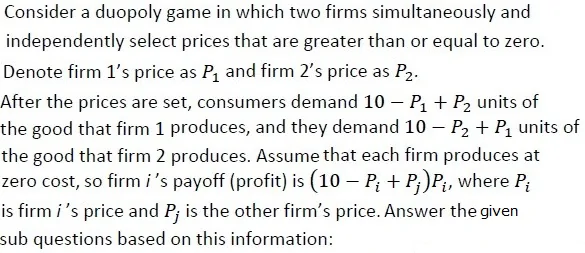 Q1MCQ2 Marks·Choose one option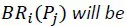
- A

- B

- C

- D

- A
- Q2MCQ2 Marks·Choose one option
Choose the incorrect statement
- AThis game is a symmetric game
- BThis game has a symmetric Nash equilibrium
- CUnder the Nash equilibrium each player chooses P=15
- DThis game has unique Nash equilibrium
Read the passage below, then answer Q3–Q4
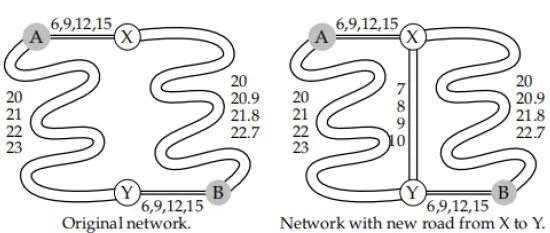
(Choosing a route) Four people must drive from A to B at the same time. Two routes are available, one via X and one via Y (Refer to the left panel of following Figure). The roads from A to X, and from Y to B are both short and narrow; in each case, one car takes 6 minutes, and each additional car increases the travel time per car by 3 minutes. (If two cars drive from A to X, for example, each car takes 9 minutes.) The roads from A to Y, and from X to B are long and wide; on A to Y one car takes 20 minutes, and each additional car increases the travel time per car by 1 minute; on X to B one car takes 20 minutes, and each additional car increases the travel time per car by 0.9 minutes. Formulate this situation as a strategic game and answer the given subquestions.
 Q3MCQ2 Marks·Choose one option
Choose the correct alternative
- AIn Nash equilibrium two people take each route
- BFor the NE action profile, each person’s travel time is either 29.9 or 30 minutes
- CBoth In Nash equilibrium two people take each route & For the NE action profile, each person’s travel time is either 29.9 or 30 minutes
- DNone
- Q4MCQ2 Marks·Choose one option
Now suppose that a relatively short, wide road is built from X to Y, giving each person four options for travel from A to B: A–X–B, A–Y–B, A–X–Y–B, and A–Y– X–B (As shown in the right panel of the given figure). Assume that a person who takes A–X–Y–B travels the A–X portion at the same time as someone who takes A–X–B, and the Y–B portion at the same time as someone who takes A–Y–B. (Think of there being constant flows of traffic.) On the road between X and Y, one car takes 7 minutes and each additional car increases the travel time per car by 1 minute. Consider the Nash equilibrium in this new situation. Choose the correct alternative
- AIn any Nash equilibrium, two persons take A–X–B, one person takes A–X–Y–B, and one person takes A–Y–B
- BIn equilibrium profile, every person’s travel time increases compared to the case when new road was not there
- CBoth In any Nash equilibrium, two persons take A–X–B, one person takes A–X–Y–B, and one person takes A–Y–B & In equilibrium profile, every person’s travel time increases compared to the case when new road was not there
- DNone
Read the passage below, then answer Q5–Q6
An item is up for auction. Player 1 values the item at 3 while player 2 values the item at 5. Each player can bid either 0, 1 or 2. If player i bids more than player j then i wins the good and pays his bid, while the loser does not pay. If both players bid the same amount, then a coin is tossed to determine who the winner is, who gets the good and pays his bid while the loser pays nothing. Formulate the game in matrix form and answer the given subquestions.
Q5MCQ2 Marks·Choose one optionWhich player does not have strictly dominated strategy?
- APlayer 1
- BPlayer 2
- CNone
- Q6MCQ2 Marks·Choose one option
Which strategies survive Iterated Elimination of Strictly Dominated Strategy?
- A(0, 0)
- B(1, 1)
- C(2, 2)
- DNone
Read the passage below, then answer Q7–Q8
Consider the following normal form game and answer the given sub questions:
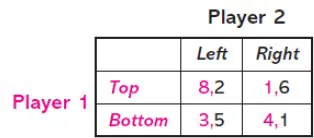 Q7MCQ2 Marks·Choose one option
This game has
- AA unique Nash equilibrium in pure strategy
- BA unique Nash equilibrium in mixed strategy
- CBoth are true
- DNone is true
- Q8NAT3 Marks·Write the number
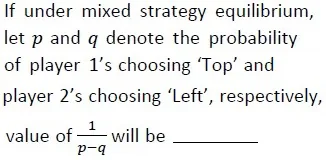 Your answer:
 Read the passage below, then answer Q9–Q16
Consider a two-player game in which player 1 can choose A or B. The game ends if he chooses A while it continues to player 2 if he chooses B. Player 2 can either choose C or D, with the game ending after C and continuing again with player 1 after D. Player 1 then can choose E or F, and then the game ends after each of these choices.
Imagine that the payoffs following choice A by player 1 are (2, 0), following C by player 2 are (3, 1), following E by player 1 are (0, 0) and following F by player 1 are (1, 2)
Model this as an extensive form game and answer the given subquestions:
Q9MCQ1 Mark·Choose one optionThis is a game of
- APerfect information
- BImperfect information
- CNone
- DCan’t be determined
- Q10MCQ1 Mark·Choose one option
How many terminal nodes does this game have?
- A3
- B2
- C4
- D5
- Q11MCQ1 Mark·Choose one option
How many information sets does this game have?
- A2
- B3
- C4
- D1
- Q12MCQ1 Mark·Choose one option
How many pure strategies does player 1 have?
- A1
- B2
- C3
- D4
- Q13MCQ1 Mark·Choose one option
How many pure strategies does player 2 have?
- A1
- B2
- C3
- D4
- Q14MCQ1 Mark·Choose one option
How many pure strategy Nash equilibria does this game have?
- A1
- B2
- C3
- D4
- Q15MCQ1 Mark·Choose one option
Which one of the Nash equilibria is also a subgame perfect equilibrium?
- A(AE, D)
- B(AF, D)
- C(BE, C)
- D(BF, C)
- Q16MCQ1 Mark·Choose one option
No. of sub games this game has
- A1
- B2
- C3
- D4
End Term · 31 Aug 2025 (FN)End Term
Read the passage below, then answer Q17–Q18
Three machines, A, B, and C, produce respectively 50%, 30% and 20% of the total no. of items of a factory. The percentages of defective output of these machines are 3%, 4% and 5%.
Based on the above data, answer the given subquestions.
Q17NAT2 Marks·Write the numberIf an item is selected at random, the probability that the item is defective is _____________
Your answer:- Q18NAT2 Marks·Write the number
Suppose an item is selected at random and found to be defective. The probability that the item was produced by machine A will be ______________
Your answer: Read the passage below, then answer Q19–Q20
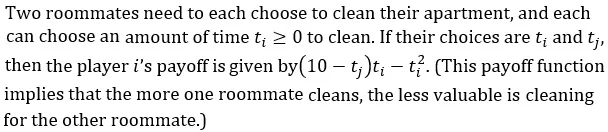
Based on the above data, answer the given subquestions.
Q19NAT2 Marks·Write the numberWhat is the best response of roommate 2 if roommate 1 chooses t_1 = 0? t_2 =________________
Your answer:- Q20NAT2 Marks·Write the number
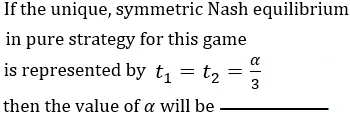 Your answer:
 Read the passage below, then answer Q21–Q28
A market game has two buyers and one seller. Seller 1 has a watch whose worth for him is ₹200 and he offers it for sale. Players 2 and 3 are two potential buyers who do not own a watch. The worth of watch is ₹280 for one buyer (player 2) and ₹300 for the other buyer (player 3). Each buyer is interested in paying the lowest price for the watch and unwilling to pay more than the watch's worth to him. Describe the game in coalition form and answer the given sub questions.
Q21NAT0.5 Marks·Write the number Your answer:
- Q22NAT0.5 Marks·Write the number
 Your answer:
 - Q23NAT0.5 Marks·Write the number
 Your answer:
 - Q24NAT0.5 Marks·Write the number
 Your answer:
 - Q25NAT0.5 Marks·Write the number
 Your answer:
 - Q26NAT0.5 Marks·Write the number
 Your answer:
 - Q27NAT0.5 Marks·Write the number
 Your answer:
 - Q28NAT0.5 Marks·Write the number
 Your answer:
 Read the passage below, then answer Q29–Q34
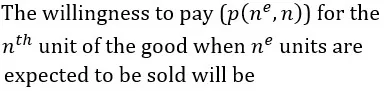
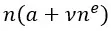
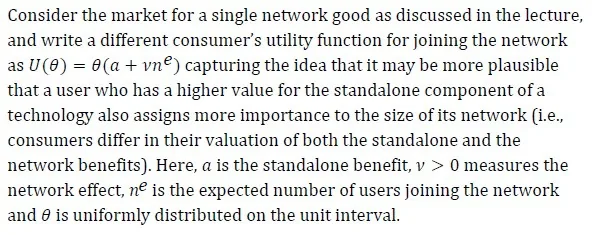
Consider the market for a single network good as discussed in the lecture, and write a different consumer’s utility function for joining the network as U(θ)=θ(a+νn^e) capturing the idea that it may be more plausible that a user who has a higher value for the standalone component of a technology also assigns more importance to the size of its network (i.e., consumers differ in their valuation of both the standalone and the network benefits). Here, a is the standalone benefit, ν > 0 measures the network effect, n^e is the expected number of users joining the network and θ is uniformly distributed on the unit interval.
Based on the above data, answer the given subquestions.
Q29MCQ1 Mark·Choose one option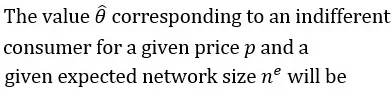
- A

- B

- C

- D

- A
- Q30MCQ1 Mark·Choose one option
The maximum value of p to have buyers will be
- A

- B

- C

- D

- A
- Q31MCQ1 Mark·Choose one option

- A

- B

- C

- D

- A
- Q32MCQ1 Mark·Choose one option
- A

- B
- C

- D

- A
- Q33MSQ1 Mark·Choose all correct options
p(n^e,n) is _____________ (more than one options are correct)
- Aincreasing function of n
- Bdecreasing function of n
- Cdecreasing function of n^e
- Dincreasing function of n^e
- Q34MCQ1 Mark·Choose one option
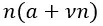
The fulfilled-expectations demand curve in this setting will be
- A

- B
- C

- D

- A
Read the passage below, then answer Q35–Q38
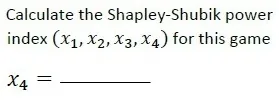
Calculate the Shapley value of the following game using the procedure for dissolving a partnership
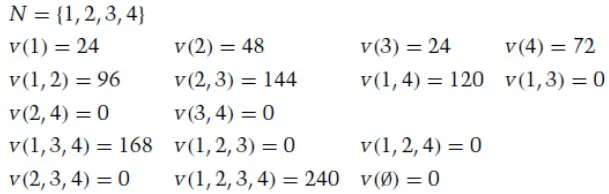
Based on the above data, answer the given subquestions.
Q35NAT1.5 Marks·Write the numberS_1 = ________________
Your answer:- Q36NAT1.5 Marks·Write the number
S_2 = ________________
Your answer: - Q37NAT1.5 Marks·Write the number
S_3 = ________________
Your answer: - Q38NAT1.5 Marks·Write the number
S_4 = ________________
Your answer: Read the passage below, then answer Q39–Q41

Based on the above data, answer the given subquestions.
Q39NAT2 Marks·Write the numberHow many pure strategy equilibria are there in this game?
Your answer:- Q40MCQ1 Mark·Choose one option
In one of these pure NEs, all three players enter the market
- ATRUE
- BFALSE
- Q41MCQ2 Marks·Choose one option
There is a symmetric mixed strategy equilibrium where all three players enter with the same probability (say p). Find the value of p
- A1/5
- B3/5
- C4/5
- D2/5
Read the passage below, then answer Q42–Q44
A cable TV station wants to connect three new customers to its network. The connections to the network are described in the following tree graph:
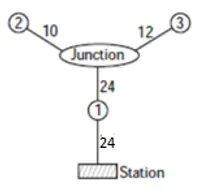
Calculate the distribution of the costs among the three players if all three decide to connect to the network.
Based on the above data, answer the given subquestions.
Q42NAT1 Mark·Write the numberThe cost to be paid by player 1 will be ______________
Your answer:- Q43NAT1 Mark·Write the number
The cost to be paid by player 2 will be _________________
Your answer: - Q44NAT1 Mark·Write the number
The cost to be paid by player 3 will be ______________
Your answer: Read the passage below, then answer Q45–Q46
Five bidders with private valuations uniformly distributed between 0 and 1 participate in a sealed bid first price auction. Assuming that everyone is playing the symmetric equilibrium bidding strategy answer the given sub-questions:
Q45MCQ1 Mark·Choose one optionOptimal bid for a bidder with valuation 0.75 will be
- A0.7
- B0.6
- C0.5
- D0.75
- Q46MCQ2 Marks·Choose one option
The expected revenue of the seller in this auction scenario will be
- A4/5
- B3/5
- C2/3
- D2/5
Read the passage below, then answer Q47–Q49
Suppose a search engine has two ad slots that it can sell. Slot a has a clickthrough rate of 10 and slot b has a clickthrough rate of 5. Three advertisers are interested in these slots. Advertiser x values click at 3 per click, advertiser y values click at 2 per click, and advertiser z values click at 1 per click.
Based on the above data, answer the given subquestions.
Q47NAT1 Mark·Write the numberTotal valuation of socially optimal allocation will be ____________
Your answer:- Q48NAT1 Mark·Write the number
VCG price for slot a will be _________
Your answer: - Q49NAT1 Mark·Write the number
VCG price for slot b will be _________
Your answer: Read the passage below, then answer Q50–Q51
A man dies, leaving an estate worth 500 units. The deceased has two creditors; one’s claim is 400 units, and the other’s claim, 300 units. The division of the estate between them is carried out according to the contested garment principle.
Based on the above data, answer the given subquestions.
Q50NAT1 Mark·Write the numberCreditor 1 with claim 400 units gets
Your answer:- Q51NAT1 Mark·Write the number
Creditor 2 with claim 300 units gets
Your answer: - Q52MCQ2 Marks·Choose one option
Suppose 5 numbers are drawn independently from the uniform distribution on the interval [0, 1] and then sorted from smallest to largest. The expected value of the number in second position on the list is
- A5/6
- B2/3
- C1/2
- D1/3
- Q53MCQ1 Mark·Choose one option
In weighted majority game [7; 1, 4, 3, 5]
- APlayer 1 is null player
- BPlayer 2 is null player
- CPlayer 3 is null player
- DPlayer 4 is null player
- Q54MCQ1 Mark·Choose one option
Consider following two statements: 1. Crowd can be wrong even if everyone in the crowd is rational and everyone takes the same action. 2. Aggregate behaviour of many people with limited information can sometimes produce very accurate results. Which statement(s) is (are) true?
- AOnly 1
- BOnly 2
- CBoth 1 & 2
- DNone
- Q55MCQ1 Mark·Choose one option
Choose the correct alternative
- AA stable matching system is necessarily a system under which everyone is satisfied.
- BA matching system is stable when an unmatched pair may find it beneficial to deviate from the matching and form their own match.
- CBoth A stable matching system is necessarily a system under which everyone is satisfied & A matching system is stable when an unmatched pair may find it beneficial to deviate from the matching and form their own match.
- DNone
End Term · 31 Aug 2025 (AN)End Term
Read the passage below, then answer Q56–Q61
Enter the coalition function for the game [61;40,40,30,10] and answer the given sub-questions:
Q56NAT1 Mark·Write the numberHow many symmetric players are in this game: _______________
Your answer:- Q57NAT1 Mark·Write the number
Which player is the null player in this game? ____________
Your answer: - Q58NAT1 Mark·Write the number
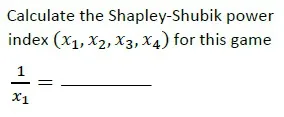 Your answer:
 - Q59NAT1 Mark·Write the number
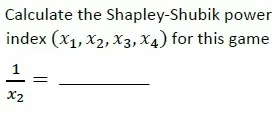 Your answer:
 - Q60NAT1 Mark·Write the number
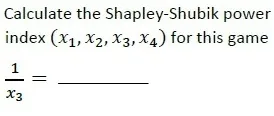 Your answer:
 - Q61NAT1 Mark·Write the number
 Your answer:
 Read the passage below, then answer Q62–Q67
Based on the above data, answer the given subquestions.
Q62MCQ1 Mark·Choose one option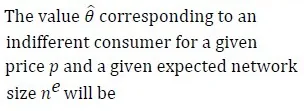
- A

- B

- C
- D

- A
- Q63MCQ1 Mark·Choose one option
The maximum value of p to have buyers will be
- A

- B

- C

- D

- A
- Q64MCQ1 Mark·Choose one option

- A

- B

- C

- D

- A
- Q65MCQ1 Mark·Choose one option
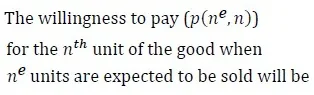
- A

- B
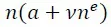
- C

- D

- A
- Q66MSQ1 Mark·Choose all correct options

- A

- B

- C

- D

- A
- Q67MCQ1 Mark·Choose one option
The fulfilled-expectations demand curve in this setting will be
- A

- B

- C

- D

- A
Read the passage below, then answer Q68–Q70
Suppose a search engine has two ad slots that it can sell. Slot a has a clickthrough rate of 10 and slot b has a clickthrough rate of 5. There are three advertisers who are interested in these slots. Advertiser x values click at 3 per click, advertiser y values click at 2 per click, and advertiser z values click at 1 per click.
Based on the above data, answer the given subquestions.
Q68NAT2 Marks·Write the numberTotal valuation of socially optimal allocation will be ___________
Your answer:- Q69NAT2 Marks·Write the number
VCG price for slot a will be ___________
Your answer: - Q70NAT2 Marks·Write the number
VCG price for slot b will be __________
Your answer: Read the passage below, then answer Q71–Q73
Calculate the Shapley value of the following game and answer the given subquestions.
 Q71NAT1 Mark·Write the number
S_1 = _____________
Your answer:- Q72NAT1 Mark·Write the number
S_2 = _____________
Your answer: - Q73NAT1 Mark·Write the number
S_3 = _____________
Your answer: Read the passage below, then answer Q74–Q76
A cable TV station wants to connect three new customers to its network. The connections to the network are described in the following tree graph:
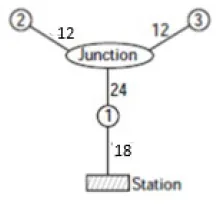
Calculate the distribution of the costs among the three players if all three decide to connect to the network.
Based on the above data, answer the given subquestions.
Q74NAT1 Mark·Write the numberThe cost to be paid by player 1 will be _____________
Your answer:- Q75NAT1 Mark·Write the number
The cost to be paid by player 2 will be ____________
Your answer: - Q76NAT1 Mark·Write the number
The cost to be paid by player 3 will be ____________
Your answer: Read the passage below, then answer Q77–Q78
Three machines, A, B, and C, produce respectively 50%, 30% and 20% of the total no. of items of a factory. The percentages of defective output of these machines are 3%, 4% and 5%.
Based on the above data, answer the given subquestions.
Q77NAT2 Marks·Write the numberIf an item is selected at random, the probability that the item is defective is ______________
Your answer:- Q78NAT2 Marks·Write the number
Suppose an item is selected at random and found to be defective. The probability that the item was produced by machine A will be ____________
Your answer: Read the passage below, then answer Q79–Q81

Based on the above data, answer the given subquestions.
Q79NAT2 Marks·Write the number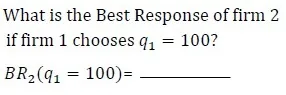 Your answer:
- Q80NAT1 Mark·Write the number
 Your answer:
 - Q81NAT1 Mark·Write the number
 Your answer:
 Read the passage below, then answer Q82–Q84

Based on the above data, answer the given subquestions.
Q82NAT1 Mark·Write the numberHow many pure strategy equilibria are there in this game?
Your answer:- Q83MCQ1 Mark·Choose one option
In one of these pure NEs, all three players enter the market
- ATRUE
- BFALSE
- Q84MCQ2 Marks·Choose one option
There is a symmetric mixed strategy equilibrium where all three players enter with the same probability (say p). Find the value of p
- A1/5
- B3/5
- C4/5
- D2/5
Read the passage below, then answer Q85–Q86
A man dies, leaving an estate worth 500 units. The deceased has two creditors; one’s claim is 400 units, and the other’s claim, 300 units. The division of the estate between them is carried out according to the contested garment principle.
Based on the above data, answer the given subquestions.
Q85NAT1 Mark·Write the numberCreditor 1 with claim 400 units gets
Your answer:- Q86NAT1 Mark·Write the number
Creditor 2 with claim 300 units gets
Your answer: Read the passage below, then answer Q87–Q88
Five bidders with private valuations uniformly distributed between 0 and 1 participate in a sealed bid first price auction. Assuming that everyone is playing the symmetric equilibrium bidding strategy answer the given sub-questions:
Q87MCQ1 Mark·Choose one optionOptimal bid for a bidder with valuation 0.6 will be
- A0.4
- B0.48
- C0.5
- D0.55
- Q88MCQ1 Mark·Choose one option
The expected revenue of the seller in this auction scenario will be
- A4/5
- B3/5
- C2/3
- D2/5
- Q89MCQ2 Marks·Choose one option
Suppose 5 numbers are drawn independently from the uniform distribution on the interval [0, 1] and then sorted from smallest to largest. The expected value of the number in second position on the list is
- A5/6
- B2/3
- C1/2
- D1/3
- Q90MCQ1 Mark·Choose one option
In weighted majority game [7; 5, 1, 3, 4]
- APlayer 1 is null player
- BPlayer 2 is null player
- CPlayer 3 is null player
- DPlayer 4 is null player
- Q91MCQ1 Mark·Choose one option
Consider following two statements: 1. Crowd can be never be wrong even if everyone in the crowd is rational and everyone takes the same action. 2. Aggregate behaviour of many people with limited information can never produce very accurate results. Which statement(s) is (are) true?
- AOnly 1
- BOnly 2
- CBoth the Only 1 & Only 2
- DNone
- Q92MCQ1 Mark·Choose one option
Choose the correct alternative
- AA stable matching system is necessarily a system under which everyone is satisfied.
- BA matching system is stable when an unmatched pair may find it beneficial to deviate from the matching and form their own match.
- CBoth a stable matching system is necessarily a system under which everyone is satisfied & a matching system is stable when an unmatched pair may find it beneficial to deviate from the matching and form their own match.
- DNone
Quiz 2 · 3 Aug 2025 (AN)Quiz 2
Read the passage below, then answer Q93–Q95
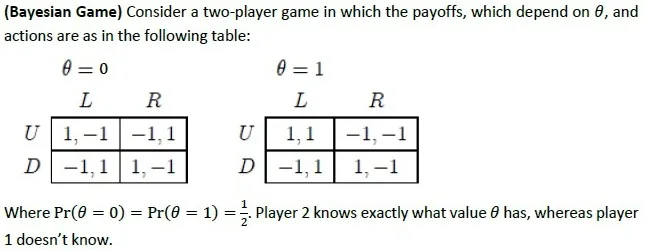
Based on the above data, answer the given subquestions.
Q93MCQ1 Mark·Choose one optionUnder Bayesian Nash Eq., player 1 will play
- AU
- BD
- Q94MCQ1 Mark·Choose one option
Under Bayesian Nash Eq., player 2, who knows that θ = 0 will play
- AL
- BR
- Q95MCQ1 Mark·Choose one option
Under Bayesian Nash Eq., player 2, who knows that θ = 1 will play
- AL
- BR
Read the passage below, then answer Q96–Q103
Each one of two political parties can choose to buy time on commercial radio shows to broadcast negative ad campaigns against their rival. These choices are made simultaneously. Due to government regulation, it is forbidden to buy more than 2 hours of negative campaign time, so that each party cannot choose an amount of negative campaigning above 2 hours. Given a pair of choices (a_1,a_2), the payoff of party i is given by the following function: v_i (a_1,a_2) = a_i − 2a_j + a_ia_j − (a_i)^2. Write the normal form representation of this game and answer the given sub-questions.
Q96MCQ1 Mark·Choose one optionIf player 1 chooses 2 hours as his action, the best response of player 2 will be
- A1.5
- B1
- C1.25
- D0
- Q97MCQ1 Mark·Choose one option
How much negative campaign time will each player choose under a symmetric and unique Nash equilibrium?
- A1.5
- B1
- C1.25
- D0
- Q98MCQ1 Mark·Choose one option
Equilibrium payoff of each player will be
- A-1.5
- B1
- C-1
- D0
- Q99NAT1 Mark·Write the number
If the parties could sign a binding agreement on how much to campaign, what levels would they choose? a_1 = _____________
Your answer: - Q100NAT1 Mark·Write the number
If the parties could sign a binding agreement on how much to campaign, what levels would they choose? a_2 = _____________
Your answer: - Q101MCQ1 Mark·Choose one option
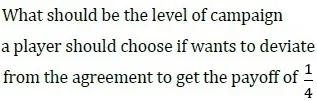
Now assume that this game is repeated infinitely and the parties cooperate and sign a binding agreement on how much to campaign. What will be the payoff of each player in each stage game if they stick to this agreement
- A-1.5
- B1
- C-1
- D0
- Q102MCQ1 Mark·Choose one option
Now assume that this game is repeated infinitely and the parties cooperate and sign a binding agreement on how much to campaign.
- A

- B

- C

- D

- A
- Q103MCQ1 Mark·Choose one option
Now assume that this game is repeated infinitely and the parties cooperate and sign a binding agreement on how much to campaign.

- A

- B

- C

- D

- A
Read the passage below, then answer Q104–Q105
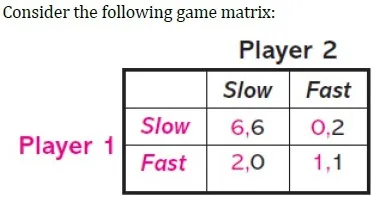
Based on the above data, answer the given subquestions.
Q104MCQ1 Mark·Choose one optionChoose the correct alternative(s)
- A(Slow, Slow) is an NE
- B(Slow, Fast) is an NE
- CBoth (Slow, Slow) is an NE & (Slow, Fast) is an NE
- DNone
- Q105MCQ1 Mark·Choose one option
ESS in this game is (are)
- ASlow
- BFast
- CBoth Slow & Fast
- DNone
Read the passage below, then answer Q106–Q111
Consider the example of cascade discussed in the lecture but with a modification that now the urn is containing either 4 blue balls and 2 red ball or 4 red balls and 2 blue ball with equal probability. That simply means that the urn is equally likely to be blue-majority urn or red-majority urn. We assume everyone hears what the previous individuals report and get their own private signal by randomly drawing one ball from the urn.
Based on the above data, answer the given subquestions.
Q106MCQ1 Mark·Choose one optionSuppose one ball is picked from the red majority urn. What is the probability that the ball is blue?
- A1/3
- B3/4
- C1/4
- D2/3
- Q107MCQ1 Mark·Choose one option
What is the probability that the urn is majority-red if the first student draws a blue ball?
- A1/5
- B4/5
- C2/3
- D1/3
- Q108MCQ1 Mark·Choose one option
Now suppose, first three students draw the ball in the sequence (Blue, Blue, Red). What is the probability of getting this sequence if the urn is a blue-majority urn?
- A5/27
- B4/27
- C16/125
- D9/125
- Q109MCQ1 Mark·Choose one option
Now suppose, first three students draw the ball in the sequence (Blue, Blue, Red). What is the probability of getting this sequence if the urn is a red-majority urn?
- A2/27
- B5/27
- C5/216
- D7/216
- Q110MCQ1 Mark·Choose one option
Now suppose, first three students draw the ball in the sequence (Blue, Blue, Red). What is the total probability of getting this sequence?
- A1/25
- B2/25
- C1/9
- D2/9
- Q111MCQ2 Marks·Choose one option
Now suppose, first three students draw the ball in the sequence (Blue, Blue, Red). What is the probability of urn being red-majority in this scenario?
- A2/3
- B1/25
- C4/25
- D1/3
Read the passage below, then answer Q112–Q116
Given the following preference structure, find a stable matching system using the Gale–Shapley algorithm when the men propose
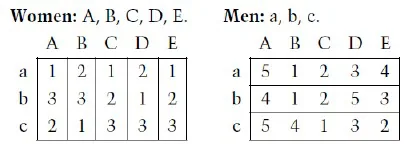
Based on the above data, answer the given subquestions.
Q112MCQ1 Mark·Choose one optionMs. A will be paired with
- Aa
- Bb
- Cc
- DNone
- Q113MCQ1 Mark·Choose one option
Ms. B will be paired with
- Aa
- Bb
- Cc
- DNone
- Q114MCQ1 Mark·Choose one option
Ms. C will be paired with
- Aa
- Bb
- Cc
- DNone
- Q115MCQ1 Mark·Choose one option
Ms. D will be paired with
- Aa
- Bb
- Cc
- DNone
- Q116MCQ1 Mark·Choose one option
Ms. E will be paired with
- Aa
- Bb
- Cc
- DNone
Official KeyMaster Answer Key & Explanations
Official answer keys from IIT Madras BS past papers. Click any question to review.
Reveal KeyCollapse Key
Master Answer Key & Explanations
Official answer keys from IIT Madras BS past papers. Click any question to review.