Indian Institute of Technology Madras
BS Degree Programme · Examination & Study Paper
Game Theory and Strategy
Quiz 2 · 3 Aug 2025 (Afternoon)
Examination Instructions & Guidelines
- Solve on notebook/paper first before checking solutions.
- MCQ: Exactly 1 option is correct. Negative marking applies.
- NAT: Numerical response. No negative marking.
- Scientific calculator allowed for all calculations.
- Official answer key is sealed at the end of this sheet.
Read the passage below, then answer Q1–Q3
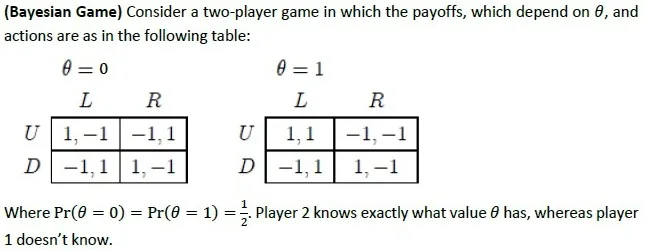
Based on the above data, answer the given subquestions.
Q1MCQ1 Mark·Choose one optionUnder Bayesian Nash Eq., player 1 will play
- AU
- BD
- Q2MCQ1 Mark·Choose one option
Under Bayesian Nash Eq., player 2, who knows that θ = 0 will play
- AL
- BR
- Q3MCQ1 Mark·Choose one option
Under Bayesian Nash Eq., player 2, who knows that θ = 1 will play
- AL
- BR
Read the passage below, then answer Q4–Q11
Each one of two political parties can choose to buy time on commercial radio shows to broadcast negative ad campaigns against their rival. These choices are made simultaneously. Due to government regulation, it is forbidden to buy more than 2 hours of negative campaign time, so that each party cannot choose an amount of negative campaigning above 2 hours. Given a pair of choices (a_1,a_2), the payoff of party i is given by the following function: v_i (a_1,a_2) = a_i − 2a_j + a_ia_j − (a_i)^2. Write the normal form representation of this game and answer the given sub-questions.
Q4MCQ1 Mark·Choose one optionIf player 1 chooses 2 hours as his action, the best response of player 2 will be
- A1.5
- B1
- C1.25
- D0
- Q5MCQ1 Mark·Choose one option
How much negative campaign time will each player choose under a symmetric and unique Nash equilibrium?
- A1.5
- B1
- C1.25
- D0
- Q6MCQ1 Mark·Choose one option
Equilibrium payoff of each player will be
- A-1.5
- B1
- C-1
- D0
- Q7NAT1 Mark·Write the number
If the parties could sign a binding agreement on how much to campaign, what levels would they choose? a_1 = _____________
Your answer: - Q8NAT1 Mark·Write the number
If the parties could sign a binding agreement on how much to campaign, what levels would they choose? a_2 = _____________
Your answer: - Q9MCQ1 Mark·Choose one option
Now assume that this game is repeated infinitely and the parties cooperate and sign a binding agreement on how much to campaign. What will be the payoff of each player in each stage game if they stick to this agreement
- A-1.5
- B1
- C-1
- D0
- Q10MCQ1 Mark·Choose one option
Now assume that this game is repeated infinitely and the parties cooperate and sign a binding agreement on how much to campaign.
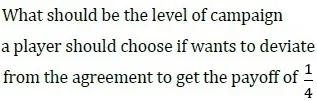
- A

- B

- C

- D

- A
- Q11MCQ1 Mark·Choose one option
Now assume that this game is repeated infinitely and the parties cooperate and sign a binding agreement on how much to campaign.

- A

- B

- C

- D

- A
Read the passage below, then answer Q12–Q13
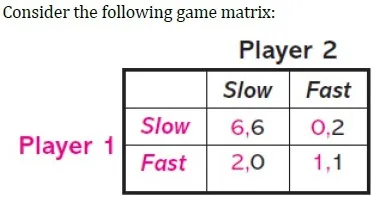
Based on the above data, answer the given subquestions.
Q12MCQ1 Mark·Choose one optionChoose the correct alternative(s)
- A(Slow, Slow) is an NE
- B(Slow, Fast) is an NE
- CBoth (Slow, Slow) is an NE & (Slow, Fast) is an NE
- DNone
- Q13MCQ1 Mark·Choose one option
ESS in this game is (are)
- ASlow
- BFast
- CBoth Slow & Fast
- DNone
Read the passage below, then answer Q14–Q19
Consider the example of cascade discussed in the lecture but with a modification that now the urn is containing either 4 blue balls and 2 red ball or 4 red balls and 2 blue ball with equal probability. That simply means that the urn is equally likely to be blue-majority urn or red-majority urn. We assume everyone hears what the previous individuals report and get their own private signal by randomly drawing one ball from the urn.
Based on the above data, answer the given subquestions.
Q14MCQ1 Mark·Choose one optionSuppose one ball is picked from the red majority urn. What is the probability that the ball is blue?
- A1/3
- B3/4
- C1/4
- D2/3
- Q15MCQ1 Mark·Choose one option
What is the probability that the urn is majority-red if the first student draws a blue ball?
- A1/5
- B4/5
- C2/3
- D1/3
- Q16MCQ1 Mark·Choose one option
Now suppose, first three students draw the ball in the sequence (Blue, Blue, Red). What is the probability of getting this sequence if the urn is a blue-majority urn?
- A5/27
- B4/27
- C16/125
- D9/125
- Q17MCQ1 Mark·Choose one option
Now suppose, first three students draw the ball in the sequence (Blue, Blue, Red). What is the probability of getting this sequence if the urn is a red-majority urn?
- A2/27
- B5/27
- C5/216
- D7/216
- Q18MCQ1 Mark·Choose one option
Now suppose, first three students draw the ball in the sequence (Blue, Blue, Red). What is the total probability of getting this sequence?
- A1/25
- B2/25
- C1/9
- D2/9
- Q19MCQ2 Marks·Choose one option
Now suppose, first three students draw the ball in the sequence (Blue, Blue, Red). What is the probability of urn being red-majority in this scenario?
- A2/3
- B1/25
- C4/25
- D1/3
Read the passage below, then answer Q20–Q24
Given the following preference structure, find a stable matching system using the Gale–Shapley algorithm when the men propose
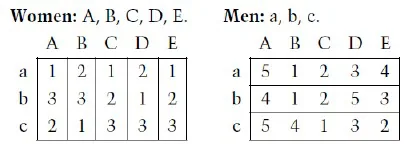
Based on the above data, answer the given subquestions.
Q20MCQ1 Mark·Choose one optionMs. A will be paired with
- Aa
- Bb
- Cc
- DNone
- Q21MCQ1 Mark·Choose one option
Ms. B will be paired with
- Aa
- Bb
- Cc
- DNone
- Q22MCQ1 Mark·Choose one option
Ms. C will be paired with
- Aa
- Bb
- Cc
- DNone
- Q23MCQ1 Mark·Choose one option
Ms. D will be paired with
- Aa
- Bb
- Cc
- DNone
- Q24MCQ1 Mark·Choose one option
Ms. E will be paired with
- Aa
- Bb
- Cc
- DNone