Indian Institute of Technology Madras
BS Degree Programme · Examination & Study Paper
Game Theory and Strategy
Quiz 1 · 26 Oct 2025 (Afternoon)
Examination Instructions & Guidelines
- Solve on notebook/paper first before checking solutions.
- MCQ: Exactly 1 option is correct. Negative marking applies.
- NAT: Numerical response. No negative marking.
- Scientific calculator allowed for all calculations.
- Official answer key is sealed at the end of this sheet.
Read the passage below, then answer Q1–Q2
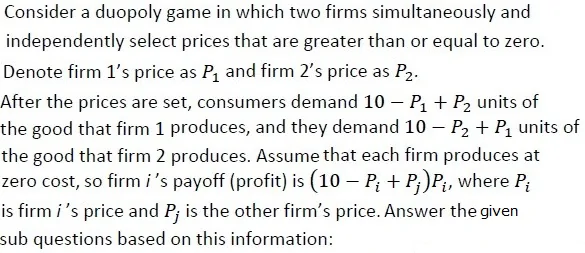 Q1MCQ2 Marks·Choose one option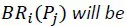
- A

- B

- C

- D

- A
- Q2MCQ2 Marks·Choose one option
Choose the incorrect statement
- AThis game is a symmetric game
- BThis game has a symmetric Nash equilibrium
- CUnder the Nash equilibrium each player chooses P=15
- DThis game has unique Nash equilibrium
Read the passage below, then answer Q3–Q4
(Choosing a route) Four people must drive from A to B at the same time. Two routes are available, one via X and one via Y (Refer to the left panel of following Figure). The roads from A to X, and from Y to B are both short and narrow; in each case, one car takes 6 minutes, and each additional car increases the travel time per car by 3 minutes. (If two cars drive from A to X, for example, each car takes 9 minutes.) The roads from A to Y, and from X to B are long and wide; on A to Y one car takes 20 minutes, and each additional car increases the travel time per car by 1 minute; on X to B one car takes 20 minutes, and each additional car increases the travel time per car by 0.9 minutes. Formulate this situation as a strategic game and answer the given subquestions.
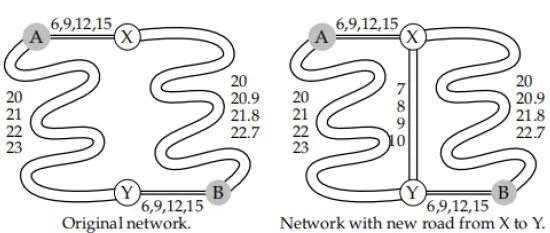 Q3MCQ2 Marks·Choose one option
Choose the correct alternative
- AIn Nash equilibrium two people take each route
- BFor the NE action profile, each person’s travel time is either 29.9 or 30 minutes
- CBoth In Nash equilibrium two people take each route & For the NE action profile, each person’s travel time is either 29.9 or 30 minutes
- DNone
- Q4MCQ2 Marks·Choose one option
Now suppose that a relatively short, wide road is built from X to Y, giving each person four options for travel from A to B: A–X–B, A–Y–B, A–X–Y–B, and A–Y– X–B (As shown in the right panel of the given figure). Assume that a person who takes A–X–Y–B travels the A–X portion at the same time as someone who takes A–X–B, and the Y–B portion at the same time as someone who takes A–Y–B. (Think of there being constant flows of traffic.) On the road between X and Y, one car takes 7 minutes and each additional car increases the travel time per car by 1 minute. Consider the Nash equilibrium in this new situation. Choose the correct alternative
- AIn any Nash equilibrium, two persons take A–X–B, one person takes A–X–Y–B, and one person takes A–Y–B
- BIn equilibrium profile, every person’s travel time increases compared to the case when new road was not there
- CBoth In any Nash equilibrium, two persons take A–X–B, one person takes A–X–Y–B, and one person takes A–Y–B & In equilibrium profile, every person’s travel time increases compared to the case when new road was not there
- DNone
Read the passage below, then answer Q5–Q6
An item is up for auction. Player 1 values the item at 3 while player 2 values the item at 5. Each player can bid either 0, 1 or 2. If player i bids more than player j then i wins the good and pays his bid, while the loser does not pay. If both players bid the same amount, then a coin is tossed to determine who the winner is, who gets the good and pays his bid while the loser pays nothing. Formulate the game in matrix form and answer the given subquestions.
Q5MCQ2 Marks·Choose one optionWhich player does not have strictly dominated strategy?
- APlayer 1
- BPlayer 2
- CNone
- Q6MCQ2 Marks·Choose one option
Which strategies survive Iterated Elimination of Strictly Dominated Strategy?
- A(0, 0)
- B(1, 1)
- C(2, 2)
- DNone
Read the passage below, then answer Q7–Q8
Consider the following normal form game and answer the given sub questions:
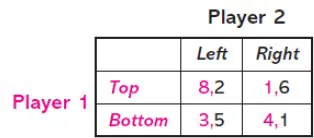 Q7MCQ2 Marks·Choose one option
This game has
- AA unique Nash equilibrium in pure strategy
- BA unique Nash equilibrium in mixed strategy
- CBoth are true
- DNone is true
- Q8NAT3 Marks·Write the number
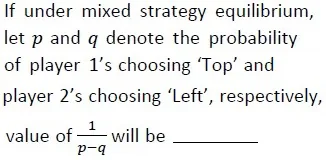 Your answer:
 Read the passage below, then answer Q9–Q16
Consider a two-player game in which player 1 can choose A or B. The game ends if he chooses A while it continues to player 2 if he chooses B. Player 2 can either choose C or D, with the game ending after C and continuing again with player 1 after D. Player 1 then can choose E or F, and then the game ends after each of these choices.
Imagine that the payoffs following choice A by player 1 are (2, 0), following C by player 2 are (3, 1), following E by player 1 are (0, 0) and following F by player 1 are (1, 2)
Model this as an extensive form game and answer the given subquestions:
Q9MCQ1 Mark·Choose one optionThis is a game of
- APerfect information
- BImperfect information
- CNone
- DCan’t be determined
- Q10MCQ1 Mark·Choose one option
How many terminal nodes does this game have?
- A3
- B2
- C4
- D5
- Q11MCQ1 Mark·Choose one option
How many information sets does this game have?
- A2
- B3
- C4
- D1
- Q12MCQ1 Mark·Choose one option
How many pure strategies does player 1 have?
- A1
- B2
- C3
- D4
- Q13MCQ1 Mark·Choose one option
How many pure strategies does player 2 have?
- A1
- B2
- C3
- D4
- Q14MCQ1 Mark·Choose one option
How many pure strategy Nash equilibria does this game have?
- A1
- B2
- C3
- D4
- Q15MCQ1 Mark·Choose one option
Which one of the Nash equilibria is also a subgame perfect equilibrium?
- A(AE, D)
- B(AF, D)
- C(BE, C)
- D(BF, C)
- Q16MCQ1 Mark·Choose one option
No. of sub games this game has
- A1
- B2
- C3
- D4