Indian Institute of Technology Madras
BS Degree Programme · Examination & Study Paper
Design Thinking for Data-Driven App Development
All 2025 papers
Examination Instructions & Guidelines
- Solve on notebook/paper first before checking solutions.
- MCQ: Exactly 1 option is correct. Negative marking applies.
- Scientific calculator allowed for all calculations.
- Official answer key is sealed at the end of this sheet.
End Term · 31 Aug 2025 (FN)End Term
- Q1MCQ1 Mark·Choose one option
In Agile, what does the principle “working software over comprehensive documentation” imply? 1. Prioritize functional product 2. Documentation is not needed at all 3. Deliver incremental value quickly 4. Focus more on code than communication Select the correct answer from the options below:
- A1, 2, and 3 only
- B1 and 3 only
- C2, 3, and 4 only
- D1, 3, and 4 only
- Q2MCQ1 Mark·Choose one option
In Design Thinking, prototyping is important because it helps to: 1. Test assumptions quickly 2. Gather user feedback early 3. Avoid making any design errors 4. Encourage iterative improvement Select the correct answer from the options below:
- A1, 2, and 3 only
- B2, 3, and 4 only
- C1, 2, and 4 only
- D1, 3, and 4 only
- Q3MCQ1 Mark·Choose one option
Which of the following are stages in the Double Diamond model of design? 1. Discover 2. Define 3. Develop 4. Deliver 5. Draw 6. Decide Select the correct answer from the options below:
- A1, 2, 3, and 5 only
- B2, 3, 4, and 6 only
- C1, 2, 3, and 4 only
- D1, 4, 5, and 6 only
- Q4MCQ1 Mark·Choose one option
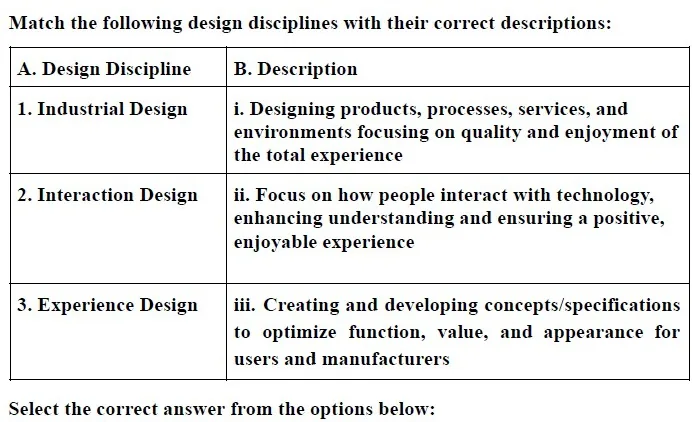
- A1–iii, 2–ii, 3–i
- B1–i, 2–iii, 3–ii
- C1–ii, 2–i, 3–iii
- D1–iii, 2–i, 3–ii
- Q5MCQ1 Mark·Choose one option
According to Kahneman’s Peak-End Rule, which aspect(s) of an interaction primarily shape a person’s long-term memory of it?
- AThe beginning of the interaction and the end of the interaction
- BThe duration of the interaction and the end of the interaction
- CThe experience when disengaged
- DThe most intense moment and the end of the interaction
- Q6MCQ1 Mark·Choose one option
Who developed the TRIZ methodology (Theory of Inventive Problem Solving)?
- AEdward de Bono
- BGenrich Altshuller
- CHerbert Simon
- DDon Norman
- Q7MCQ1 Mark·Choose one option
State whether the following statement is True or False: “A modified customer journey map includes emotional highs and lows, pain points, and opportunities identified during the Test phase in addition to the standard steps of the journey.”
- ATrue
- BFalse
- Q8MCQ1 Mark·Choose one option
Which of the following could possibly be considered examples or concepts of intrapreneurship and intrapreneurial development? 1. Google’s “20% time” initiative, where some employees devote 20 percent of their time to side projects. 2. Facebook’s “Like” button developed during the company's hackathon. 3. Flamin’ Hot Cheetos developed by a Frito-Lay janitor who pitched the idea to executives.
- AOnly 1
- BOnly 2
- COnly 3
- DAll of these
- Q9MCQ1 Mark·Choose one option
As per Don Norman’s Law of Product Development, product launches are always accompanied by ______ and ______.
- ADeadlines; marketing campaigns
- BSchedules; budgets
- CPrototypes; customer reviews
- DDesigns; test reports
- Q10MCQ1 Mark·Choose one option
When testing a prototype, which of the following practices align with effective user testing principles? 1. Select participants who closely match the target population. 2. Test prototypes in conditions that mimic real-world use as closely as possible. 3. Ensure that prototypes are tested individually always, and never in pairs, to capture unbiased user behavior. How many of the above statements are correct?
- AOnly 1
- BOnly 2
- CAll 1, 2, 3
- DNone of these
- Q11MCQ1 Mark·Choose one option
In the context of digital marketing, what is the primary purpose of a push notification?
- ATo boost an app’s visibility or ranking in app stores
- BTo deliver real-time updates or reminders directly to a user’s device
- CTo measure the conversion rate of an ad campaign
- DTo track user behavior directly from a user’s device
- Q12MCQ1 Mark·Choose one option
State whether the following statement is true or false “In UX design, while simplicity aims to reduce complexity, minimalism is about reducing the elements to a strict minimum.”
- ATrue
- BFalse
Read the passage below, then answer Q13–Q15

Based on the above data, answer the given subquestions.
Q13MCQ1 Mark·Choose one optionIn a productivity app, the search bar not only finds documents but also allows users to send payments, schedule meetings, and request support from the same interface. This eliminates the need for multiple separate features. Which TRIZ principle does this illustrate?
- ASegmentation
- BUniversality
- CPrior action
- DNested doll
- Q14MCQ1 Mark·Choose one option
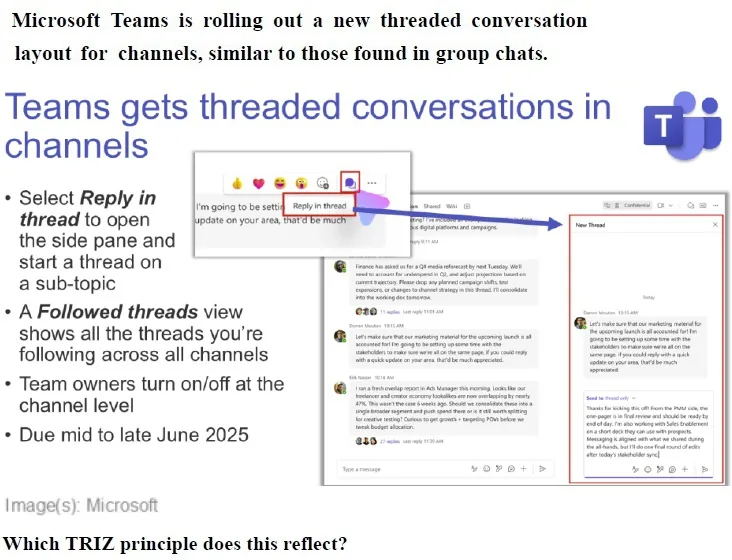
- ATaking Out
- BUniversality
- CNested Dolls
- DPrior Action
- Q15MCQ1 Mark·Choose one option
To improve the comfort of e-readers like Kindle, designers added a lightweight cover with a built- in hand strap, allowing users to hold the device easily without feeling its weight during long reading sessions.
 Which TRIZ principle does this design improvement illustrate?
- AAnti-weight
- BCopying
- CSegmentation
- DMechanics substitution
- Q16MCQ1 Mark·Choose one option
An UX researcher designs a new software tool at home on their personal laptop, outside office hours. However, the concept for the tool emerged during a brainstorming session at work, while they were under contract with the company. In this case, who is legally the inventor, and who is most likely to own the IP rights?
- AThe company is the inventor and retains ownership
- BThe researcher is the inventor; the company still owns the IP
- CThe researcher is automatically both inventor and owner
- DThe company is the inventor, while the researcher owns the IP
- Q17MCQ1 Mark·Choose one option
Which of the following statements correctly describe Intellectual Property (IP)? 1. Copyright covers creative expressions such as books, art, or music but not raw ideas. 2. Patents are granted even when the invention is not novel or is obvious. 3. Trade secrets require public disclosure to remain valid. 4. Trademarks safeguard distinctive elements of a brand, like its name or logo. Select the correct answer from the options below:
- A1, 3, and 4 only
- B1 and 4 only
- C1, 2, and 4 only
- D2, 3, and 4 only
- Q18MCQ1 Mark·Choose one option
While assessing a fitness-tracking app, a design team listed these user-related observations: 1. Feelings and emotions users experienced during navigation. 2. Trust and beliefs about the app’s reliability. 3. Impressions of the app’s usability and interface design. 4. Bodily or mental responses while using it (e.g., fatigue, motivation). 5. Patterns of behaviour in app usage (e.g., frequency, feature avoidance). Which of these typically fall under User Experience (UX)?
- A1, 2, 3, 4 only
- B2, 3, 4, 5 only
- C1, 3, 4, 5 only
- D1, 2, 3, 4, 5
- Q19MCQ1 Mark·Choose one option
In the PRESENT method of effective communication discussed in the Design Thinking for Data- Driven App Development course, two simple story structures were introduced. The first structure is: Start, Middle, and End. What is the second structure?
- AAnalyze, Solve & Test, and Present
- BSituation, Action/Solution, and Result
- CContext, Conflict/Challenge, and Solution
- DProblem, Ideation, and Prototype/ Present
- Q20MCQ1 Mark·Choose one option
Which of the following could the course team of Design Thinking for Data-Driven App Development do to make the upcoming term even more legendary? (Hint: Our team wants to give you 1 mark as a token of thanks for being awesome. All statements are correct.) [Check ‘All’ as answer] 1. Send each team free pizza during their late-night GP1, GP2, GP3 marathons. 2. Invite Elon Musk (or at least his Twitter bot) to the final presentations. 3. Add a “Best Meme Prototype” award alongside “Best App Idea.” 4. Give participants a lifetime supply of sticky notes so they never run out during brainstorming. Select the correct answer from the options below:
- AOnly 1
- BOnly 2
- COnly 3
- DAll.
End Term · 31 Aug 2025 (AN)End Term
- Q21MCQ1 Mark·Choose one option
Which of the following are core principles of Agile project management? 1. Customer collaboration over contract negotiation 2. Responding to change over following a plan 3. Comprehensive documentation over working software 4. Individuals and interactions over processes and tools Select the correct answer from the options below:
- A1, 2, and 3 only
- B1, 2, and 4 only
- C2, 3, and 4 only
- D1, 3, and 4 only
- Q22MCQ1 Mark·Choose one option
In Agile + Design Thinking, what are the benefits of running design sprints? 1. Quickly validate ideas before coding 2. Reduce waste from unwanted features 3. Ensure final designs are perfect before final release 4. Align the team on user needs Select the correct answer:
- A1, 2, and 3 only
- B1, 3, and 4 only
- C1, 2, and 4 only
- D2, 3, and 4 only
- Q23MCQ1 Mark·Choose one option
According to Don Norman, in Human-Centered Design (HCD), which of the following are key goals of the design process? 1. Meeting people’s needs 2. Ensuring the product is understandable and usable 3. Creating a positive and enjoyable user experience 4. Satisfy a large number of design constraints and concerns Select the correct answer from the options below:
- A1, 2, and 3 only
- B2, 3, and 4 only
- C1, 3, and 4 only
- D1, 2, 3, and 4
- Q24MCQ1 Mark·Choose one option
In the Double Diamond Design Process introduced by the British Design Council, the design journey involves two main divergence and convergence phases: one for identifying the right problem and another for developing the right solution. During this process, what do the X and Y axes most likely represent in the Double Diamond diagram?
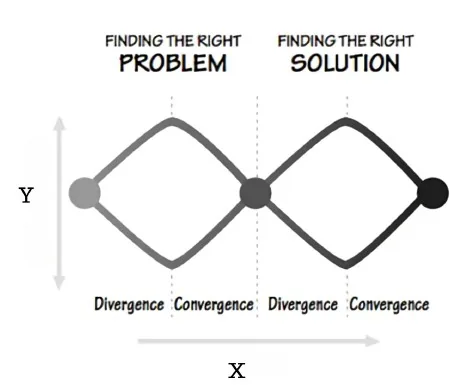
- A

- B

- C

- D

- A
- Q25MCQ1 Mark·Choose one option
State whether the following statement is true or false “In UX design, while simplicity aims to reduce complexity, minimalism is about reducing the elements to a strict minimum.”
- ATRUE
- BFALSE
- Q26MCQ1 Mark·Choose one option
The "5 Whys" technique was first described at which organization?
- AKawasaki
- BMitsubishi
- CToyota
- DYamaha
- Q27MCQ1 Mark·Choose one option
State whether the following statement is True or False: “A modified customer journey map includes emotional highs and lows, pain points, and opportunities identified during the Analyze phase in addition to the standard steps of the journey.”
- ATRUE
- BFALSE
- Q28MCQ1 Mark·Choose one option
Which of the following scenarios best illustrates intrapreneurship?
- AAnanyaa, frustrated with corporate life, quits her job to start her own design consulting firm.
- BRohan, a marketing executive, creates a new customer loyalty app for his company and leads its rollout.
- CMohak’s firm hires an external agency to design an innovative supply chain system.
- DAastha, co-founder of a small startup, pitches his product idea to venture capitalists for funding.
- Q29MCQ1 Mark·Choose one option
As per Don Norman’s Law of Product Development, product launches are always accompanied by ______ and ______.
- ADeadlines; marketing campaigns
- BSchedules; budgets
- CPrototypes; customer reviews
- DDesigns; test reports
- Q30MCQ1 Mark·Choose one option
When testing a prototype, which of the following practices align with effective user testing principles? 1. Select participants who closely match the target population. 2. Test prototypes in conditions that mimic real-world use as closely as possible. 3. Use paired participants occasionally to encourage open discussion of thoughts and frustrations. How many of the above statements are correct?
- AOnly 1
- BOnly 2
- CAll 3
- DNone
- Q31MCQ1 Mark·Choose one option
During a design thinking hackathon promotion, the organizing team spent ₹15,000 on general outreach and an additional ₹8,400 to boost a specific social media post. That boosted post alone resulted in 300 registration app installs. What was the Cost Per Install (CPI)?
- A₹50.00 per install
- B₹78.00 per install
- C₹28.00 per install
- D₹36.00 per install
- Q32MCQ1 Mark·Choose one option
In practical web design, applying the peak-end rule means focusing on:
- ALoading speed and bounce rate metrics only
- BCreating a highly engaging moment during the experience and ending on a satisfying note
- CIncreasing the total time users spend on the site regardless of content quality and ending on a satisfying note
- DMaximizing the number of clickable elements on each page
Read the passage below, then answer Q33–Q35

Based on the above data, answer the given subquestions.
Q33MCQ1 Mark·Choose one optionAn AI-based grammar tool offers phrasal predictions as you type, without needing to finish the document first.
 Which TRIZ principle applies?
- ABeforehand cushioning
- BPeriodic action
- CUniversality
- DPreliminary action
- Q34MCQ1 Mark·Choose one option
A pen has both a ballpoint tip and a stylus tip for touchscreen devices in one tool.
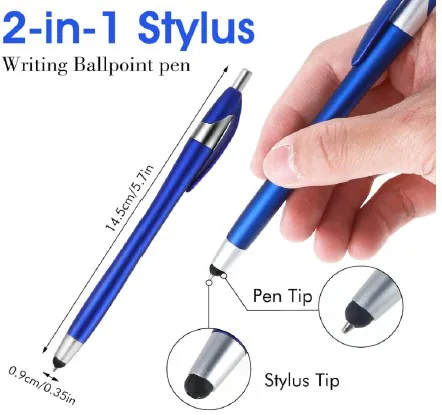 Which TRIZ principle applies?
- AMechanics substitution
- BMerging
- CComposite materials
- DUniversality
- Q35MCQ1 Mark·Choose one option
An e-learning platform adapts the difficulty of quiz questions in real time based on the learner’s performance. Which TRIZ principle applies?
- AFeedback
- BCopying
- CSegmentation
- DSelf-service
- Q36MCQ1 Mark·Choose one option
An engineer develops a novel algorithm entirely on their own time, using personal equipment, but based on an idea discussed in a company meeting where the engineer is under employee contract. Who is the inventor, and who typically owns the IP?
- AThe company is the inventor and company is typically the owner
- BThe engineer is the inventor; the company may own the IP
- CThe engineer is both the inventor and owner by default
- DThe company is the inventor; the engineer owns the IP
- Q37MCQ1 Mark·Choose one option
Which of the following statements about Intellectual Property (IP) are correct? 1. Copyright protects original expressions, not ideas. 2. Patents protect inventions even if not novel and obvious. 3. Trade secrets must be publicly disclosed to be protected. 4. Trademarks protect brand identifiers like logos and names. Select the correct answer:
- A1, 3, and 4 only
- B1 and 4 only
- C1, 2, and 4 only
- D2, 3, and 4 only
- Q38MCQ1 Mark·Choose one option
While evaluating a new health-tracking mobile app, the UX research team observed several aspects as given below: 1. The emotional reactions users had while navigating the app. 2. The beliefs users held about the app’s accuracy and trustworthiness. 3. The perceptions users formed about the app’s design and ease of use. 4. The physical and psychological responses triggered during usage (e.g., eye strain, sense of accomplishment). 5. The behaviours users displayed while interacting with the app (e.g., checking it daily, avoiding certain features). Which of the above aspects are typically considered part of User Experience (UX)?
- A1, 2, 3, 4 only
- B2, 3, 4, 5 only
- C1, 3, 4, 5 only
- D1, 2, 3, 4, 5
- Q39MCQ1 Mark·Choose one option
In the PRESENT method of effective communication discussed in the Design Thinking for Data- Driven App Development course, two simple story structures were introduced. The first structure is: Start, Middle, and End. What is the second structure?
- AAnalyze, Solve & Test, and Present
- BSituation, Action/Solution, and Result
- CContext, Conflict/Challenge, and Solution
- DProblem, Ideation, and Prototype/ Present
- Q40MCQ1 Mark·Choose one option
Which of the following could the course team of Design Thinking for Data-Driven App Development do to make the upcoming term even more unforgettable? (Hint: Our team wants to give you 1 mark as a gesture of thanks for taking this course. All statements are correct.) [Check ‘All’ as answer] 1. Buy coffee for nervous participants during the project viva voce. 2. Help teams find investors if they wish to take their project work forward. 3. Award +10 bonus marks for attending all live sessions. 4. Buy Mural and Figma licenses for each team so canvases and prototypes don’t have to be drawn on napkins. Select the correct answer from the options below:
- AOnly 1
- BOnly 2
- COnly 3
- DAll
Quiz 2 · 3 Aug 2025 (AN)Quiz 2
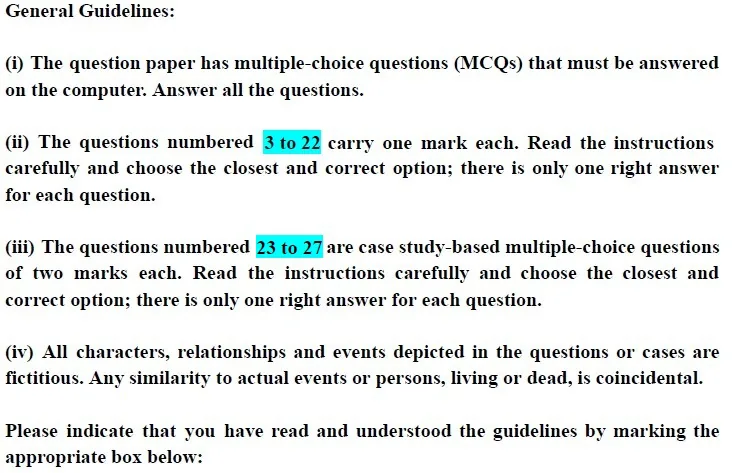
Useful Reference Data for this Paper
 Q41MCQ1 Mark·Choose one option
The Test phase in Karmic Design Thinking (KDT) corresponds to:
- ANirodha
- BSamudaya
- CDukkha
- DMarga
- Q42MCQ1 Mark·Choose one option
What does "project scope" refer to in the context of Design Thinking & Agile project management?
- AThe duration and timeline of sprints to develop the product
- BThe specific goals, features, and deliverables agreed upon for the product
- CA list of known risks and mitigation strategies during the project
- DThe total financial resources, and project members allocated for the project
- Q43MCQ1 Mark·Choose one option
Which statement best illustrates the iterative nature of Agile and Design Thinking?
- AThe final solution is defined before development begins
- BDesign is done once and then development is iterated
- CRepeatedly test and improve ideas based on user feedback
- DOnce a prototype is iterated, the solution is fixed
- Q44MCQ1 Mark·Choose one option
Which of the following best explains why Agile+Design Thinking are suitable approaches in early- stage app development projects?
- AThey require fully defined user requirements before starting development
- BThey embrace uncertainty and allow teams to adapt as user needs
- CThey eliminate the need for user input by relying on expert intuition
- DThey are suitable for projects with low complexity and short timelines
- Q45MCQ1 Mark·Choose one option
Which of the following is NOT a way to analyze user needs during the design thinking process?
- AAsking open-ended questions to users
- BObserving user behavior
- CCreating user personas
- DMaking assumptions about user needs
- Q46MCQ1 Mark·Choose one option
According to Don Norman in The Design of Everyday Things, which of the following best reflects how Human-Centered Design (HCD) contributes to successful product development and market fit? 1. The understanding of people and the needs that the design is intended to meet primarily comes through observation. 2. The principle is to avoid specifying the problem as long as possible. 3. It promotes early, fixed specification of product requirements to speed up development. Select the correct option using the codes given below:
- A1 only
- B1 and 3 only
- C1 and 2 only
- D1, 2 and 3
- Q47MCQ1 Mark·Choose one option
During the Empathize phase of KDT, how can you minimize assumptions and accurately uncover latent user needs?
- ABy noting problems that users explicitly mention as frequent in their daily routines
- BBy using HMW problem statements to discover friction points that may not be verbally expressed
- CBy mapping end-to-end experiences across multiple users to reveal patterns
- DBy testing a range of proposed solutions to validate which one aligns with the user’s expectations
- Q48MCQ1 Mark·Choose one option
Which of the following best reflects the relationship between design research and marketing research in understanding user needs? 1. Marketing research generate value for the organization, design research generate value for the end user 2. Marketing research offers qualitative depth, while design research scales insights across demographics 3. Design research uncovers deep user needs from small samples; marketing research reveals broad purchasing patterns 4. Designers and marketers should work independently to avoid conflicts in user insights and product positioning Select the correct option using the codes given below:
- A1, 2 and 3 only
- B1, 2 and 4 only
- C1 and 3 only
- D1, 3 and 4 only
- Q49MCQ1 Mark·Choose one option
State whether the following statement is TRUE or FALSE: ‘People who cannot temporarily let go of their role or status or set aside their own expertise or opinion will fail to empathize with others who have conflicting thoughts, experiences, or mental models.’
- ATRUE
- BFALSE
- Q50MCQ1 Mark·Choose one option
Which of the following is NOT a way to test a design during the design thinking process?
- AConducting user research
- BBuilding a prototype
- CTesting with users
- DAnalyzing user feedback
- Q51MCQ1 Mark·Choose one option
Which of the following activities represent appropriate Empathize phase practices in the KDT process? 1. Harish spends a week working at the BS programs office to observe how the exam question paper team handles last-minute requests from the course team. 2. Syed, an employee with the exam logistics team, travels to remote exam centers in rural Telangana to shadow supervisors and document infrastructure pain points. 3. Akshaya, reviews survey responses from 500 students about their satisfaction with campus events after Shaastra, a tech festival at IIT Madras. 4. Avni, a student volunteer, participates in a collegiate festival called Paradox, observing crowd movement and accessibility across venues. 5. Hamsini, a data scientist, builds a machine learning model to predict student dropout risk using course clickstream and assignment data. 6. Shriprasad, spends time interacting with student founders at the Research Park and Centre for Innovation (CFI) to learn how the campus supported their startup journeys. Select the correct option using the codes given below:
- A1, 3, 4, 5 and 6 only
- B1,2,4 and 6 only
- C1, 2, 4, 5 and 6 only
- D1, 3, 4, and 6 only
- Q52MCQ1 Mark·Choose one option
According to Don Norman in The Design of Everyday Things, what strategic insights from product development are essential for creating market-ready offerings that ensure customer satisfaction and brand value? 1. The quality of customer service, maintenance, and upgrade support throughout the product lifecycle 2. Consideration of environmental impact across manufacturing, distribution, and end-of-life disposal 3. Cross-functional coordination between technical, business, and social teams to align product features with customer expectations Select the correct option using the codes given below:
- A1 and 2 only
- B1 and 3 only
- C2 and 3 only
- D1, 2 and 3
- Q53MCQ1 Mark·Choose one option
In the Analyze phase of Design Thinking, what is the primary purpose of using the Multi-Whys technique?
- ATo generate a wide range of innovative solutions by repeatedly asking "Why?"
- BTo dig deeper into the root cause of a user’s problem by repeatedly asking "Why?"
- CTo validate the design hypotheses by repeatedly asking "Why?"
- DTo test if the problem has already been solved by a competitor by repeatedly asking "Why?"
- Q54MCQ1 Mark·Choose one option
A common pitfall in applying the Multi-Why technique is:
- AReaching conclusions too rapidly without sufficient depth
- BAsking less than five Why questions to uncover innovative solutions
- CStopping the inquiry process before uncovering the design hypotheses
- DStopping the inquiry process before uncovering the true underlying issue
- Q55MCQ1 Mark·Choose one option
Which of the following best reflects the iterative mindset central to Design Thinking?
- ABuild once, validate quickly, and deploy at scale
- BSolve problems based on expert assumptions to avoid delays
- CEmbrace early failure and refine solutions through cycles of testing
- DFinalize the best solution during the ideation phase to reduce complexity
- Q56MCQ1 Mark·Choose one option
What is a key advantage of using Silent Brainstorming in the Solve phase of Design Thinking?
- AIt allows the facilitator to control idea flow by prioritizing known solutions
- BIt forces the least experienced team members alone contribute during ideation
- CIt encourages individual creativity without group bias or influence
- DIt reduces the number of ideas generated to maintain focus on feasibility
- Q57MCQ1 Mark·Choose one option
In the Design Thinking process, the Test phase is characterized by gathering user feedback to refine and validate solutions. This approach makes the Test phase primarily a ________ phase.
- AConvergent
- BExploratory
- CDivergent
- DAbstract
- Q58MCQ1 Mark·Choose one option
Why are “How Might We” (HMW) questions considered powerful tools in the Design Thinking process?
- AThey help designers avoid complex or ambiguous user problems
- BThey reframe negative problem statements into open-ended opportunities for creative solutions
- CThey translate user feedback into measurable KPIs to track design progress
- DThey enable the transformation of pain points into broad design challenges that promote exploration
- Q59MCQ1 Mark·Choose one option
In the context of iterative design, what is the primary value of using low-fidelity prototypes early in the development process?
- ATo simulate real-world usage conditions and capture precise user interaction metrics
- BTo validate technical feasibility and prepare high-resolution mockups for developers
- CTo encourage rapid experimentation and ideation by focusing on core layout and user flow
- DTo perform detailed usability testing and finalize the design for production
- Q60MCQ1 Mark·Choose one option
In the ENV model for identifying conflicts of interest, which of the following correctly reflects the structure of a well-framed problem introduction?
- A

- B

- C

- D

- A
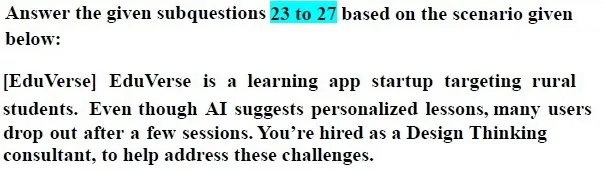
Read the passage below, then answer Q61–Q65
 Q61MCQ2 Marks·Choose one option
[EduVerse] Which of the following activities best represent initial steps in the Empathize phase of Karmic Design Thinking when addressing rural student challenges? 1.Talk to local teachers of rural schools 2.Analyze drop-out reports of rural students 3.Conduct field interviews with rural students Select the correct option using the codes given below:
- A1, 2 and 3 only
- B1 and 3 only
- C2 and 3 only
- D3 only
- Q62MCQ2 Marks·Choose one option
[EduVerse] After empathizing, how do you identify patterns in student pain points?
- AMulti-Why analysis
- BConflict of interest
- CJourney mapping
- DA/B testing
- Q63MCQ2 Marks·Choose one option
[EduVerse] You discover dropouts happen due to poor UX & no human contact. Which phase of Karmic Design Thinking are you in?
- AEmpathize
- BAnalyze
- CTest
- DSolve
- Q64MCQ2 Marks·Choose one option
[EduVerse] The team has brainstormed “gamified quizzes” and “teacher nudges via WhatsApp” as final ideas. What’s your next step?
- ARoll both ideas to market
- BVote and launch best
- CPrototype and test with students
- DAdd 10 more ideas
- Q65MCQ2 Marks·Choose one option
[EduVerse] The EduVerse team finalizes their learning app prototype based on your recommendation and begins developing key features like personalized dashboards, gamified quizzes, and AI-based feedback systems. They allocate tasks across teams, manage dependencies, and begin implementing the core functionality while tracking deliverables. Which phase of the project management cycle does this represent?
- APlanning
- BExecution
- CMonitoring & Control
- DClosure
Official KeyMaster Answer Key & Explanations
Official answer keys from IIT Madras BS past papers. Click any question to review.
Reveal KeyCollapse Key
Master Answer Key & Explanations
Official answer keys from IIT Madras BS past papers. Click any question to review.