Indian Institute of Technology Madras
BS Degree Programme · Examination & Study Paper
Deep Learning Practice
Fine-tuning LLMs: PEFT & GPU memory
Examination Instructions & Guidelines
- Solve on notebook/paper first before checking solutions.
- MCQ: Exactly 1 option is correct. Negative marking applies.
- MSQ: One or more options correct. Select all to score.
- NAT: Numerical response. No negative marking.
- Scientific calculator allowed for all calculations.
- Official answer key is sealed at the end of this sheet.
- Q1MCQ2 Marks·Choose one option
When performing full fine-tuning of a large language model (e.g., 10B parameters) using Adam, which component consumes the most GPU memory?
- AThe model’s weights (parameters).
- BThe gradients calculated for each parameter.
- CThe optimizer states (e.g., momentum and variance).
- DThe vocabulary and embedding matrix.
- Q2MCQ2 Marks·Choose one option
A company wants to align its chatbot with values of being helpful, harmless, and honest. Human labelers provide ideal responses and rank AI-generated outputs. Which adaptation technique is designed for this?
- AInstruction Tuning
- BZero-shot prompting
- CReinforcement Learning from Human Feedback (RLHF)
- DContinued pre-training
- Q3MCQ3 Marks·Choose one option

- A

- B

- C

- D

- A
- Q4MCQ3 Marks·Choose one option
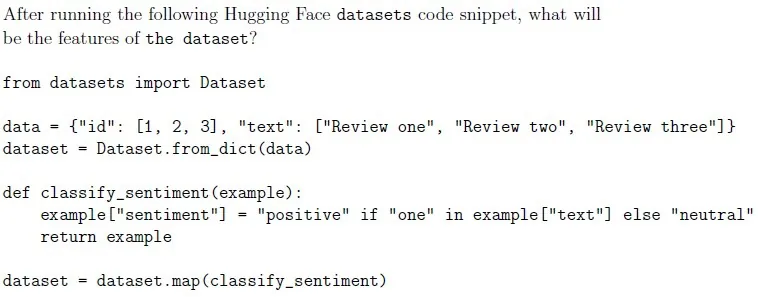
- A

- B

- C

- D

- A
- Q5MCQ3 Marks·Choose one option
What is a key implication of using a Parameter-Efficient Fine-Tuning (PEFT) method like LoRA when adapting a large language model for a new task?
- AInference speed is 10x faster.
- BOnly a small number of new parameters are trained while freezing original weights.
- CIt eliminates the need for labeled data.
- DModel must be retrained from scratch.
- Q6MSQ4 Marks·Choose all correct options
A research lab has access to a powerful 175B parameter language model. They need to adapt it for a highly specialized legal text analysis task, but they only have about 500 labeled examples and limited access to high-end GPUs for fine-tuning. Which of the following are viable and computationally efficient adaptation strategies? (Select ALL that apply)
- AFull fine-tuning
- BZero-shot prompting
- CFew-shot in-context learning
- DLoRA (PEFT)
- EPre-training from scratch
- Q7MSQ4 Marks·Choose all correct options
A team is fine-tuning a 7B parameter model on a single GPU with 24GB of memory. They are using the Adam optimizer (which stores 2 states per parameter) and 32-bit precision (4 bytes per parameter/ state/gradient). They find that they run out of memory even with a batch size of 1. Which of the following strategies could help them complete the fine-tuning process on this GPU? (Select ALL that apply)
- AIncrease learning rate
- BUse LoRA
- CUse quantization (8/4-bit)
- DSwitch to SGD
- EGradient accumulation
- Q8NAT3 Marks·Write the number
 Your answer: