Indian Institute of Technology Madras
BS Degree Programme · Examination & Study Paper
AI: Search Methods for Problem Solving
Automated planning
Examination Instructions & Guidelines
- Solve on notebook/paper first before checking solutions.
- MCQ: Exactly 1 option is correct. Negative marking applies.
- MSQ: One or more options correct. Select all to score.
- NAT: Numerical response. No negative marking.
- Scientific calculator allowed for all calculations.
- Official answer key is sealed at the end of this sheet.
End Term · 31 Aug 2025 (FN)End Term
Read the passage below, then answer Q1–Q4
AUTOMATED PLANNING
The domain description of a Blocks World with a single one-armed robot is given below.
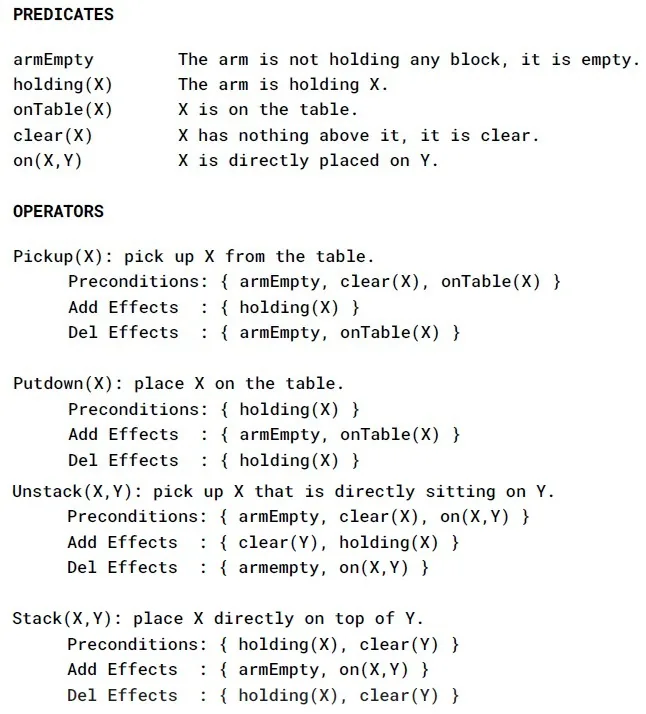
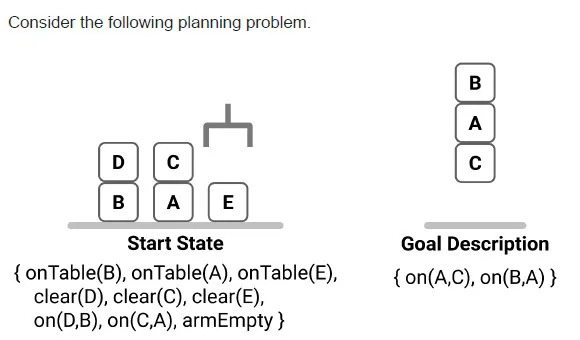
Based on the above data, answer the given subquestions.
Q1MSQ1 Mark·Choose all correct optionsWhich of the following are applicable actions in the start state?
- APutdown(D)
- BUnstack(D, B)
- CUnstack(C, A)
- DPickup(E)
- EPickup(A)
- FStack(B, A)
- GStack(A, C)
- Q2MSQ1 Mark·Choose all correct options
Which of the following are relevant actions in the goal state?
- APutdown(D)
- BUnstack(D, B)
- CUnstack(C, A)
- DPickup(E)
- EPickup(A)
- FStack(B, A)
- GStack(A , C)
- Q3MSQ1 Mark·Choose all correct options
In the planning graph, which of the following are mutex action pairs in Layer 1?
- AUnstack(D, B), Pickup(E)
- BUnstack(D, B), Unstack(C, A)
- CPickup(E), Stack(B, A)
- DPickup(E), Stack(A, C)
- Q4MSQ1 Mark·Choose all correct options
In the planning graph, which of the following are mutex proposition pairs in Layer 1?
- Aclear(B), holding(C)
- Bclear(B), clear(A)
- Cclear(E), on(D, B)
- Dclear(E), holding(D)
End Term · 31 Aug 2025 (AN)End Term
Read the passage below, then answer Q5–Q8
AUTOMATED PLANNING
The domain description of a Blocks World with a single one-armed robot is given below.
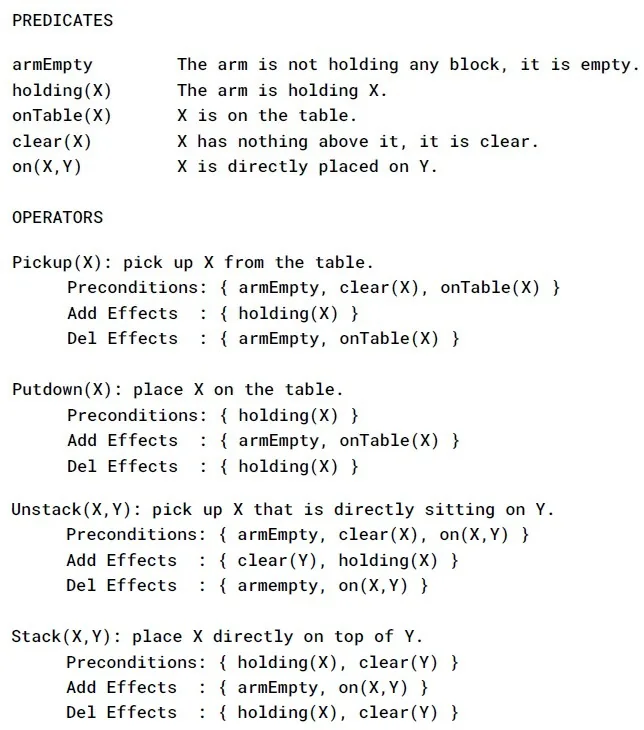
Consider the following planning problem.
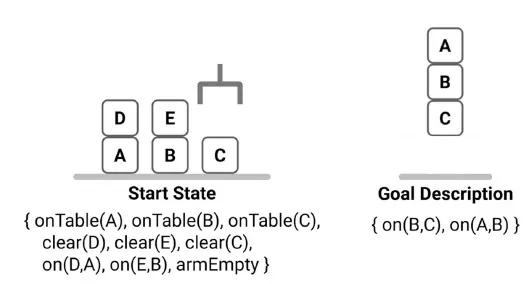
Based on the above data, answer the given subquestions.
Q5MSQ1 Mark·Choose all correct optionsWhich of the following are applicable actions in the start state?
- APutdown(D)
- BUnstack(D,A)
- CUnstack(E,B)
- DPickup(C)
- EPickup(A)
- FStack(A,B)
- GStack(B,C)
- Q6MSQ1 Mark·Choose all correct options
Which of the following are relevant actions in the goal state?
- APutdown(D)
- BUnstack(D,A)
- CUnstack(E,B)
- DPickup(C)
- EPickup(A)
- FStack(A,B)
- GStack(B,C)
- Q7MSQ1 Mark·Choose all correct options
In the planning graph, which of the following are mutex action pairs in Layer 1?
- AUnstack(D,A), Pickup(C)
- BUnstack(D,A), Unstack(E,B)
- CPickup(C), Stack(A,B)
- DPickup(C), Stack(B,C)
- Q8MSQ1 Mark·Choose all correct options
In the planning graph, which of the following are mutex proposition pairs in Layer 1?
- Aclear(A), holding(E)
- Bclear(A), clear(B)
- Cclear(C), on(D,A)
- Dclear(C), holding(E)
Quiz 2 · 3 Aug 2025 (AN)Quiz 2
Read the passage below, then answer Q9–Q15
AUTOMATED PLANNING
The domain description of a Blocks World with a single one-armed robot is given below. Note: this is the same domain description used in the weekly assignments.
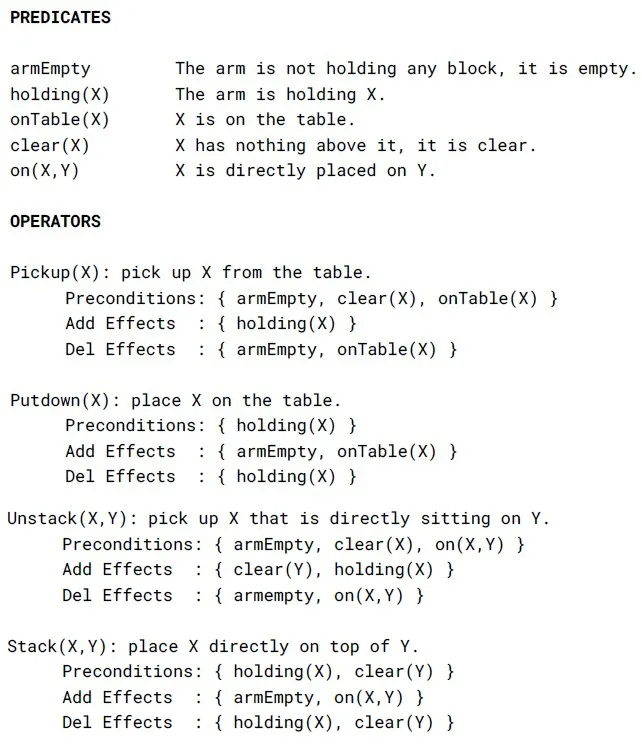
Tie-breaker: When actions are chosen non-deterministically, choose actions that lead to a plan. Throw away the actions that lead to dead-ends or cycles.
Tie-breaker: Treat the goal description, preconditions and effects as lists that are accessed from left to right. When the elements in a list are pushed one by one to a stack, the last element in the list will be at the top of the stack. It has the effect of reversing the list.
A planning problem is given below, find a plan using the operators and predicates defined in the blocks-world domain.
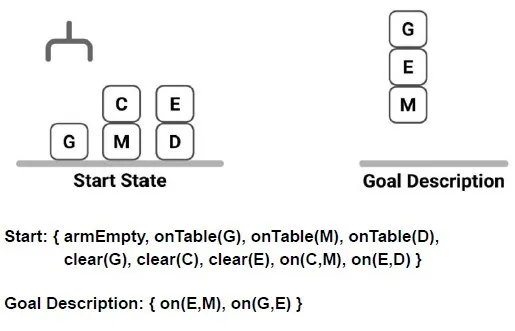
Based on the above data, answer the given subquestions
Q9NAT1 Mark·Write the numberWhat is the length of the optimal plan? Enter the number of actions in the optimal plan. NO SPACES, TABS, DOTS, BRACKETS OR EXTRANEOUS CHARACTERS. Answer format: 42
Your answer:- Q10MSQ1 Mark·Choose all correct options
Which of the following are applicable actions for the given planning problem?
- APickup(D)
- BPickup(G)
- CPickup(M)
- DUnstack(C,M)
- EUnstack(E,D)
- Q11MSQ1 Mark·Choose all correct options
Which of the following are relevant actions for the given planning problem?
- APickup(G)
- BStack(E,M)
- CStack(G,E)
- DUnstack(C,M)
- EUnstack(E,D)
- Q12MCQ1 Mark·Choose one option
Which of the following can be pushed as the first three elements onto the stack by the Goal Stack Planning algorithm? In the representation below the stack has a bottom on the right marked by the entry END. Use appropriate tie-breakers listed in the main data.
- A{ on(E,M), on(G,E) }; on(E,M); on(G,E); END
- B{ on(E,M), on(G,E) }; on(G,E); on(E,M); END
- Con(G,E); on(E,M); { on(E,M), on(G,E) }; END
- Don(E,M); on(G,E); { on(E,M), on(G,E) }; END
- Q13MCQ1 Mark·Choose one option
For the subgoal ordering given in the goal description (and using the given tie breaking rules), which of the following is the first action popped out of the stack in Goal Stack Planning?
- APickup(G)
- BStack(G,E)
- CUnstack(E,D)
- DUnstack(C,M)
- Q14MCQ1 Mark·Choose one option
For the subgoal ordering given in the goal description (and using the given tie breaking rules), does the Goal Stack Planning algorithm find an optimal plan?
- AYes
- BNo
- CCannot be determined
- Q15MCQ1 Mark·Choose one option
If the subgoals in the goal description are swapped places then does the Goal Stack Planning algorithm find an optimal plan?
- AYes
- BNo
- CCannot be determined