Indian Institute of Technology Madras
BS Degree Programme · Examination & Study Paper
Advanced Algorithms
Iterative compression & FPT
Examination Instructions & Guidelines
- Solve on notebook/paper first before checking solutions.
- MCQ: Exactly 1 option is correct. Negative marking applies.
- Scientific calculator allowed for all calculations.
- Official answer key is sealed at the end of this sheet.
End Term · 31 Aug 2025 (FN)End Term
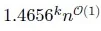
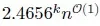
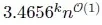
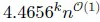
- Q1MCQ3 Marks·Choose one option

- A
- B
- C
- D
- A
End Term · 31 Aug 2025 (AN)End Term
- Q2MCQ3 Marks·Choose one option

- A
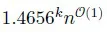
- B
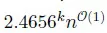
- C
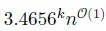
- D
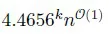
- A
Quiz 2 · 3 Aug 2025 (AN)Quiz 2
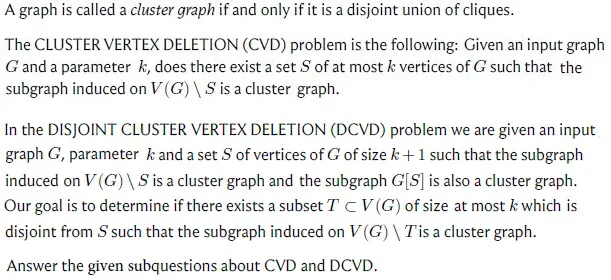
Read the passage below, then answer Q3–Q14
 Q3MCQ3 Marks·Choose one option
A graph G is a cluster graph if and only if it does not have an induced path on 3 vertices.
- ATRUE
- BFALSE
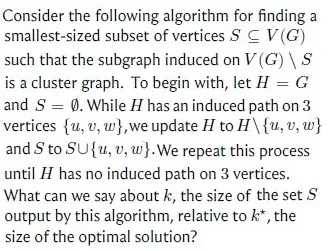
- Q4MCQ2 Marks·Choose one option
- A

- B

- C

- A
- Q5MCQ2 Marks·Choose one option
In the DISJOINT CLUSTER VERTEX DELETION problem, if the subgraph induced on S is not a cluster graph, we can immediately return YES.
- ATRUE
- BFALSE
- Q6MCQ2 Marks·Choose one option
In the DISJOINT CLUSTER VERTEX DELETION problem, if the subgraph induced on the vertices of S is not a cluster graph, we can immediately return NO.
- ATRUE
- BFALSE
- Q7MCQ2 Marks·Choose one option
If the subgraph induced on the vertices of S is a cluster graph and a vertex in V (G) \ S is adjacent to at least two vertices in S which are in different cliques, then we can delete it and leave the parameter unchanged.
- ATRUE
- BFALSE
- Q8MCQ2 Marks·Choose one option
If the subgraph induced on the vertices of S is a cluster graph and a vertex in V (G) \ S is adjacent to at least two vertices in S which are in different cliques, then we can delete it and decrease the parameter by 1.
- ATRUE
- BFALSE
- Q9MCQ2 Marks·Choose one option
If the subgraph induced on the vertices of S is a cluster graph and a vertex in V (G) \ S is adjacent to some but not all vertices in a clique of G[S], then we can delete it and leave the parameter unchanged.
- ATRUE
- BFALSE
- Q10MCQ2 Marks·Choose one option
If the subgraph induced on the vertices of S is a cluster graph and a vertex in V (G) \ S is adjacent to some but not all vertices in a clique of G[S], then we can delete it and decrease the parameter by 1.
- ATRUE
- BFALSE
- Q11MCQ2 Marks·Choose one option
After modifying the input instance, we can solve DISJOINT CLUSTER VERTEX DELETION by solving a matching problem on a bipartite graph.
- ATRUE
- BFALSE
- Q12MCQ2 Marks·Choose one option
DISJOINT CLUSTER VERTEX DELETION is polynomial time solvable.
- ATRUE
- BFALSE
- Q13MCQ2 Marks·Choose one option
DISJOINT CLUSTER VERTEX DELETION is NP-hard.
- ATRUE
- BFALSE
- Q14MCQ2 Marks·Choose one option

- ATRUE
- BFALSE
Read the passage below, then answer Q15–Q21
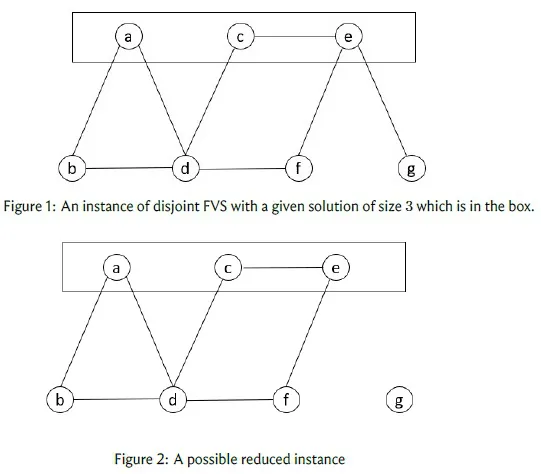
In Figure 1, we have a graph G and an FVS of size 3 which is given by the box, i.e., S ∶= {a,c,e}. We need to find a DISJOINT FVS of size 2.
For each of the given statements in the subquestions, determine if it is true or false.
Q15MCQ2 Marks·Choose one optionAccording to the reduction rules for DFVS, Figure 2 shows a valid intermediate instance in the reduction with k= 2.
- ATRUE
- BFALSE
- Q16MCQ2 Marks·Choose one option
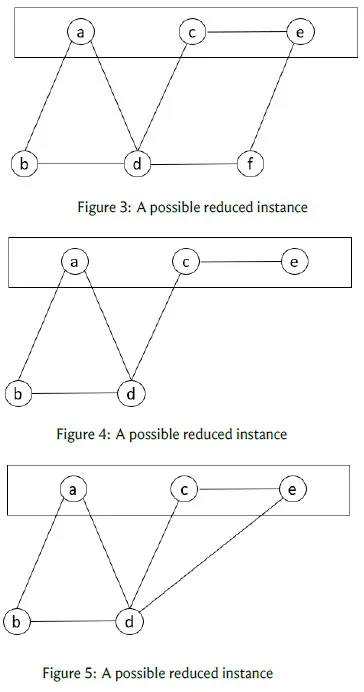
According to the reduction rules for DFVS, Figure 3 shows a valid intermediate instance in the reduction with k= 2.
- ATRUE
- BFALSE
- Q17MCQ2 Marks·Choose one option
According to the reduction rules for DFVS, Figure 4 shows a valid intermediate instance in the reduction with k= 2.
- ATRUE
- BFALSE
- Q18MCQ2 Marks·Choose one option
According to the reduction rules for DFVS, Figure 5 shows a valid intermediate instance in the reduction with k= 2.
- ATRUE
- BFALSE
- Q19MCQ2 Marks·Choose one option
According to the reduction rules for DFVS, Figure 4 shows a valid intermediate instance in the reduction with k= 1.
- ATRUE
- BFALSE
- Q20MCQ2 Marks·Choose one option
The graph in Figure 1 has a FVS disjoint from S of size 2.
- ATRUE
- BFALSE
- Q21MCQ2 Marks·Choose one option
The graph in Figure 1 has a FVS disjoint from S of size 1.
- ATRUE
- BFALSE